
Three things you need to know
- How to restore degraded land? Aim for 4 Returns at once: inspiration, social, natural and financial.
- The most lasting solutions to land degradation are slow: restoration takes at least 20 years, far longer than most investors will wait.
- A landscape recovers only when its whole community pulls together: farmers, businesses and local government, working the same plan for years.
This article is based on a live Wildya masterclass with Lily Maxwell-Lwin, who leads external communications at Commonland, a not-for-profit that helps local communities restore degraded land at scale.
Lily walked us through the 4 Returns Framework, Commonland’s answer to how you actually restore degraded land, and why the most lasting solutions to land degradation grow back four things at once: hope, community, nature and income.
Want more stories like this, plus practical tips to grow your nature venture and the impact it has on the planet? The Impact Millionaire newsletter reaches 4,000+ nature founders every week.
Who is Lily Maxwell-Lwin?
Lily is not, by her own admission, the person you would expect to explain ecology. “I’m not an ecological expert,” she told us.
Her job is to take Commonland’s work, which spans thousands of farmers and more than 20 landscapes, and explain it so the rest of us can learn from it.
Commonland was set up in 2013 by ecologist Willem Ferwerda, and it was born from a simple frustration: he had spent years running short conservation projects that fell apart the moment their funding ran out.
A landscape, he realised, needs a generation to heal, not a four-year grant.
So he built a model designed to restore degraded land over decades rather than years, and it became the 4 Returns Framework Lily now speaks for.
Meet Michael: how to restore degraded land in practice
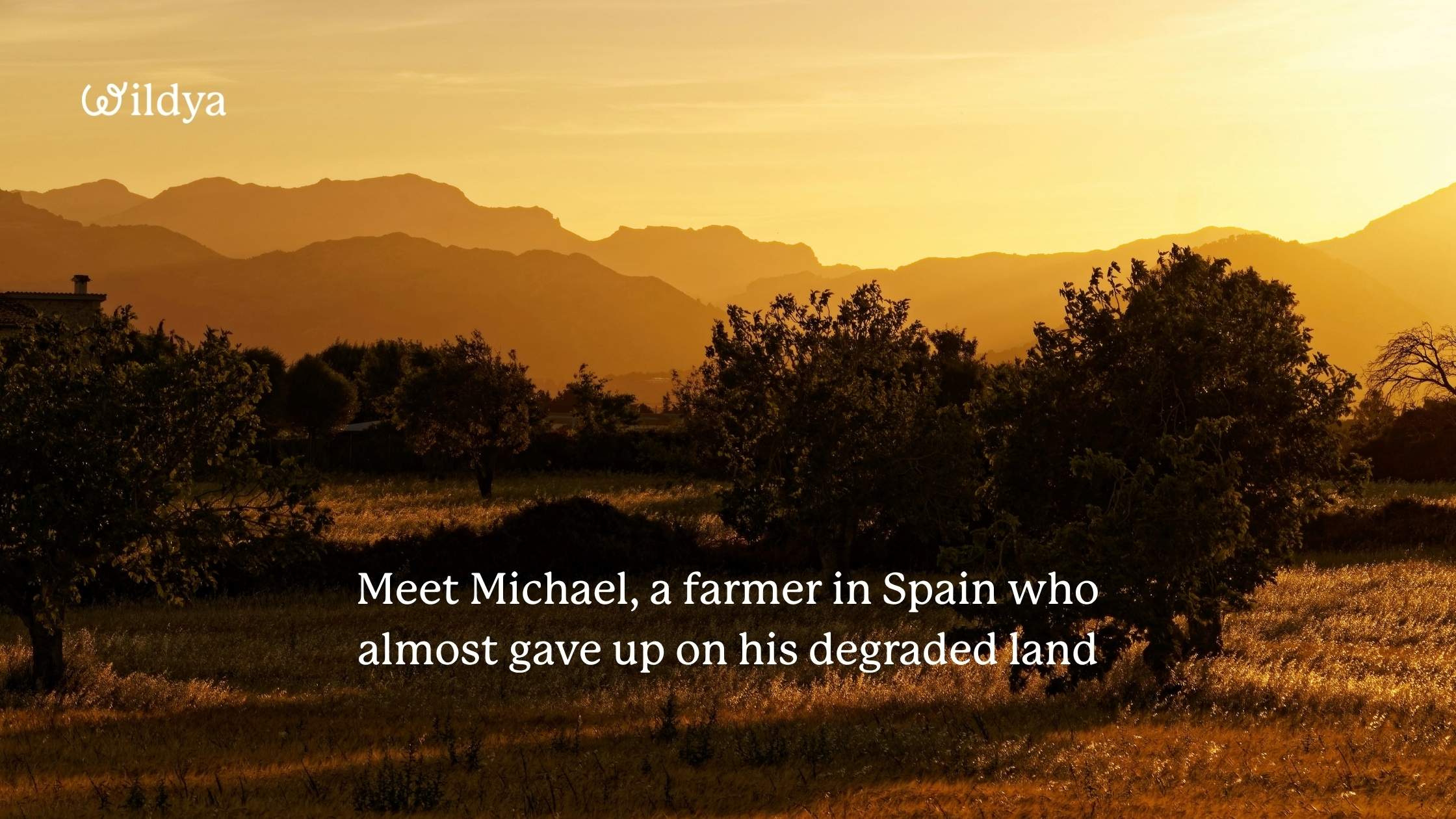
Every restoration story starts with a person. Lily started with Michael.
Michael farms in the Altiplano Estepario in southern Spain, a dry steppe caught between Mediterranean forest and outright desert, and one of the areas in Europe most at risk of turning fully to sand. 🇪🇸
Michael’s land was degraded, which is a mild word for a brutal problem.
Degraded land is land that has lost its ability to feed anything: its soil thinned, its water gone, its plants and animals packed up and left.
Around 40% of the world’s usable land is now in that state, Lily told us, most of it worn out by intensive farming, with mining and city sprawl doing the rest.
The vicious cycle Michael was stuck in
When Michael inherited the family farm, he inherited soil that could no longer earn him a living.
The only way to grow a crop was to keep buying chemical fertilisers and sprays, which fed the plants for a season but left the soil as lifeless as before. Every year cost more and gave back less, the vicious cycle of land degradation playing out in a single field.
Land like this can still look fine from the road. Farmers call it a green desert: green on top, dead underneath, where the soil has stopped breathing, and the food web that should live in it has gone silent.
Healthy soil is thick with microbes, worms and fungi feeding the plants from below. Take that life out, and you are left with dust the colour of grass. 🧑🌾
Michael came close to giving up a farm his family had worked for generations.
This is how land degradation spreads: when soil is this far gone and the farmer walks away, the desert simply moves in and takes the field.
How his farm came back to life
His farm came back because he stopped trying to fix it alone.
Michael found a local association called AlVelAl, named after the three districts of the Altiplano where it started, and joined a community of farmers all learning to work with the land instead of stripping it.
Through AlVelAl, he learned regenerative farming, the practices that rebuild soil rather than mine it.
He also got something money alone could not give him: a shared machinery bank. 🚜
Regenerative farming needs specific, pricey equipment that a single small farmer could never justify buying, so AlVelAl’s members bought it together and share it, like a library where you borrow a seed drill instead of a book.
That one arrangement let dozens of farmers change their methods without going broke.
It worked. Visit Michael’s farm today, and you find almond and olive trees, sheep grazing between them, and what Lily calls “an amazing haven of wildlife,” a sharp contrast to the bare fields of neighbours who have not yet made the switch. 🐑
It took him years, and the constant backing of the community, but the vicious cycle finally started running the other way.
Michael’s story is Commonland’s whole approach in miniature. AlVelAl is one of the local partners Commonland helped set up to restore degraded land across the Altiplano, and everything that saved his farm (the community, the shared tools, the long view) is the sort of solution to land degradation the 4 Returns Framework is built around.
How Commonland restores degraded land: the 4 Returns Framework
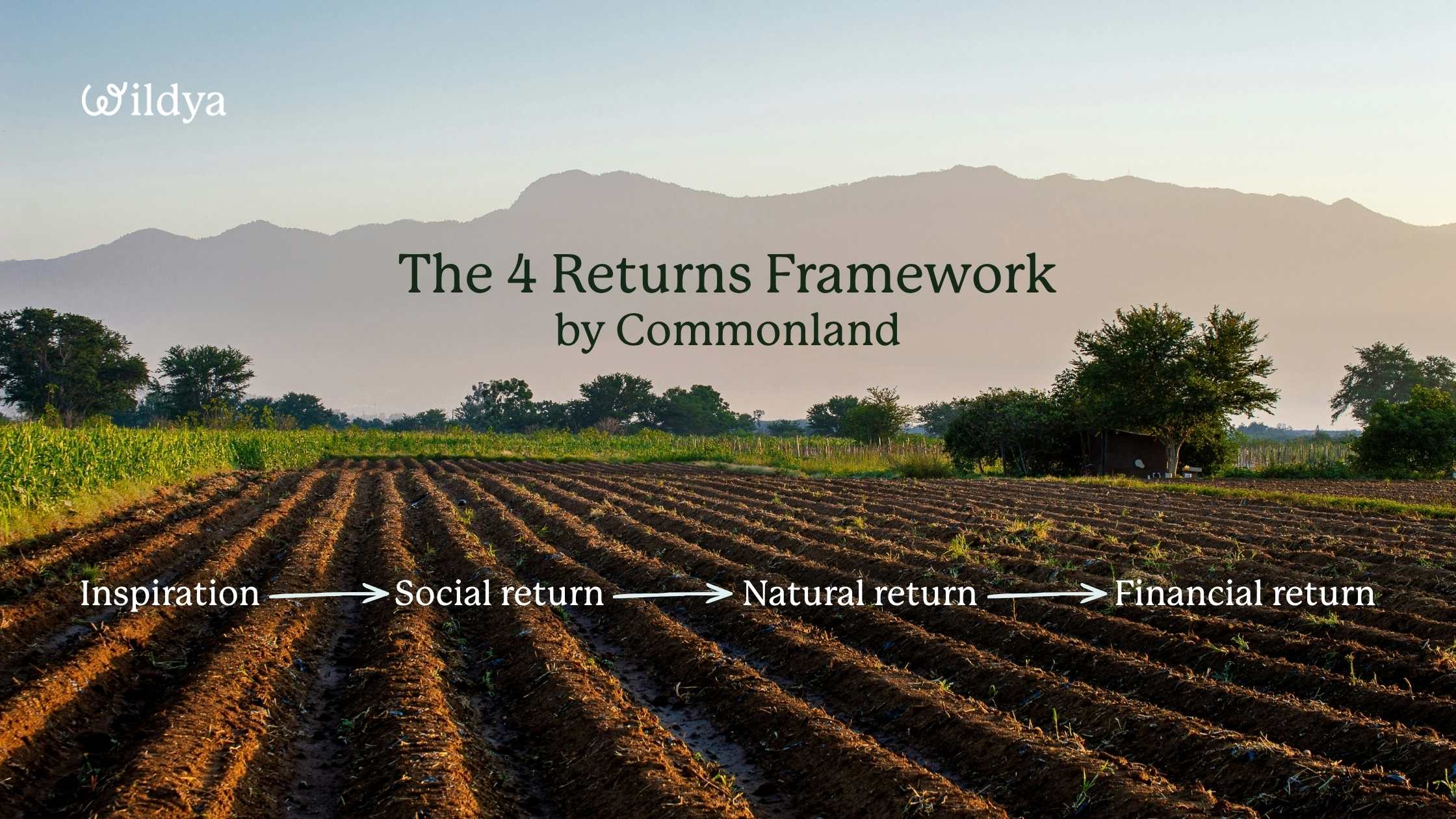
Zoom out from Michael’s single farm and you get the model Commonland uses everywhere. It starts by being honest about how land dies, then works backwards to bring it back.
The four losses behind land degradation
Ferwerda noticed that land degradation almost never happens in one blow. It falls apart in a chain, the way a food chain collapses when you remove the bottom rung.
First the natural base goes: the soil, water and wildlife, exactly what Michael watched drain out of his fields. 🌳
With the land no longer producing, the money follows, the jobs, the income and the whole local economy built on that soil. 💰
As the work disappears, the community begins to scatter, neighbours moving away and shared culture thinning out. 🧑🌾
And last, hope goes: people stop believing the place has a future, so they leave for the city for good. 🏙️
Commonland’s point is that these four losses are knotted together, so no single fix works on its own. Replant a hillside but leave the people around it with no work and no reason to care, and the young trees are dead within a year.
So the framework restores all four things at the same time, and calls them the four Returns.
The four Returns that restore degraded land
🙏 The first return is inspiration, and Commonland puts it first on purpose. Lily describes it as “planting seeds of hope for a better future and giving people a sense of purpose.” Inspiration is the seed the other three returns grow from.
Nobody sticks with a 20-year restoration without believing it is worth the wait, and it was this return that pulled Michael back from the edge of quitting.
🏡 The second is the social return: the jobs, education and connections Lily calls “the building blocks of thriving communities.” This is where a landscape gets its people back.
When Michael joined AlVelAl he did not just pick up farming tips, he found neighbours doing the same work, shared knowledge, and a reason to stay in a region young people had been leaving for the city.
🪱 The third is the natural return, the one most people picture when they hear the word restoration: “restoring biodiversity, water, soil health,” in Lily’s words, so the land can hold water and grow food again.
Bring the soil life and the insects back, and the birds and larger animals follow, which is how a bare field becomes Michael’s haven of wildlife.
💸 The fourth is the financial return, the part every other model leads with. Money still matters here, but it comes last for a reason: it grows out of the first three.
The goal is “long term sustainable income” from regenerative businesses built for each specific landscape, whether that is Michael’s almonds or a local olive oil cooperative.
Chasing all four Returns together is what Commonland means by working holistically. “What we mean by holistic,” Lily explained, “is that we look at everything that makes a landscape healthy, not just planting trees.”
In practice, that means restoring a whole water catchment instead of one photogenic field, and treating a city, its farmland and its wild areas as parts of one living system.
It also means committing to a minimum of one generation, 20 years, to restore degraded land in a single place. And that timescale runs straight into how most money works.
Financing real solutions to land degradation
The framework is easy to love. The money behind it is the hard part, and this is where Lily stopped selling and started confessing.
Why lasting solutions to land degradation are slow
A farmer switching to regenerative methods does not get paid for it straight away. “They have that U-curve,” Lily explained: yields and profits dip through the years of transition before they climb back up, higher than before.
That dip can last several years, and it is the most honest fact about restoration. The best solutions to land degradation cannot be rushed, because soil and trees keep their own schedule no matter how impatient the funder is.
For now, most of this runs on philanthropy.
Commonland is funded by backers like the IKEA Foundation and the Dutch Postcode Lottery, who are willing to think in decades. “It’s easier to convince a philanthropic funder that you want to work for 20 years and regenerate the world,” Lily admitted, “than it is to convince an investor.“
Patient capital is the mycelium of this work: the slow, invisible network underground that feeds everything long before there is any fruit to show for it. Starve it, and nothing above the surface survives.
Commonland’s model is one route through the money problem. If you want the full map of how nature ventures get funded, we walked through six of them.
The economy still leaves nature off the books
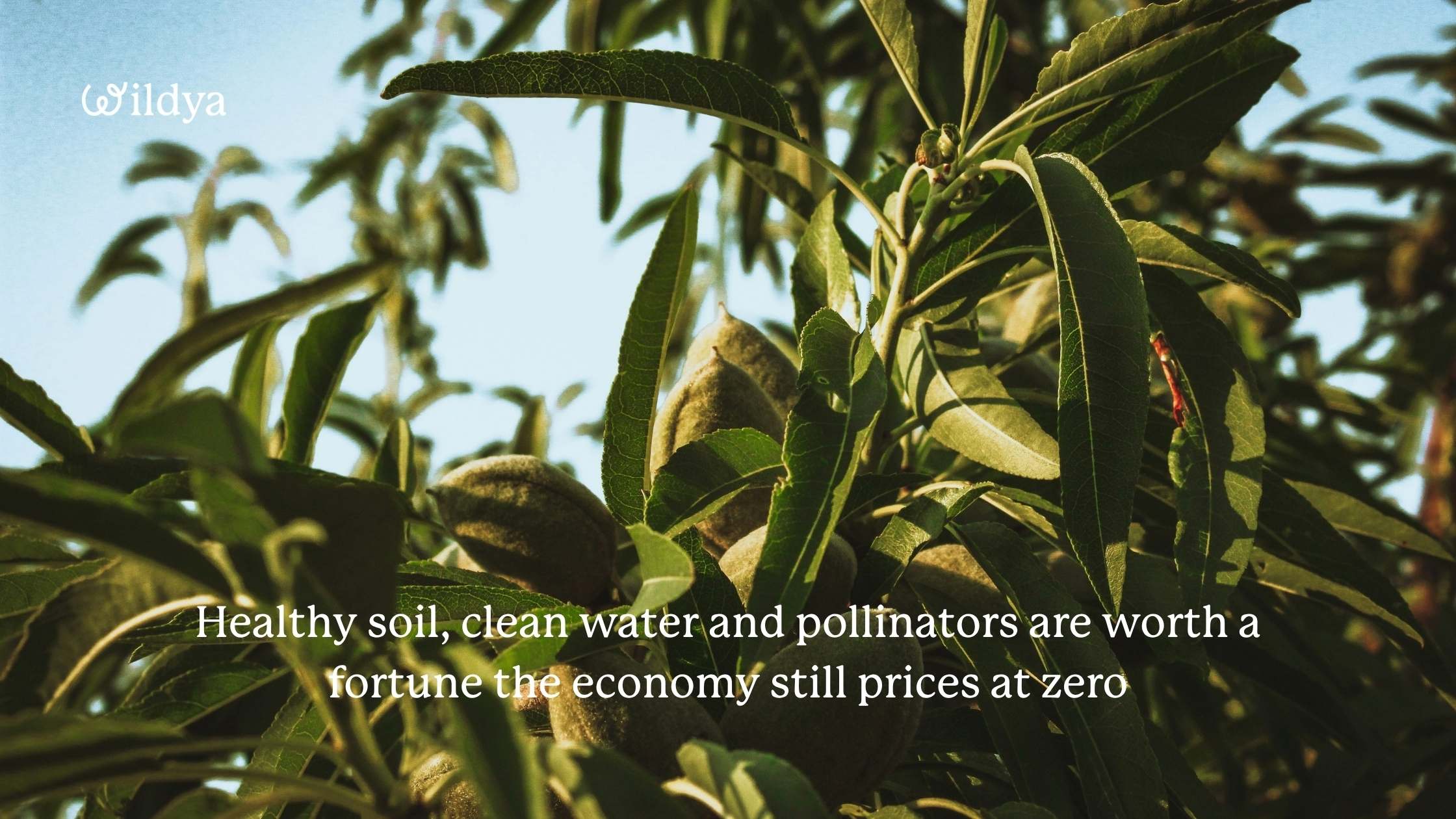
“The current economic system doesn’t value nature,” Lily said. “If we did value nature, you would see massive return on investment financially, but that’s not priced in right now.”
This is the root of the funding problem. A living landscape produces clean water, healthy soil and pollinators, all of which have enormous real value and a market price of exactly zero.
So on paper, restoring them looks like spending money to gain nothing.
Commonland’s response is stubborn and simple. “Let’s not destroy, and let’s restore that value you’ve not actually put on your balance sheet,” as Lily put it.
Until the accountants catch up, it uses blended finance: philanthropic money goes in first to take the risk out of a young regenerative business, so that private investors will follow once it can stand on its own.
Sometimes the fix is smaller than anyone expects. The shared machinery bank that saved Michael cost each farmer a fraction of a tractor, and it let a whole valley of farmers switch methods at once.
This is where Wildya’s favourite idea creeps in. The real return was never going to show up as zeros in a bank account. It shows up as hectares pulled back from the desert, as farmers who stayed put, as birds returning to a valley that had gone quiet. 🐾
That is the only wealth an impact millionaire really counts, and Commonland is quietly getting rich on it.
What Commonland is building
Commonland began with four landscapes: Spain, South Africa, Australia and the Netherlands.
Today it supports local partners across more than 20 landscapes in Europe, Africa and Asia-Pacific, covering roughly 2.7 million hectares, with around 20,000 people trained through its programmes.
Most of what it has learned is free to use.
The 4 Returns platform is an open online library of tools and guides for anyone applying the framework, and a printed guidebook collects a decade of practical lessons on reversing land degradation from landscapes like Michael’s.
Commonland also runs a two-year Landscape Leadership Lab that trains local people to lead restoration where they live.
If you are trying to restore degraded land yourself, the landscapes, reports and tools on Commonland’s website are the place to start, and Lily is easy to reach on LinkedIn.
How to restore your degraded land
Lily ended with the line that reframes the whole problem. “We all live in a landscape,” she said, “and we all have the power, no matter how small, to restore that landscape and to recreate and sustain life.”
Her advice for anyone daunted by the scale of it is to shrink the problem down to where you stand. Look at your own watershed, she suggested, the nearest river and the land feeding into it, and ask what it needs.
A whole degraded planet is impossible to hold. One landscape is not.
For the founders and NGO builders searching for how to restore degraded land, the answer is in Commonland’s method. Restoring degraded land works the way it worked for Michael and AlVelAl: put the hope back first, bring people together, heal the soil, and fund the patience it takes.
Start with the landscape you can reach, and count your success in what comes back to life. 🌾
What you should do next
- You do not need a million hectares to start restoring one. Lily’s whole point is that everyone lives in a landscape worth fixing, including you. If you have the itch but not the idea yet, our Wild Idea Finder helps you turn a vague urge to help nature into something you could actually build.
- Having the wild idea is the easy bit. Building it is where people freeze. If you want to turn restoring your own patch of land into a real venture or NGO, the Ecopreneur Beginner Bootcamp takes you from wild idea to your first paying supporters in eight weeks, the messy early stretch Michaell had to work out the hard way.
- If your nature venture is already alive but the money or the model refuses to scale, you are standing exactly where Lily kept pointing. Our Fractional Executive Team works alongside you to find which lever is stuck (attention, product, money or people) and pull it, so you spend your week restoring land instead of chasing funders who never quite commit.