
Three things you need to know
- The first step in knowing how to approach investors is understanding which type of fund was built for your timeline. Most weren’t, and the structure tells you more than the name.
- To get funding for a nature venture, look past the impact label. A fund that calls itself impact but runs a conventional 10-year closed structure will eventually apply conventional pressure.
- The number one thing that closes doors at Planetary Impact Ventures before a conversation even starts: founders who pitch without spending five minutes reading what the fund actually invests in.
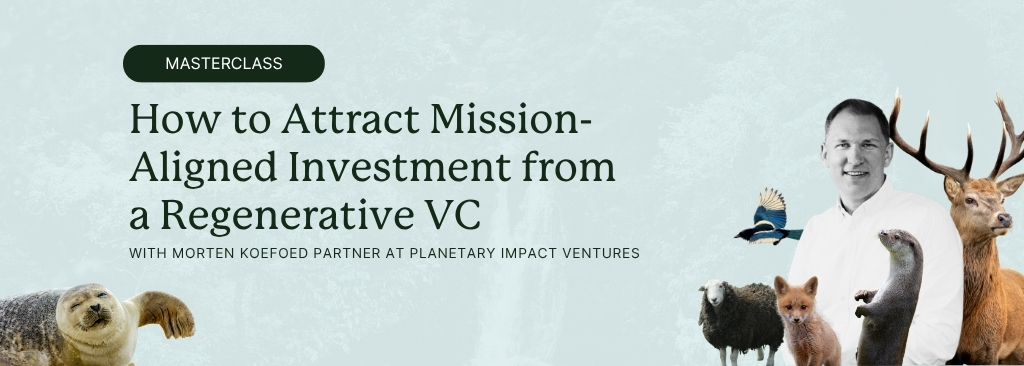
This article is based on a live Wildya masterclass with Morten Koefoed, Partner at Planetary Impact Ventures, a regenerative investment fund based in Denmark that invests in food, farming, soil, and nature ventures.
Morten walked us through how to approach investors whose values actually match yours, what makes them say yes or no, and what it takes to get funding for a nature venture without ending up with the wrong people on your cap table.
Want more insights like this landing in your inbox? The Impact Millionaire newsletter reaches 4,000+ nature founders every week.
Who is Morten Koefoed?
Morten’s path into impact investing did not start in nature.
He studied economics at the University of Copenhagen, moved into investment banking, then spent almost seven years at Carlsberg working on mergers and acquisitions (M&A) and corporate strategy. Not exactly a rainforest origin story. 🌴
On paper: a classic corporate career. In practice, something was off.
“I grew sort of increasingly tired without really being able to verbalize completely what was making me tired.”
Corporate fatigue played a part. So did a slow-building sense that the work didn’t mean much. Presentations nobody had read. Decisions that moved nothing forward.
A project at Carlsberg changed that.
He was tasked with finding new uses for spent grain, the leftover grain from the brewing process that normally ends up as animal feed. That search brought him to Agrain, a startup working to get that grain back directly into the human food chain.
The energy of that encounter was unlike anything from years of M&A.
He tried to make a partnership work inside Carlsberg. Management had other priorities. Nothing came of it.
When he found out Planetary Impact Ventures had invested in Agrain, that became his way in. He joined the fund about three years ago.
What venture capital is (and why it matters for nature founders)
Before getting into why most VC funds don’t work for nature ventures, a quick explanation of what VC actually is.
Venture capital (VC) is early-stage financing for companies that banks won’t touch. Banks need a track record and revenue. VC funds take the risk on young companies instead, in exchange for equity, and generate returns when those companies grow, get acquired, or go public.
On paper, that sounds like exactly what a nature startup needs. In practice, the model was built for something else entirely.
How the VC model actually works (and why unicorns matter)
Most VC investments fail. That is not a flaw in the model. It is the model.
A fund makes 20 or 30 bets. Most don’t return much. One or two hit big, and those wins pay for everything else.
In VC language, that one massive win is a unicorn: a startup valued at over a billion dollars. Fittingly, they’re about as common in the wild. 🦄
The whole model bets on finding one. So funds back companies that can scale fast and cheaply.
Software is perfect for this. A digital product can be sold to ten million users at almost no extra cost compared to selling it to ten. No factory, no raw materials, no growing season.
As Morten put it: “nothing in the natural world scales exponentially.” The VC model is, in practice, built on the opposite of how nature works.
Why conventional VC funds leave nature founders behind
Nature does not scale like software. As Morten says, “A tree grows to the size that a tree has to grow to.” 🌳
Developing a biostimulant to replace synthetic fertiliser needs field trials across multiple growing seasons. Miss one season and you wait a full year for the next.
Restoring degraded soil takes years before meaningful results show up.
A fund hunting for a unicorn within 10 years is not going to stay patient with any of that. The structure and the work are misaligned from the start.
The result is a system where capital competes to flow into AI and software, while nature ventures are left looking for funding in a world that was never designed with them in mind.
What a fund built for nature actually looks like
That gap between what conventional VC offers and what nature ventures actually need is real. But knowing a gap exists only gets you so far.
Understanding what sits on the other side of it is more useful.
The structure that changes things
Most funds that brand themselves as impact investors still run identically to conventional VC:
💰 A 10-year closed fund,
💰 Standard return requirements,
💰 And carried interest (the share of fund profits that managers take for themselves, typically around 20%) that rewards fast financial returns above everything else.
Morten says this to other fund managers: “I think you need to adjust your structure to fit what you’re trying to fund.”
If a fund’s structure looks the same as every conventional fund’s, it will produce the same pressures as every conventional fund’s. The “impact” in the name carries the whole claim, and that is a thin foundation.
Planetary Impact Ventures is built differently. It’s an evergreen fund:
🌿 Open-ended,
🌿 No fixed deadline forcing exits before founders are ready,
🌿 No carried interest, wages are modest by industry standards.
Like the forests it invests in, it is built to last rather than harvested on a schedule.
The fund currently manages around 22 million euros, with a sister fund focused on owning and farming land sustainably. 👩🌾
This matters for founders because the structure shapes the relationship. A fund with a 10-year clock is watching it from day one.
What 7 to 9 percent return means for you as a founder
Conventional VC often targets annual returns of 20 percent or more.
Planetary Impact Ventures targets 7 to 9 percent. Morten is transparent about that.
A fund chasing 20 percent annual returns pushes its portfolio companies toward fast growth and early exits.
Think of it like two rivers flowing into the same valley: one is a fast, narrow torrent that erodes everything in its path, the other moves slower and deeper and actually nourishes the ground it touches.
A fund targeting 7 to 9 can move at a pace that actually matches the rhythm of a nature venture, one growing through seasons rather than sprints. 🌸
Morten’s image for it: “if you have a hole in your roof, you don’t go and put thousands of dollars into a casino to try to win more money. You fix the hole in your roof. You’re probably not gonna get a 20 percent return by fixing the hole in your roof, but it’s nonetheless very, very necessary.”
Nature investing is that hole in the roof. Protecting and restoring nature will not deliver the same returns as a software unicorn.
But it is the most necessary work there is, and leaving it unfunded because it does not hit 20 percent is like watching your roof cave in while you’re busy at the casino. 🎰
But before deciding which investors to approach, you need to understand the different funding paths available for your nature venture. We mapped out six of them
How to approach investors who fund nature ventures
Understanding the landscape matters. But at some point, you have to actually walk into a room, real or virtual, approach investors, and make your case.
What Morten looks for to fund a nature venture
Morten is not looking for a polished deck. He’s looking for founders who are burning for the problem they are trying to solve.
“There’s a lot of founders that also talk about impact because you know, it’s trendy. But you can also see typically on people whether they’re burning for the idea or they’re burning for something else.”
In practice, a founder burning for the problem means deep familiarity with the problem, a commercial path you can defend when pushed, and openness to being challenged on your direction.
Planetary Impact Ventures has told founders before committing that they would like to see the product roadmap focused differently, on where the real impact case is strongest.
The founders who engaged with that seriously got further than the ones who pushed back.
How to approach investors and get their attention
Getting a meeting is not the hard part. Showing up prepared is.
“Try to educate yourself a little bit about what fund you’re speaking to and what drives them. If there is information, just try to find out what they’re looking for, because everyone is looking for something. And the more you know that, the more you can also tailor your pitch to that fund.”
Every fund publishes its investment criteria.
Reading it before you reach out costs 10 minutes. Skipping it signals that you are sending the same deck to 200 funds, or that you could not be bothered.
Neither is a strong opening when you are trying to approach investors who receive hundreds of pitches.
When you do reach out to investors who back nature ventures, the most powerful thing you can bring is clarity: about the problem you are solving, and why you are the person solving it. Talk about the actual mission in plain language.
For founders building real nature businesses, the mission does not need decorating.
Morten also noted that Planetary Impact Ventures has built a network of around 20 to 25 aligned co-investors across Europe: funds with the same long-term mindset, investing in the same areas.
Getting in front of Planetary Impact Ventures is not just about one fund’s 22 million euros. For the right founders, it opens a door into a wider pool of patient capital (funding that gives companies the time they actually need to grow, without a clock forcing premature exits).
Red flags that close the door before you walk in
The most common thing that ends a conversation before it starts: founders who approach investors without understanding what those investors actually back.
This shows up as emails pitching agriculture tech to a fund that backs ocean ventures, or a venture requiring 20 million euros of upfront capital to a pre-seed fund. 🌊
Five minutes on the website would have caught either. Morten puts it plainly: if there is information out there about what a fund looks for, use it.
The second flag is impact language layered on top of a conventional business model.
Morten notices the difference between founders who are building for nature and those who have added sustainability to their pitch because they think it helps. If you are a nature founder, lead with the real problem.
What Morten and Planetary Impact Ventures are building
Five years in, a 22 million euro fund, investments across Denmark, Belgium, and the UK, and a soil fund in development. This is what Planetary Impact Ventures and Morten are building.
What Planetary Impact Ventures backs and why
Planetary Impact Ventures takes its name from the planetary boundaries framework: a scientific model mapping the nine areas where human activity is pushing Earth’s systems past safe limits.
Seven of those nine are currently in overshoot. Ocean acidification was just added to the list. None are moving in the right direction. 🌍
What stands out is how many trace back to the food system. Energy is slowly moving away from fossil fuels, with renewables taking on a larger share each year.
The food system is a different story. Morten explains, “the food system is the one that stands out because it’s so big.”
Most assessments put food production’s share of global greenhouse gas emissions at around a third. Industrial agriculture is also the main driver behind several other boundaries in overshoot, from biodiversity loss to water contamination. 🚜
Planetary Impact Ventures invests across the full chain from soil to what people eat: regenerative agriculture, soil health, biostimulants, plant-based food, and anything that reconnects food production to biodiversity.
They are not interested in companies that reduce pesticide use by a percentage. “We actually want to completely alleviate pesticides.”
The fund currently invests across Denmark, Belgium, and the UK. If you are based in Europe, and focus on food production or regenerating nature, this one might be for you.
How to get funding for a nature venture: connect with Morten Koefoed
Planetary Impact Ventures invests in early stage companies and does not push founders toward exits before the work is done.
A sister soil fund in development takes that commitment further: Planetary Impact Ventures will own and farm land directly, taking their own medicine by growing alongside the businesses they back. 🌾
Morten is direct about why startups are the most interesting place to build: “When you’re starting a new business, you actually have an obligation to consider that.”
Large corporations are locked into infrastructure built before anyone thought about planetary limits. A startup has no such constraint.
That clean sheet is a genuine advantage in a conversation with an investor who has built their entire fund around this framework.
If you are building in food, soil, agriculture, or nature and are based in Europe, Morten is worth connecting with.
Approach the right investors, not just any of them
The nature founders who get funding for a nature venture from a fund like Planetary Impact Ventures do not do it by sending better decks to more people.
They do it by understanding the landscape first: which funds are actually built for their timeline, what the structure means in practice, and what gets genuine attention versus what closes doors.
Most of that information is already out there. Reading it is the first step to knowing how to approach investors who will still be in your corner three growing seasons later when things get slow.
“Money flows where the highest return is. We need to flow money into where the problem is.”
If your work is the problem, there are people with capital actively looking for you. You just have to meet them.
What you should do next
- Knowing how to approach investors is one part of the work. Building the pitch that earns a second meeting is another. Manoj Harasgama, serial entrepreneur and investor, walks through the full VC fundraising process: from how to build your investor list, to what to do in the room, to how momentum closes rounds.
- If impact VC is not the right fit for where you are now, or you want to explore other ways to build financial momentum first, we broke down six ways to fundraise your nature venture: crowdfunding, grants, public funding, and more.
- If your nature venture is already running and something is blocking your next step towards being investor-ready, whether it is attention, product, money, or people, the Wildya Fractional Executive Team works directly with you to diagnose what is holding you back and help you move it.