
Three things you need to know
- To get corporate clients for your nature business, you need one thing before anything else: being credible enough that the right clients come looking for you.
- Attracting customers without a marketing budget is more viable than it sounds.
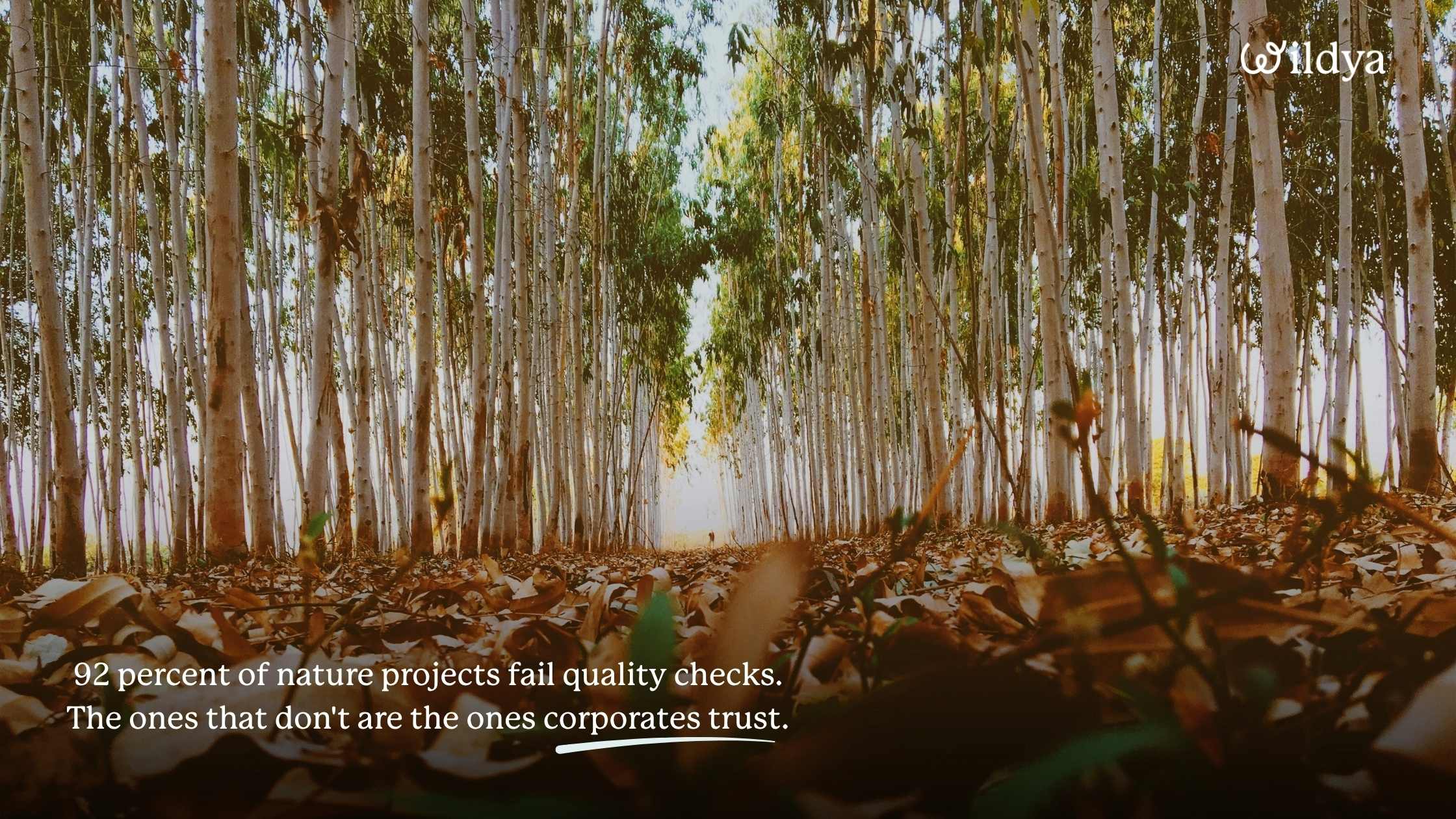
- 92 percent of the nature-based projects Earthly has screened fail their minimum quality standards. In a market full of distrust, passing a rigorous assessment is what corporates are paying for.
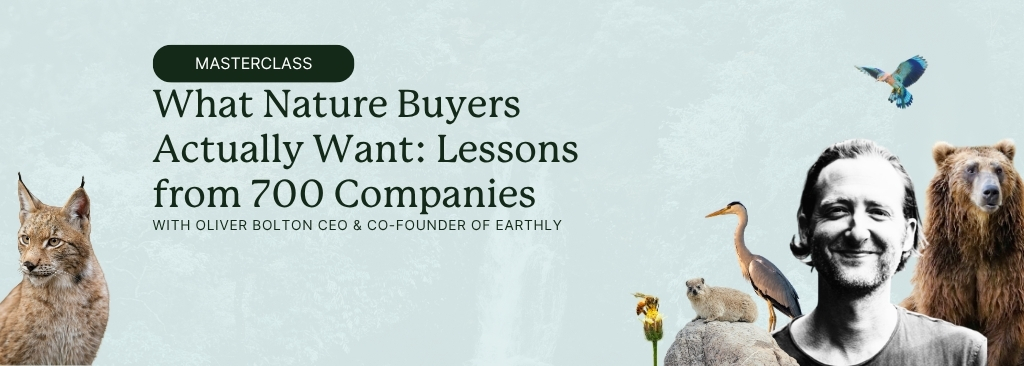
This article is based on a live Wildya masterclass with Oliver Bolton, CEO and co-founder of Earthly, a tech platform helping businesses invest in high-quality nature-based projects across carbon, biodiversity, and social impact.
Oliver walked us through how to get corporate clients in a space where trust is the rarest resource, what attracting customers for your nature business actually requires, and the hard lessons behind building something corporates genuinely pay for.
Want more insights like this landing in your inbox? The Impact Millionaire newsletter reaches 4,000+ nature founders every week.
Who is Oliver Bolton?
Oliver dropped out of university at 21 or 22 to start a health drinks business. He ran it for 15 years.
Along the way, it became one of the first 60 UK B Corps, certified in 2015 when the movement was small enough that everyone in it knew each other.
Oliver sat on the food and drink panel, met other founders building purpose-led businesses, and something planted itself.
“Why wouldn’t it be great to create a company from scratch with impact at its heart?”
By 2018, he was ready for something different. He had known his eventual co-founder Lorenzo through mutual friends for five or six years. They caught up, realised they wanted the same thing, and started building.
The first version of what became Earthly was a B2C app called Almond: a platform that rewarded people with trees for buying from sustainable brands by connecting their payment cards to identified sustainable merchants. 🌳
Automatic, frictionless nature donations at checkout. They built it to around 20,000 users, mostly in the UK.
Then COVID hit. People stopped shopping the way the app depended on.
At the same time, a Spanish bank, which had found Earthly through the Plug and Play European startup cohort, asked whether they could develop features from Almond into CaixaBank’s own banking platform.
The deal was worth around 25,000 euros. Small money. Big signal.
Oliver and Lorenzo had also been struggling to find and screen quality nature-based projects for the app. The two problems pointed in the same direction.
They had spent around £500,000 building Almond’s technical infrastructure. Walking away from it was not comfortable.
“I wish we pivoted halfway through the development of the app. We would have spent less money and we would be further along with Earthly now.”
They pivoted anyway.
Beginning of 2020, the business was rebranded as Earthly and rebuilt around a single purpose: screening and validating nature-based projects so corporate buyers could trust them enough to invest.
How to get corporate clients in a market that has lost its trust
The nature space is navigating a trust crisis. Greenwashing scandals, bad project approvals, and corporate reputational fear have made credibility the rarest thing in the room.
If you understand the context and can position yourself as genuinely rigorous, you are already ahead of most of the competition.
Why corporate buyers stopped trusting nature markets
For years, projects were approved under frameworks that measured one thing, carbon sequestration, while ignoring everything else. Biodiversity. Social impact. Whether the project was ecologically appropriate for its location at all. 🌎
Oliver came across one of these while browsing one of the world’s largest carbon credit registries.
“Wow. This project’s really bad. Like, how has this been approved?”
It was a eucalyptus monoculture in Brazil. Eucalyptus plantations absorb carbon efficiently enough to score well on carbon metrics.
But they are biological deserts: wrong species for the ecosystem, suppressing native biodiversity, offering nothing to the local wildlife that relies on a functioning habitat. 🐆
Good carbon numbers. Terrible nature.
This was the market working exactly as designed. And it was not an isolated case.
When the Guardian published its investigation into REDD+ carbon projects, describing 80 percent of those projects as worthless, it confirmed what had been quietly accumulating for years.
The fallout was severe. And it was broad enough that all nature investments became suspect, not just the fraudulent ones.
Companies that had invested in genuine, well-intentioned projects started hiding it.
Oliver saw this himself. He would approach clients and propose creating content together about their nature investments. The response was consistent.
“They would say: oh, no. We just want to do it internally.”
“It was really concerning that companies were wanting to support nature but were scared to do it because of the reputational risks.”
This is the market any nature founder is now operating in.
Chief sustainability officers are not sceptical of your work because they do not care about nature. They are sceptical because getting it wrong, or being perceived to have gotten it wrong, is a career-defining risk.
Your job is not just to have a credible product. Your job is to be credible enough that they can stake their reputation on you.
What a 92 percent failure rate tells you about the opportunity
Earthly has now screened over 1,000 nature-based projects.
92 percent do not meet their minimum quality standards.
The work behind many of those projects matters. What is missing is integrity and verifiable transparency. And without those, corporate trust does not follow, regardless of how important the underlying work is.
That number is alarming. It is also, for the nature founders reading this, a significant opportunity.
If 92 percent of projects fail a rigorous, scientific assessment, the 8 percent that pass it are immediately and obviously distinguishable.
In a market where everything claims to be credible and most of it is not, being clearly, verifiably different from 92 percent of your competition is not a feature. It is the entire proposition.
Earthly’s assessment, now in its third version called Keystone 3, examines over 160 quality indicators across carbon, biodiversity, and social impact.
It screens any project type (from seagrass meadows to highland peatlands) across any registry, anywhere. For every indicator, the research team assesses both the evidence and its confidence in that evidence.
Think of it like a species survey that adapts whether you are in a Scottish bog or a Brazilian cerrado: the methodology holds, the terrain changes. 🦙
For a chief sustainability officer managing reputational risk, this level of rigour is the reason they can sign off on an investment without losing sleep.
How Oliver built what corporates actually pay for
Building something corporates actually pay for took Oliver two hard lessons: knowing when to pivot, and knowing what to stop building.
Why knowing when to pivot is the first lesson
The structural limits of Almond were visible earlier than the moment Oliver acted on them. Looking back, he is direct about what he would have done differently.
“Have goals, and if I haven’t got this minimum target by this date, then I need to pivot. And actually, it’s easier said than done. Really stick to those goals.”
The structural limits of Almond (UK only, dependent on consumer shopping behaviour, facing a cost barrier that a student focus group summed up bluntly by saying she was focused on being able to afford food) were visible before £500,000 had been spent on technical infrastructure.
The decision to stay longer than the evidence warranted is one Oliver describes as his most expensive lesson.
For nature founders watching their current model plateau: the moment to change direction is almost always earlier than it feels.
What you have already built is real, and hard to walk away from. But the longer you wait, the larger the sunk cost gets, and the harder the pivot becomes.
The CaixaBank deal offered something more than 25,000 euros. It offered proof of a different direction before that direction had been fully built.
A corporate willing to pay for something before it exists is worth treating as more than a contract. It is a signal about where the real product might live.
Saying no to what clients do not pay for
Once Earthly had rebuilt around the assessment, the temptation to add features was constant.
Oliver’s team built three-dimensional visual representations of clients’ nature investments: interactive digital islands where corporate buyers could explore their portfolio rendered in 3D. 🏝️
Oliver was personally excited about it. The team worked hard on it. It looked impressive.
Nobody used it.
“Clients like it, but they go and look at their island for 20 seconds and then they never go back to it.”
He shut it down.
“I’ve historically always done too much.”
The lesson for anyone building a nature business trying to get corporate clients: find out specifically what your clients are willing to pay for, then stop building everything else.
This is harder than it sounds when you are a founder who finds almost everything interesting.
But Earthly wins pitches because the assessment is what clients actually pay for. The 3D islands were a distraction from the thing that made corporates choose them. Every hour spent on a feature clients do not use is an hour not spent improving the thing they do.
Knowing what to stop is as important as knowing what to build.
Before going further, getting corporate clients is only one way to fund your nature work. If you want to understand all the paths available, we mapped out six of them.
Attracting customers for your nature business: the approach that earns trust
Whether you are approaching corporates through inbound content, direct outreach, or industry networks, the mechanism underneath is the same: trust has to come first.
Understanding B2B and B2C clients for your nature business
Before talking about channels, it is worth understanding who your clients actually are, because the answer shapes everything else about how you reach them.
Oliver started with a consumer product and switched to selling to businesses. For Earthly, B2B (business to business) is the right model.
For some nature ventures, B2C (business to consumers) is the mission and cannot be avoided. But understanding the difference matters either way.
“I think B2B is easier, personally, because you can speak to fewer customers that are typically going to spend more money.”
The practical reality of B2C in the nature space is demanding. You need mass adoption, significant marketing spend, and a product compelling enough to compete with every other claim on a consumer’s attention and budget.
Oliver’s team ran a focus group with students during the Almond era. One participant said she wanted to buy sustainable products but was focused on being able to afford food.
That is not a failure of the product. It is the structural difficulty of building a consumer nature business in a world where most people cannot easily pay a premium for impact.
B2B shifts those dynamics. A corporate sustainability officer does not need convincing that environmental credibility matters. The problem they need solved is different: how do I find something I can stand behind without putting my career, or my company’s reputation, at risk?
That is a more specific, more tractable starting point.
If your nature venture can work as a B2B model, it is worth understanding what makes that conversation easier: fewer relationships, higher value per client, and a buyer who is already motivated.
If B2C is the only route for what you are building, the lesson from Oliver’s journey is the same: know the structural costs of that choice early, and build accordingly.
How to get corporate clients through inbound
Oliver’s approach to getting corporate clients is not built around cold outreach or aggressive sales pipelines.
“Create useful content, try and tell people about what you are doing in a credible way. And then when they are ready, they happily receive the inquiries.”
In practice, this means white papers, webinars, and a public track record of work that demonstrates capability before any sales conversation begins.
Earthly publishes a detailed assessment methodology. Chief sustainability officers looking for a credible nature partner find it. When those companies are ready to invest, Earthly is already in the room.
The value of this approach is not speed. It is selectivity.
Inbound clients (the ones who came to you because they found your work credible) tend to be better clients. They already understand what you do. They are less likely to push back on your methodology. They are more likely to refer others.
“We solve integrity and we build trust. We reduce reputational risk. And people get that as a value proposition.”
For nature founders, the specific form of your inbound content will depend on what you are building.
The principle is the same regardless: make your expertise visible, make your standards clear, and make it easy for the right people to find you when they are ready to act.
Attracting customers for your nature business on LinkedIn
Three years ago, Earthly shrank. The team went from 16 to 8. The marketing budget was cut by 80 percent.
Oliver started posting on LinkedIn instead.
“I made a commitment: I’ll do a year and post three times a week.”
The posts were not Earthly promotional content. They were about nature. Projects Oliver visited across the UK. Stories of what was growing, what was being restored, what was happening quietly in places most people had never heard of.
His personal profile, which had previously done nothing commercially, became Earthly’s most effective sales channel.
Earthly tracks every lead that comes through Oliver’s LinkedIn profile using a unique URL. The numbers were clear. Prospective clients were connecting, reading over months, getting the company front of mind, and reaching out when the moment was right.
For attracting customers for your nature business with zero budget, the lesson is not that LinkedIn is magic (even though it can be). It is that trust is built through repeated, consistent presence over a long time.
Like mycorrhizal networks threading through soil, the results are largely invisible for months. Then, suddenly, everything is connected. 🍄🟫
What Oliver Bolton and Earthly are building
Earthly launched the third version of its assessment, Keystone 3, on the morning of this masterclass. Over 160 quality indicators. Any ecosystem. Any registry. Globally.
Alongside it, Earthly has developed voluntary biodiversity credits with South Downs National Park, splitting government-approved biodiversity net gain units into 9 square metre credits sold for around £200 each, legally protected for 30 years.
For a corporate buyer, this means a tangible, locally anchored investment in UK nature recovery, not an abstract offset on the other side of the world.
Earthly is also working with a new fund called Biome in Western Australia through the Founders Factory NatureTech program, on indigenous-led projects combining carbon, biodiversity, and social impact.
And next in development is a pre-assessment product for project developers, helping them understand what best practice looks like before going to market, rather than only hearing about failure after the fact.
“I do truly believe we are at the beginning of this next second wave of nature protection and restoration.”
If you are running a nature-based project and want to understand what makes it investable, or if you are a corporate looking for credible nature investments, connect with Oliver.
Start with what they cannot afford to get wrong
Corporate buyers are not a hard audience to understand. They need to reduce reputational risk. They need to be able to stand behind what they invest in. They need the work to be real.
“How to get corporate clients for your nature business” is, in that sense, a simpler question than it appears.
Build the most credible, verifiable version of what you do. Make it visible publicly and consistently.
Stop building the things your clients do not value. Let the right people find you.
Attracting customers for your nature business through inbound takes longer than cold outreach. But the clients it brings are the ones who already trust you before the first conversation. That changes everything about how that conversation goes.
With this masterclass, Oliver hopes “More people can learn from my mistakes, perhaps.”
The second wave of nature investment is forming. Getting into it means being the operation that survives scrutiny, not just the one that claims to.
What you should do next
- LinkedIn is one of the most effective free tools for attracting customers for your nature business. Oliver’s results came from consistency and authenticity, not a polished content strategy. Our guide on how to write LinkedIn posts that build a real audience, with real examples from Oliver Dauert, shows you how to do it.
- If you are at the stage of building the foundations of your nature venture before approaching any corporate clients, the Ecopreneur Beginner Bootcamp is where to start. You’ll validate your idea, get your story clear, and build a solid nature venture from the beginning.
- If your nature venture is already running and getting corporate clients is what is stuck, the Wildya Fractional Executive Team works directly with you to diagnose what is blocking growth and help you move it, whether that is the offer, the audience, the story, or the sales process.