
Three things to know about AI for nature
- AI for nature can now detect rainforest destruction in hours. No need to wait 18 months for the satellite data.
- The same AI system that helps protect whale sharks can also help poachers find them.
- Before asking if AI can save nature, ask a smaller question: is the time you save worth what the model consumes to run it?
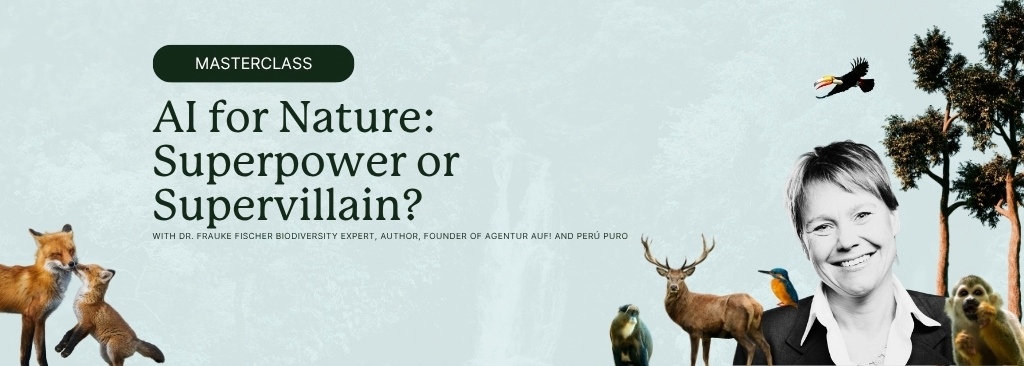
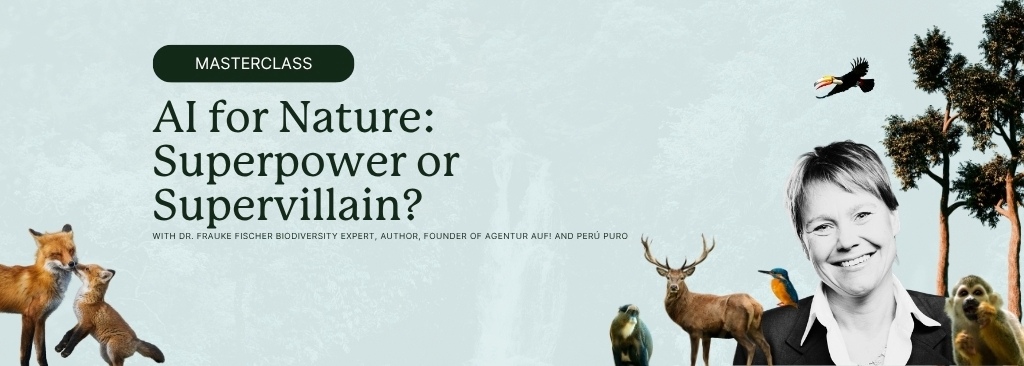
This article on AI for nature is based on a live Wildya masterclass with Dr. Frauke Fischer, biodiversity expert, author of “Kann KI die Natur retten?” (Can AI save Nature, published in German), founder of Agentur auf!, Germany’s first biodiversity-focused management consultancy, and co-founder of PERÚ PURO, a regenerative cacao venture protecting 900 hectares of Peruvian rainforest.
If you want more insights on building or scaling a nature venture, The Impact Millionaire newsletter lands in 4,000+ inboxes every week.
Who is Dr. Frauke Fischer?
The first book she ever bought with her own birthday money was about the behaviour of wolves. She was ten years old. 🐺
She is a biodiversity expert by training, but also by instinct, by upbringing, by genuine lifelong obsession. Her grandmother used to point out every bird and every plant on walks.
Most people grow out of that phase. Dr. Fischer just kept going.
She studied biology, did an exchange year in the US, then spent a decade in West Africa for her PhD, studying the effects of overhunting on antelopes. 🦌
When she came back to Germany, she founded Agentur auf! in 2003, Germany’s first management consultancy focused entirely on biodiversity. She still runs it today alongside a part-time lecturing role.
“It has always been my aim, my desire, to help people who are not specialists on biodiversity to become more aware of the importance of biodiversity and ecosystem services.”
None of that is the reason we invited her though.
We invited her because she wrote “Can AI save nature?“, a book that takes the same honest, rigorous approach she brings to everything else. And because that is exactly the question we wanted to sit with for an hour.
If anyone has earned the right to give an honest answer on whether AI is helping or harming nature, it is her.
Two examples of AI for nature already running
There are already applications of AI for nature running right now that are changing what conservation teams can do. Two of Dr. Fischer’s examples in this session are hard to forget.
Catching deforestation before it’s too late
Until recently, knowing where rainforest was being destroyed felt a lot like reading last year’s weather report. Satellite data on deforestation arrived between 3 and 18 months after the fact.
By the time the findings were published, the trees were gone, the wildlife had scattered, and the only thing left to do was count what had been lost. 🐆
AI changed that.
As Dr. Fischer described, “Today, we are able with the help of AI to see where rainforest has been destroyed today or yesterday, even in quite remote areas.“
When you know today, you can send rangers, police, or local communities out in time. When you know 18 months later, you write a report.
Think of it like this: conservation used to work like a trail camera you only checked once a year. You would find hundreds of photos of a poacher who had long since disappeared.
Now the camera sends a message the moment something moves. The picture is the same. The response time is not.
What AI for nature taught us about whale sharks
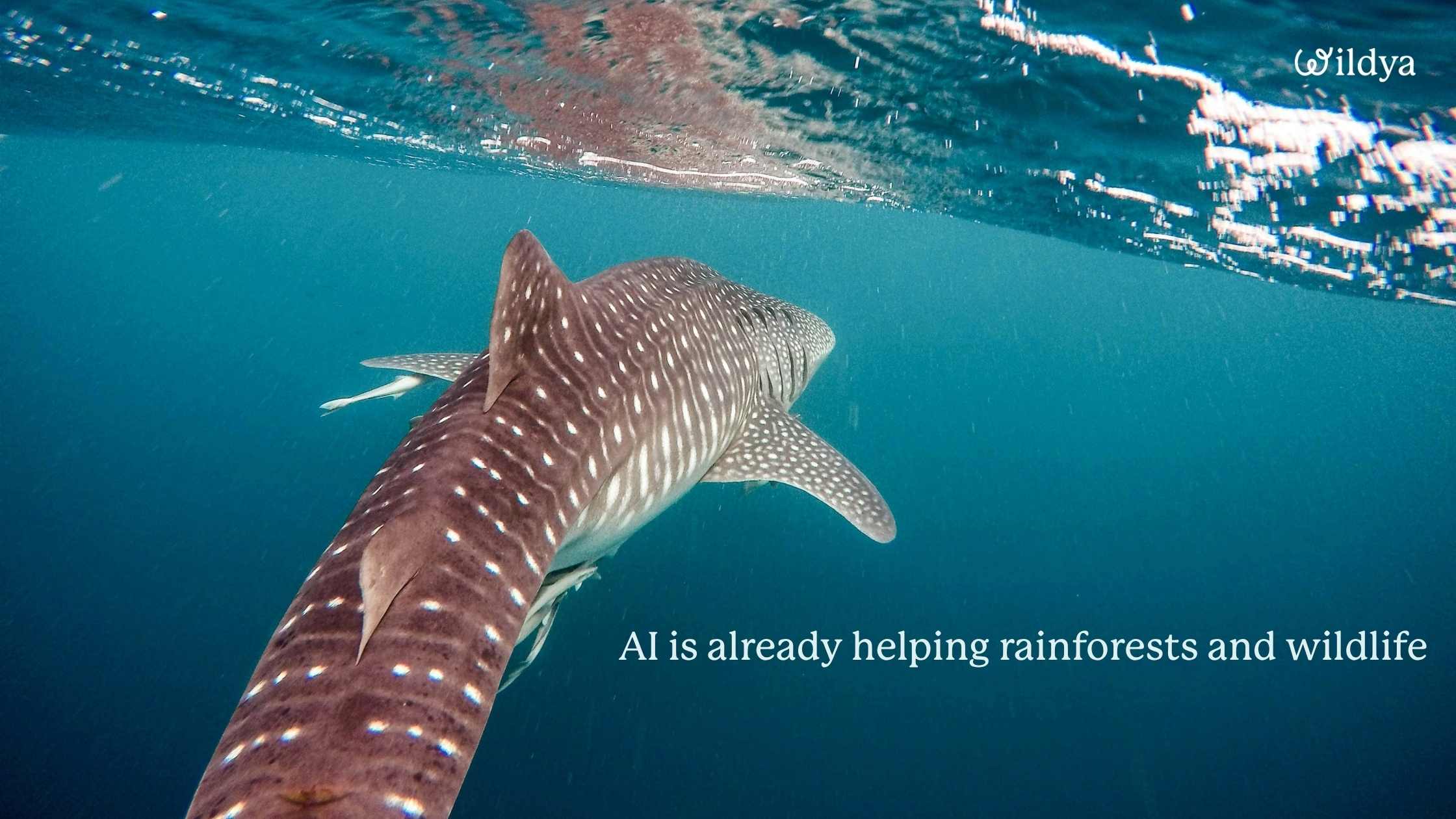
In 1986, the total number of whale shark photographs ever taken by humans stood at 300. That was after over a century of encounters with the biggest fish in the ocean. We barely knew these animals existed, let alone how many there were or where they went. 🐋
We now know more than 3,000 individual whale sharks. Most of that knowledge came from holiday divers posting photos to social media with no scientific intent. And AI started paying attention.
Whale sharks have dark skin with a unique pattern of white dots and stripes. No two individuals are identical, which makes them very easy for an AI trained in pattern recognition to tell apart.
AI scans social media accounts, finds photos of whale sharks, reads the pattern, and builds an ID card.
Same shark in two different photos from two different oceans? The AI system links them. New shark? New file.
Beyond identification, AI now predicts where whale sharks are likely to be at any given time. Shipping companies buy that data to avoid collisions with them.
They care about hull damage more than conservation, but the result is the same: fewer whale sharks get killed.
However, Dr. Fischer also mentioned that the AI eventually started generating its own research questions and answering them with the data it had collected.
The species ID was just the beginning. The system started connecting whale shark movements to water temperature, seasonal patterns, ocean currents, and building its own hypotheses from there.
Can AI save nature, or is it also part of the problem?
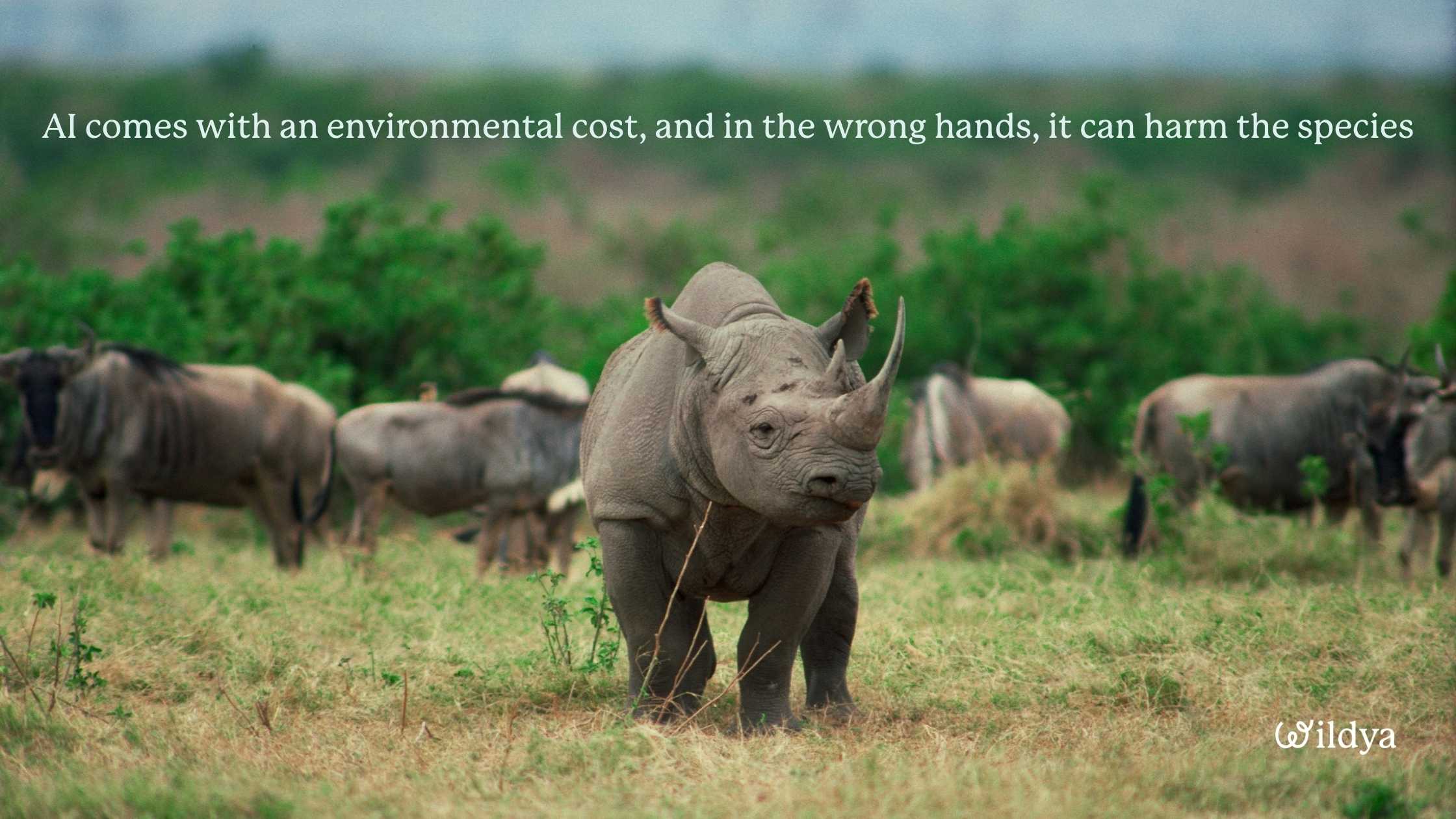
AI is not a neutral tool. Every application comes with costs, and some of them run deeper than most people realise.
AI has a real environmental cost
Running AI models consumes water, energy, and minerals.
The infrastructure required to train large language models draws heavily on resources, many of which come from rainforest regions. This all happens before a single conservation query is run.
Training a single large language model can consume water in quantities measured in bathtubs. Not drops. Bathtubs. 🛁
Dr. Fischer is not arguing that AI for nature conservation should stop. Nature-related applications represent a tiny fraction of what AI is used for globally, and pulling them would barely move the overall footprint.
But it changes how carefully we should think before we reach for the tool.
She used a simple example. If you want to cook an egg, a generation ago you asked a colleague. Then people used Google. Now they ask ChatGPT. The answer is the same every time.
The water, the energy, the minerals extracted to build the infrastructure… those are not.
“We have to learn how to apply it in a sensitive and responsible way,” she explains.
Can AI save nature when the same data feeds the wrong hands?
The whale shark tracking system is a powerful conservation tool. It is also, in the wrong hands, a perfect hunting guide. 🐋
Someone wanting to poach rare marine animals no longer needs to search the ocean. They could open an app and find 3,000 known whale sharks by predicted location. The work is already done for them.
Like Dr. Fischer says, “If you’re an illegal whale shark hunter, these information would be pure gold for you. You don’t have to look for whale sharks. You just use your AI app.“
The same logic applies to tigers, lions, rhinos, and elephants. The more precisely we track an endangered species using AI, the more valuable that data becomes to anyone who wants to exploit it. “This is a huge, huge problem.” 🐅
Can AI save nature if the tools built to protect it also make rare species easier to find and kill? Dr. Fischer raises this directly in her book, and she does not offer a clean answer. Because there is not one.
How to approach AI in your nature venture
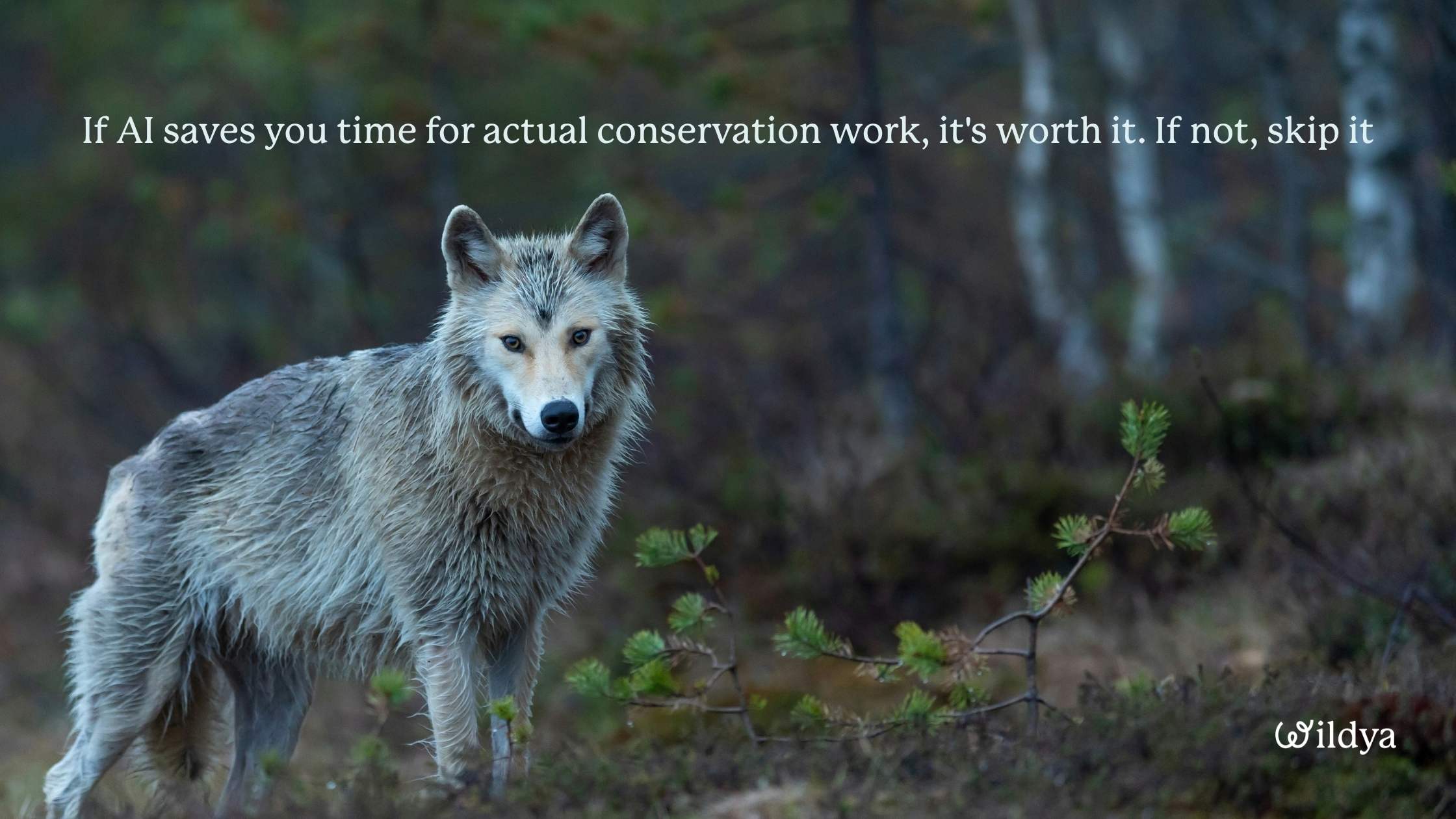
Dr. Fischer’s practical position for ecopreneurs comes down to a ratio.
If using AI saves you five hours, and you spend those five hours doing something that helps nature more than the model’s environmental cost, that is a reasonable trade.
Franke says, for example, writing a newsletter with AI might save five hours a week. Those five hours spent elsewhere, on direct conservation work, on community building, on the things that actually require a human, tip the balance in the right direction.
She also raised a risk that does not get enough attention: misinformation. AI models learn from whatever is on the internet. If someone deliberately floods a topic with false information, those claims eventually get absorbed and repeated with confidence.
Dr. Fischer used wolves as an example. Imagine someone fills the internet with stories of wolves attacking people across Germany. Ask an AI model “are wolves dangerous?” and it might answer: “Last year, at least 100 people were killed by wolves in Germany.” 🐺
As she noted, none of that is true. But the model delivers it with the same tone it uses for everything else.
“If your AI application is based on bad data, you will get the wrong answers. They sound very good, very convincing and very elaborated, but it’s all trash.“
For conservation issues that depend on public trust, policy decisions, and species protection, that is a real vulnerability.
One thing she returned to across the session: the best AI applications for nature happen when ecologists and technologists are in the same room. Neither group gets it right alone.
Oliver went through all the best AI tools he actually uses to run Wildya. Worth a look before you start experimenting.
What Dr. Fischer is building and how to support her
Dr. Fischer has spent 20 years doing the work that most people are only now starting to talk about. Agentur Auf! was Germany’s first biodiversity-focused management consultancy. She founded it in 2003, when almost no company in Germany wanted that conversation. They do now.
She also co-founded PERÚ PURO, a regenerative cacao and coffee venture in Peru that has been protecting 900 hectares of rainforest for ten years now. If you want to try what winning the silver medal at the world chocolate championship tastes like, this is the go-to.
But the reason we brought her into this session is her book.
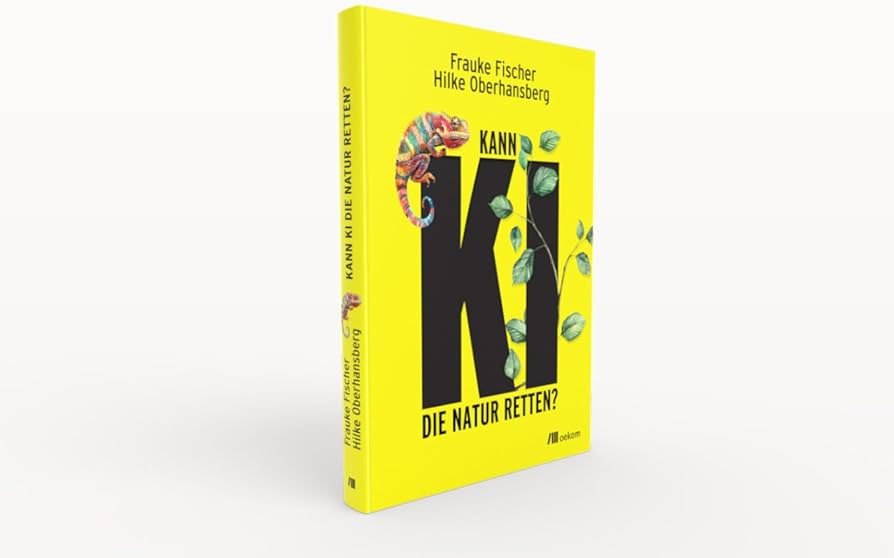
Written together with economist Hilke Oberhansberg, “Kann KI die Natur retten?” (can AI save nature?) is the most honest treatment of this question we have come across. No cheerleading, no doom.
It asks whether AI can save forests, translate animal voices, or protect rhinos from poachers, and then answers honestly: sometimes yes, and sometimes the same tool hands poachers a map. 🦏
It is currently only available in German.
If you want to keep up with her thinking beyond the book, follow her on LinkedIn. And if you are looking for a keynote speaker on biodiversity and AI for nature, she is the person.
AI for nature is a tool, not an answer
Can AI save nature on its own? Dr. Fischer’s honest answer is no.
It can help, in specific and real ways. It can also cause harm that most people have not thought through yet.
The ecopreneurs who get AI for nature right are the ones asking the harder question before they reach for the tool: does this actually help, and at what cost?
As Dr. Fischer closed out the session: “There is no alternative for optimism. Keep on working for the good things and don’t give up.“
What you should do next
- If you want to see what AI for nature actually looks like when someone builds it into a conservation operation, read how Douglas Eriksen turned Cango Wildlife into AI infrastructure for the whole conservation sector.
- If you want to build a nature venture and understand how to use the right tools (including AI) without losing sight of the mission, the Ecopreneur Beginner Bootcamp helps you start it, in just 8 weeks, from the foundation to your first paying supporters.
- If your nature venture is already running, but you want to bring it to the next level, our Fractional Executive Team diagnoses which single lever is blocking your growth (Attention, Product, Money, or People) and dedicates one day a week to pulling it. Strategy and execution together, including how to use AI where it actually helps, until the gap closes.