
3 things to know about trust in business
- Trust in business is a set of conditions that make trusting behavior possible, not a feeling. Those conditions follow the same pattern across every species on Earth.
- There are 8 trust principles: willingness, discovery, familiarity, honesty, cooperation, reliability, feedback loops, and boundaries. If one goes missing, the whole system breaks.
- You cannot rush building trust. Trying to shortcut it is what breaks it.
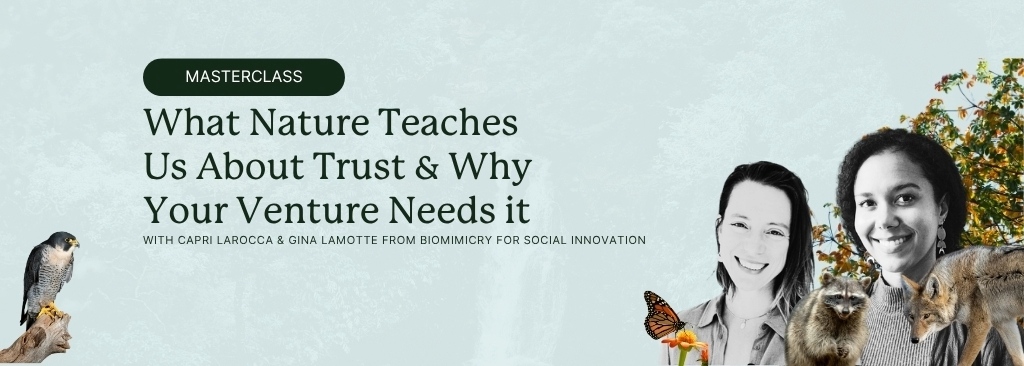
This article is based on a live Wildya masterclass with Gina LaMotte and Capri LaRocca from Biomimicry for Social Innovation (BSI), a nonprofit that translates nature’s genius into practices and tools that change how we do change.
Resources on building trust, growing your nature venture, and doing it the wild way go out in the Impact Millionaire Newsletter every week.
Who are Gina LaMotte and Capri LaRocca?
Gina LaMotte is the managing director of BSI, and Capri LaRocca is their engagement and learning lead.
BSI is a nonprofit founded about 15 years ago by Toby Hertzlik to support leaders who are interested in applying nature’s strategies to solve social and organisational challenges.
They train and coach leaders, run in-person immersions, and build tools that bring nature’s patterns into how people lead, cooperate, and communicate. This is done through biomimicry.
Biomimicry asks one question: what would nature do?
When you face a leadership, design, or organisational challenge, you look at how living systems have already solved similar problems after 3.8 billion years of trial and error. As Gina puts it, it’s “a conscious emulation of nature’s genius.“
Most people first encounter biomimicry through product design. The bullet train modelled on a kingfisher’s beak. The building in Harare ventilated like a termite mound. 🐜
BSI works at a different level. Instead of asking how nature builds better products, they ask how nature leads, distributes resources, communicates, and builds trust in relationships.
The work Gina and Capri brought to this masterclass came from one of those questions: What can 3.8 billion years of living systems teach us about trust in business?
The answer, it turns out, is quite a lot.
Biomimicry is a whole field on its own. If you want to understand how it works before reading further, we’ve covered it already.
What 3.8 billion years of nature revealed about trust in business
BSI spent two and a half years researching this question. Here’s what they found, and what it means for how you run your venture.
Trust in business is a set of conditions
In most conversations, trust gets treated like a gut feeling. You meet someone, something clicks or it doesn’t, and you either move forward or you don’t.
Capri’s team found that biology tells a different story.
BSI defined trust as “one’s willingness to accept the risk of engagement based on the expectation that the behavior of another will produce some positive outcome.“
That definition shifts everything. Trust is a calculation, not a feeling. The question isn’t “do they like me?”. The question is: does the benefit of engaging with me outweigh the risk?
Just a little more benefit than risk is enough to get things moving. Like a bird approaching a new feeding spot, it doesn’t need certainty. It needs the odds to tip, even slightly, in its favour. 🐦⬛
For your nature venture, this means you don’t need to convince a cautious funder your project is perfect. You need to tip the scales just past halfway.
The research also found that trust is a process.
It gets established, it grows, it gets maintained, and it can erode. If it erodes too far, there is no fixing it in the middle. You go back to the beginning and start establishing it again.
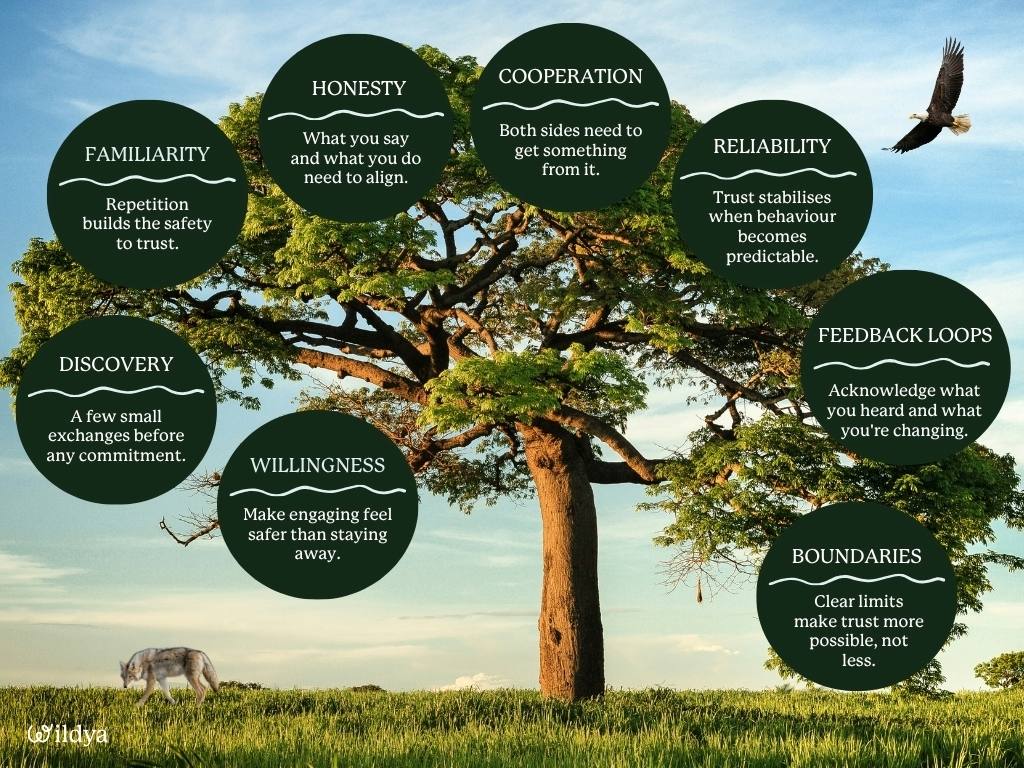
The 8 principles of building trust
BSI’s team of biologists studied over 180 organisms, from insects to mammals to marine invertebrates, and distilled the findings across more than 350 scientific papers.
What they found repeated across species, across ecosystems, across completely different kinds of relationships: the same 8 trusting patterns.
1️⃣ Willingness is the entry point.
Before any organism commits to an interaction, it runs that 50 plus 1 calculation: is this likely to produce more benefit than harm?
A chimpanzee meeting a stranger doesn’t groom them or share food on day one. It sits nearby. Proximity first, nothing more. 🐒
For your venture, this means your first ask with a funder or a potential partner should never be a big one. Make engaging feel low-risk.
2️⃣ Discovery follows.
Early interactions should be small and exploratory. Think of the way a goose approaches a new stretch of land: a few cautious passes, reading the landscape, before it commits to landing. No contract, no ask, just information and discovery. 🪿
Rushing into a major partnership before you’ve had a few smaller exchanges tends to backfire, in both boardrooms and nature.
3️⃣ Familiarity builds through repetition.
The more predictably you show up, the easier it becomes for someone to build a pattern around you. Predictability feels like safety, and safety lowers the cost of trusting.
A consistent newsletter or a regular check-in does more for familiarity than one impressive pitch ever will.
4️⃣ Honesty holds the whole thing together.
What you say and what you do need to match. Mixed signals, even accidental ones, break trust fast.
This applies to your impact reports, your communications, and how you behave in every small exchange with a potential partner or customer.
5️⃣ Cooperation kicks in when both sides are getting something from the relationship.
The exchange doesn’t need to be equal, it needs to feel mutual.
Mycorrhizal fungi give trees phosphorus; trees give fungi carbon. The amounts don’t match, but the relationship has held for hundreds of millions of years because both sides keep getting something from it. 🍄🟫
If one side is always giving and the other always taking, something eventually cracks.
6️⃣ Reliability is doing what you said you would do, consistently.
Trust stabilises when your behaviour becomes predictable over time.
7️⃣ Feedback loops are how trust stays healthy.
You need signals that tell you what’s working and what isn’t.
As Gina pointed out in the masterclass, organisations that close the loop openly, saying “we heard you and here’s what we’re changing,” build more trust than those that go quiet after receiving criticism.
8️⃣ Boundaries round it out, and this one surprises most people.
Capri said, “clear boundaries don’t weaken trust. They actually make it more possible, because they reduce uncertainty.“
The cleaner fish has its cleaning station, and the bigger fish know where to come and how to behave when they arrive. Imagine a shark showing up to a cleaner fish out of nowhere. The fish will think first it’s going to get eaten.
That structure isn’t a limit on the relationship. It’s what makes the relationship possible. 🐟
Why building trust is harder than most founders expect
The research uncovered something that explains a frustration most ecopreneurs know well: why it feels so hard to get people on board, even when the mission is urgent.
Who’s actually willing to take the risk
One of the most useful insights from BSI’s research was about who actually has willingness. It turns out comfortable people are the hardest to move.
Capri put it plainly: “comfort phase favors the status quo.“
Willingness opens up at the extremes. When someone is desperate, they take risks they’d normally avoid. When someone has so much that generosity comes naturally, they take risks too.
The people in the middle, doing fine, not struggling but not thriving either, are the hardest to move. They have no strong reason to take the risk of engaging with something new.
For ecopreneurs, this explains a lot. Your target funder is probably comfortable. Your potential partner organisation probably isn’t in crisis. They’re running, just about.
The perceived cost of engaging with you is higher than the perceived benefit, even when your mission is urgent.
The answer isn’t to push harder. Find the people already at the edges, and make the first step so small that even comfortable people might try it once.
Why you can’t shortcut building trust
The question came up during the masterclass: given that biodiversity loss isn’t slowing down, can we speed this up?
The answer from Gina and Capri was no. Gina put it as “moving at the speed of trust,” and the phrase lands hard because it pushes against almost everything the startup world tells you to do. Move fast. Iterate. Scale.
The problem is that urgency quietly erodes reliability and familiarity, two of the 8 conditions you need in place.
Every follow-up that slips, every promise delayed because the week got too full, every partnership launched before the relationship was ready: these chip away at what you’ve been building.
Gina also named a principle BSI uses in their broader biomimicry work: relationship before task. Build relationships with people first. The task comes after.
It sounds slow. But it’s the approach that actually holds.
Nature doesn’t have a quarterly report to file. An old-growth forest took 500 years to become what it is. You’re not replicating that in six months. But you can start planting today through small, consistent interactions. 🌳
What Gina and Capri are building
The Nature of Trust produced a free, publicly available toolkit. It’s a website-based resource built to make the research accessible and usable.
It includes about 35 short videos and downloadable materials matched to each of the 8 principles: journal prompts, team activities, group questions, and case studies.
Some teams are using the trust insight cards as a weekly exercise, working through one principle per session.
The toolkit is designed to be practical. You pick the principle that feels most relevant to a relationship or challenge in your venture right now, and work through the resources for that one.
If you want to go deeper on the 8 principles with a cohort, BSI is launching the Nature of Trust CoLab, a 10-week online training combining live sessions, peer work, field assignments, and a certificate of completion.
Registration details arrive in early May.
If you want to start with a broader introduction to biomimicry first, the Intro to Biomimicry for Social Innovation is a 4-week online course launching in August 2026, covering how nature’s patterns apply to leadership, partnership building, and resilience planning.
And if you want something lighter to begin with, Nature Positive Practices sends two nature-based leadership practices to your inbox each week, each one grounded in a deep pattern from the natural world.
Trust in business: nature already solved this
The conditions that make trust in business possible are the same ones nature has been running on for millions of years.
Capri said something near the end of the masterclass that ties this all together: “survival of the fittest is often misinterpreted as the fittest is likely the strongest and most dominant in a system. But actually it’s those that are most fit to their environment. So that often looks like those that are in most mutualistic relationships and in community with their environment, which requires a lot of trust.”
The cleaner fish, a small wrasse, takes the risk of swimming close to a shark to pick out parasites. The shark holds still. 🦈
Over time, through enough of those small, reliable interactions, the trust is built and both sides keep showing up because they keep getting something from it.
Building trust in business works the same way. A sequence of small conditions, built consistently, that make the next interaction feel worth the risk.
If trust in business is the bottleneck for your nature venture, whether a funder won’t commit, a partner stays cautious, or a supporter base won’t grow, the 8 principles give you a map.
Start with willingness. Make the first step low-risk. Show up consistently. Close the feedback loops.
This article is based on a live Wildya masterclass with Gina LaMotte and Capri LaRocca. If you’re starting a nature venture from scratch and want to build it on solid ground from day one, the Ecopreneur Beginner Bootcamp is where it begins.