
3 key takeaways
- How to build an online community that survives past month 2 starts with one question: what problem do all these people share that they can’t fix alone?
- Your first 10 genuinely engaged members create more energy than your next 100 passive ones. Focus on 10 first.
- Communities without rituals fade out. Give members a predictable reason to show up and they will.
Half the nature founders we talk to are building alone.
No peers to pressure-test ideas with. No network to open doors. No one who actually understands when you say you want to do something about the 70% collapse in insect populations over the last 30 years. 🦗
That isolation is expensive. And completely unnecessary.
The question of how to build an online community keeps coming up in the biodiversity and nature space, and for good reason. Whether you’re running a coral restoration project, building a wetland monitoring platform, or starting an NGO, the lone-wolf approach burns people out fast. Even wolves hunt in packs. 🐺
Most attempts fail quietly. They launch with 50 enthusiastic members. Drop to 12 by month 2. Get archived by month 4.
What separates the communities that survive from the ones that don’t comes down to a few early decisions. And if you want to create an online community that keeps moving after the initial hype fades, those decisions are the ones worth getting right.
Why ecopreneurs need an online community more than most
Ecopreneurs and nature founders are working in one of the most isolated fields there is.
You’re solving problems most investors don’t understand yet, building products the mainstream isn’t ready for, and navigating funding landscapes that look nothing like regular startups.
The people who get it are few. Which makes community less of a nice-to-have and closer to a survival tool.
Think about how mycorrhizal networks function in forests. Trees that look like they’re competing for light are actually sharing nutrients underground through fungal connections. 🌳
Remove that network and you don’t just lose the connection, you weaken the whole forest.
Ecopreneurs work the same way. Shared knowledge, shared warnings, shared wins all make individual ventures more likely to survive.
How to build an online community from scratch
Getting started is where most people already go wrong. These are the decisions worth getting right before anyone joins.
Start with a shared problem, not a platform
Most people start by picking a tool. Circle or Discord? Slack or WhatsApp? Wrong first move.
The first question to answer is: what is the one problem every potential member shares that they can’t solve alone?
“An interest in nature” is too vague. “Ocean organisation who can’t find non-grant revenue” is a community. Specific enough to attract the right people. Specific enough to make joining worth their time. 🌊
A community built around a shared problem has a built-in reason to exist. People come back because they still have the problem. A community built around a vague shared interest attracts people who look around once, see nothing happening that serves them, and leave quietly.
How to build an online community when nobody knows you yet
Getting to 10 engaged members is where most communities actually die. Not because the idea is bad, but because founders expect momentum to build itself. Nobody is coming unless you go and get them.
Don’t announce the community on LinkedIn and wait. Go and find the first 10 people yourself. DM them. Email them. Have a real conversation before you hand them a link to join.
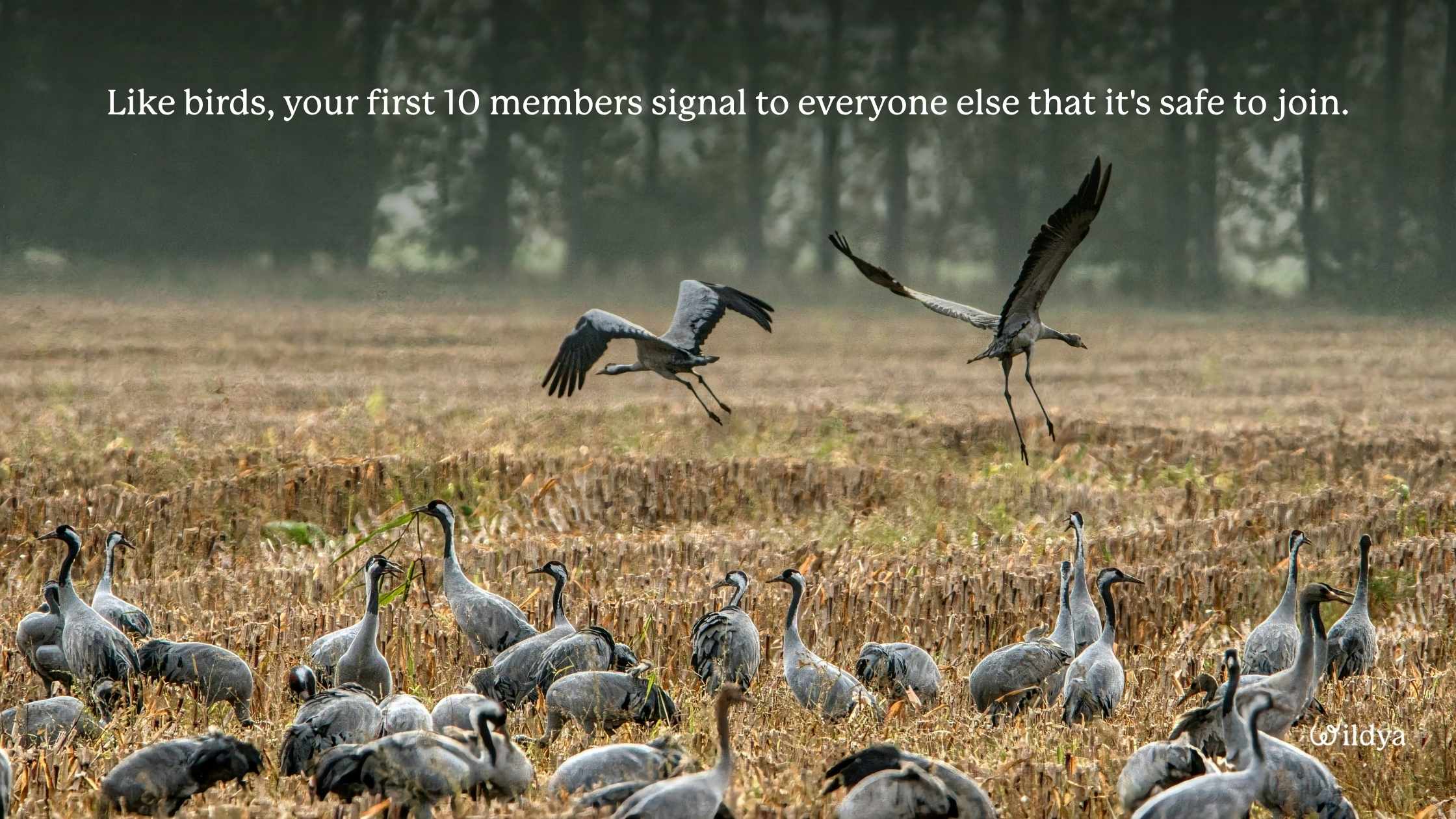
Why 10 specifically? Because 10 people actively talking, asking questions, and sharing things creates energy. Energy is what attracts the next wave of joiners.
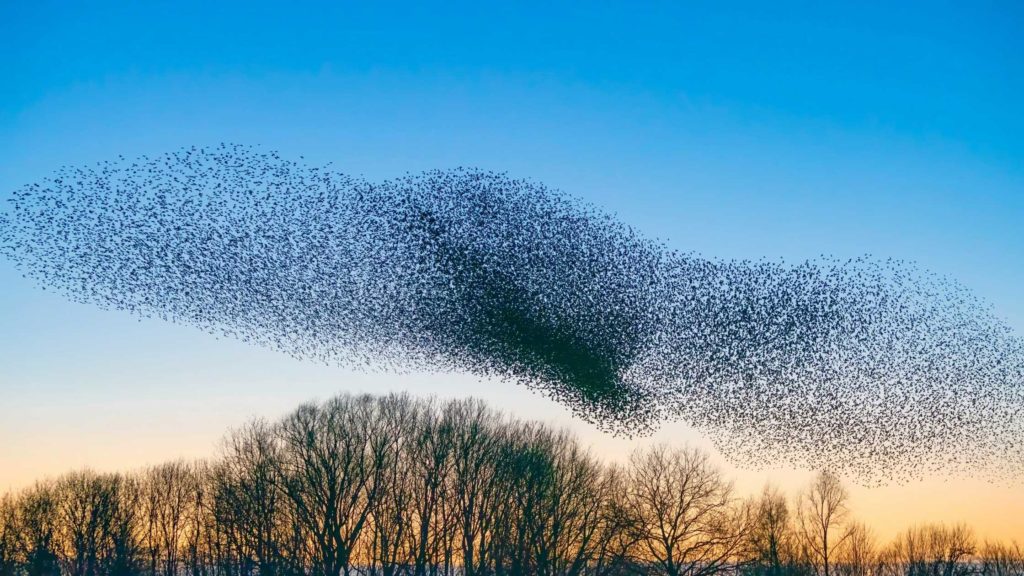
One flock of migratory birds landing in a field, feeding, moving around, signals to every bird flying past that it’s worth stopping here. 50 birds perched in silence, not feeding, not moving, tells every passing flock to keep flying. 🪿
Your first 10 members are the flock that signals safety. Choose them carefully.
Choose your platform based on where your people already are
The platform matters less than most people think. A thriving community on a free Facebook Group beats a beautifully designed Circle with no one talking.
That said, platform choice does affect how much friction your members experience. And friction kills participation.
For early-stage nature ventures and bootstrapped ecopreneurs: start with something free.
Discord works well for community-oriented conversations. WhatsApp or Telegram suit smaller, tighter groups. Facebook Groups can reach a broad audience, but check first that your specific members are actually active on Facebook. A lot of niche professional audiences aren’t.
Bet on the platform they’re already on, not the one you prefer.
Once you have 50 to 100 active members and a clearer picture of what your community needs, look at paid options.
Circle is popular for its clean structure and the ability to monetise down the line. Mighty Networks is worth considering if you want to combine courses with community.
But, the more premium the platform, the higher the expectation from members.
If your platform promises a polished experience but the conversations are sparse, the mismatch stings more than a basic free tool with a tight culture.
Write the rules before you let anyone in
On coral reefs, cleaner wrasse fish set up dedicated cleaning stations where larger fish, including predators, come to be groomed of parasites. 🐠
Both sides follow a clear behavioural code: the large fish signals it wants cleaning, and genuinely doesn’t eat the cleaner fish during the process.
The moment that code breaks down, the station stops working for everyone. Your community runs on the same logic. Clear rules are what make it safe enough for people to show up honestly.
What kinds of posts and questions are welcome? What isn’t allowed? How do members treat each other when they disagree? These answers shape culture faster than any amount of “great post!” replies from the founder.
Write them down before you launch. Pin them somewhere visible. And enforce them from day one, because culture is defined by the first few things you let slide.
A few rules that tend to work well for nature communities:
🐾 No selling before you’ve added value,
🐾 No doom without a constructive angle (nature needs builders not just mourners),
🐾 And introductions before anything else.
Knowing who’s in the room makes people feel safe enough to ask real questions.
Plan the welcome before the first member arrives
The moment someone joins, they need a clear first step.
An “introduce yourself” thread they’re invited to post in, a pinned “start here” post that tells them what the community is for and how it works, a personal welcome that asks them one specific question.
The goal is to get them to their first contribution within 48 hours, because a member who posts once is significantly more likely to come back than one who joined and only watched.
A seedling doesn’t just need soil. In the first days after germination it needs the exact right conditions: water, light, temperature. Miss that window and it doesn’t recover. 🪴
Your new members are the same. The onboarding experience is what turns someone who joined out of curiosity into someone who feels like they belong there.
Before you can build a community around your nature venture, you need to be clear on what that venture actually is. The Wild Idea Finder generates 33 personalised, practical nature business ideas based on your answers, in about 13 minutes.
Your email is the only cost. Nature needs your creativity more than your credit card.
Create an online community people actually return to
Getting people to join is one challenge. Getting them to come back is a completely different one, and most community builders confuse the two.
Give people something to do together
Passive content consumption kills communities. If the only thing happening is the founder sharing links and asking “what do you think?” members check in less and less.
There’s nothing at stake and nothing to actually do.
Structured participation changes this. Weekly discussion prompts. Co-working sessions. Member spotlights. A shared challenge where everyone reports progress on Fridays.
These give people a reason to show up that has nothing to do with waiting for interesting content to appear.
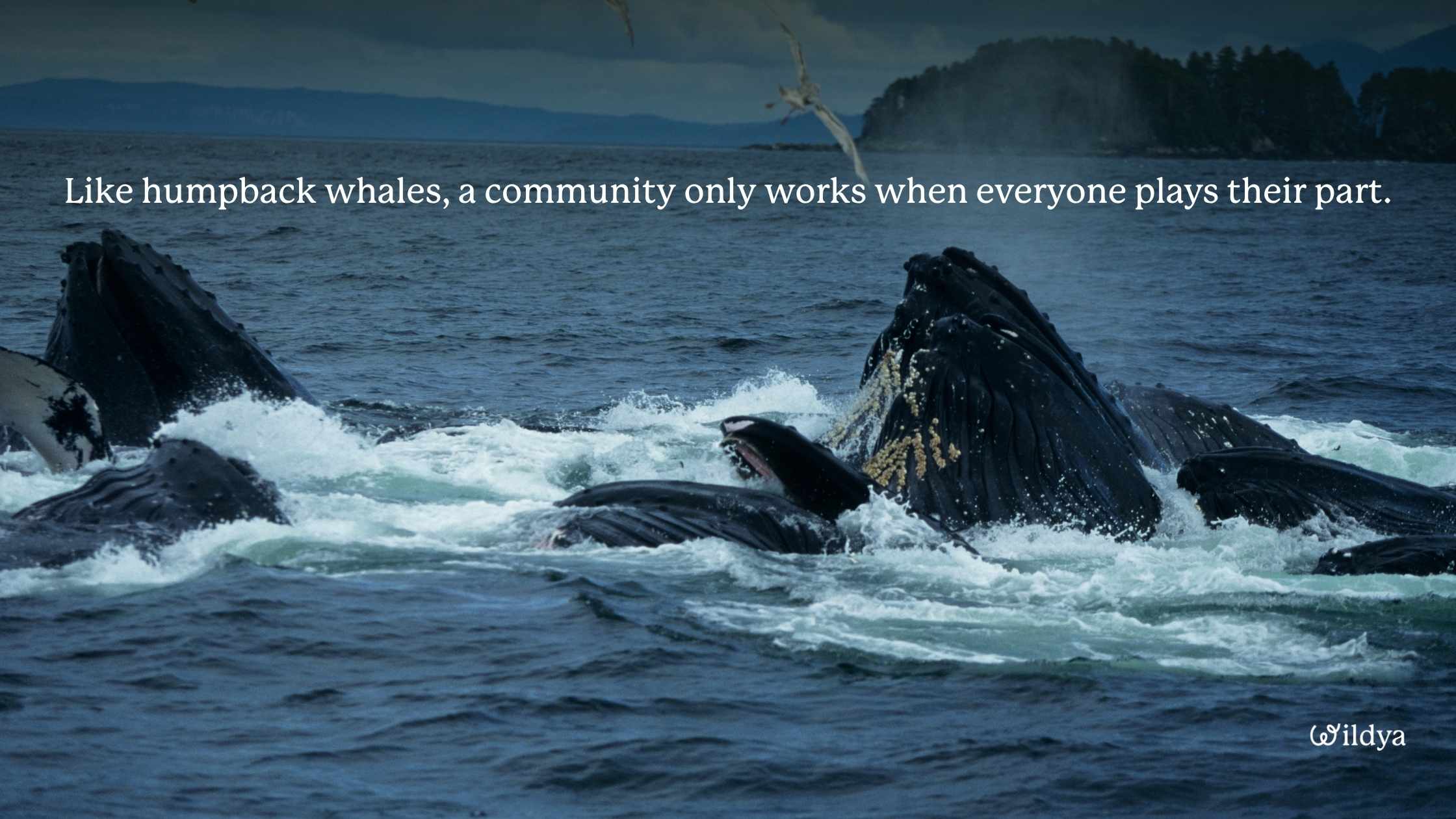
Think of humpback whales doing bubble net feeding. Some blow the spiral of bubbles, others call, others drive the fish upward through the center. It only works when everyone shows up and plays their part. 🐳
Your community needs the same: something that only happens if people actually participate.
The difference between a community and an audience is simple: one does things together, the other watches. You’re building the first one.
Create an online community culture through rituals
Rituals are what keep a community breathing long after the initial excitement fades. Unlike one-off events, rituals are predictable. Members know they happen. They plan around them. They bring people to them.
In nature, you see this everywhere. Salmon return to the same rivers every year. Wildebeest cross the same paths. These aren’t conscious decisions, they’re rhythms built over generations. 🐟
Your community needs its own rhythm for people to organise their participation around.
A good ritual doesn’t have to be elaborate. A “what are you working on this week?” thread every Monday. A monthly founder Q&A. An annual in-person gathering.
What matters is consistency. If it happens every time without fail, it becomes the backbone people build their involvement around.
The mistakes most community builders make
Some of these you’ll recognise from communities you’ve been part of. Others, hopefully, you won’t have to make yourself.
1️⃣ Launching before you’re ready
Opening the doors before you have anything to offer your first members kills first impressions fast. Test with a small closed group. Iron out the basics. Then open properly.
2️⃣ Doing all the talking
If 80% of posts come from the founder, you have an audience, not a community. Your job is to ask questions, spark introductions between members, and then step back.
3️⃣ Treating it like a marketing channel
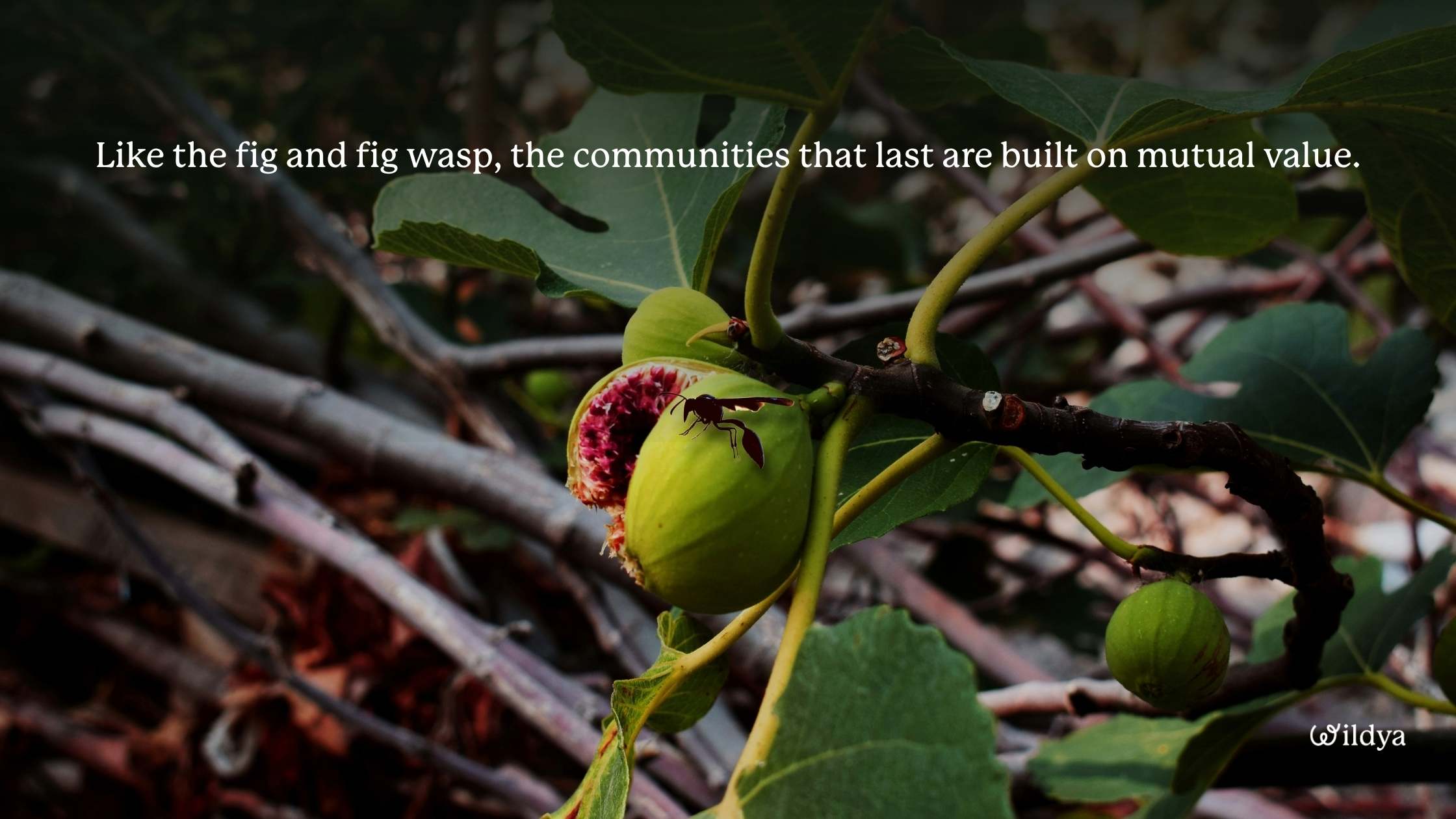
A fig tree and its fig wasp have one of nature’s most locked-in partnerships: the tree provides shelter and food, the wasp pollinates. If one side only takes, the relationship collapses fast.
Members read the same dynamic, especially if they only hear from you when you have something to sell.
4️⃣ Ignoring the quiet ones
The loudest members are never the majority. Most people read without posting. Create ways to participate that don’t require writing paragraphs: polls, short prompts, reactions.
These keep the quiet majority connected and present.
5️⃣ Growing too fast
Flooding your community with members who barely fit your niche dilutes the signal until the people who genuinely care leave to find a better room.
Ecosystems don’t get healthier by adding random species. They get healthier when the right ones find the right conditions.
6️⃣ Not welcoming new members personally
When someone joins and hears nothing for 3 days, they leave. A short personal welcome message, even just a sentence, a question, is the difference between a member who stays and one who forgets they joined.
7️⃣ Trying to grow without a recognisable presence
People follow people they trust. If your personal brand is unclear, your community invitation will be too. Before asking people to join something you’ve built, make sure they know who built it.
If that last one hit close to home, here’s a guide on building a personal brand as an ecopreneur that’s worth reading before you launch anything.
How to build an online community that lasts
How to build an online community is really a question about creating the conditions for people to care about something together.
The platform, the posting schedule, the number of members at launch, none of these are the deciding factor.
Start with a sharp problem. Find the right people. Give them something to do together. Protect the culture from the start.
You can create an online community on a shoestring budget in a weekend if you know what it’s for and who it’s for. Most people who fail skip those two questions and go straight to logos and launch emails.
Nature doesn’t build ecosystems by accident. Every forest, reef, and grassland you’ve ever loved got there because the right species found the right conditions at the right time. 🪸
Your community is no different. Get the conditions right first, and the rest follows.
Want weekly tips on starting and scaling your nature venture, including what actually helps communities and organisations grow in the biodiversity space?
The Impact Millionaire Newsletter goes out every week to 4,000+ ecopreneurs. 60 to 120 seconds of reading time. No fluff. Real action.