
3 takeaways from VC fundraising masterclass
- The pitch deck is not the first step in VC fundraising. Research, warm introductions, and the right investor list come before it.
- Showing the difficult parts of your business in a pitch builds credibility faster than pretending everything is running smoothly.
- Investors buy clarity and momentum, not complexity. If your story takes too long to land, you have already lost them.
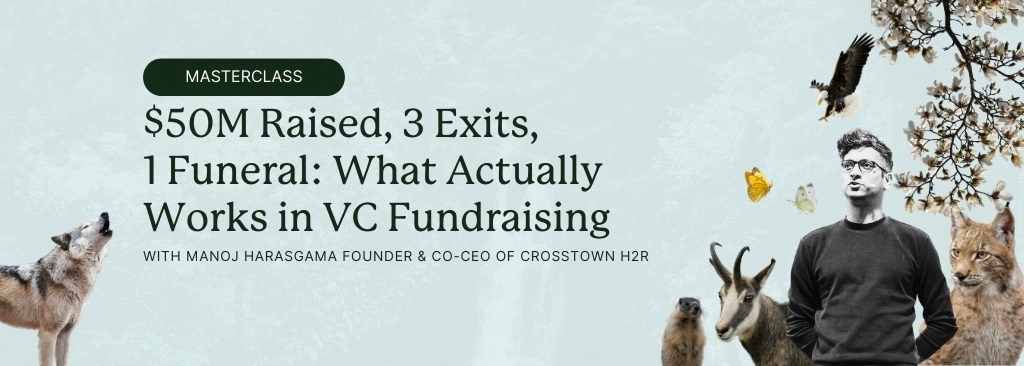
This article is based on a live Wildya masterclass with Manoj Harasgama, serial entrepreneur, investor, and founder of Crosstown H2R, a company working to decarbonise gas turbines and cut CO2 emissions at scale.
If you want more insights on building or scaling your nature venture, The Impact Millionaire newsletter lands in 4,000+ inboxes every week.
Who is Manoj Harasgama?
Manoj Harasgama first entered the financial world as a student by joining his first startup, at a time when most of his peers were heading into consulting and private equity. That company was eventually sold to Axel Springer, one of Europe’s largest media groups.
After that he built TreatWell, a marketplace for beauty and wellness, which today has around 700 employees and processes close to €800M in annual revenue.
Then came join.com, an HR tech platform now at double-digit millions in revenue with a team of 100. He then shifted into climate deep tech with Crosstown H2R.
Manoj has raised $50M across multiple startups. Exited three of them. Buried one. And now he sits on both sides, as a founder building Crosstown H2R and as an investor backing others.
In this masterclass he walked the Wildya community through the playbook: how to pitch so VCs actually say yes, which mistakes kill deals before you walk in the room, and what to look for beyond the money.
Should your nature venture pursue VC fundraising?
Venture capital (VC) is funding from specialist investment firms that back high-growth startups in exchange for equity. Think large global names like Andreessen Horowitz or Sequoia, and dozens of sector-specific or geography-specific funds beyond that.
Not everyone should pursue it. Manoj is direct about this.
VCs think in a 5 to 10 year window. They need to see a credible path from where you are today to growing revenues and eventually profitability. At an early stage, before your numbers are significant, they are backing a story and a person more than a spreadsheet.
For NGOs without a revenue arm, VC is almost never the right fit.
For early-stage nature companies, the question is practical: do you actually need a large amount of upfront capital to build what you are building?
Manoj needed it for Crosstown H2R because testing deep tech hardware at scale costs money that bootstrapping cannot cover. Not every nature venture has that constraint.
If you can test and grow with smaller amounts, angel investors or grants will often get you further, without the equity trade-off.
And if you feel that none of them will work for your stage and sector, know this: there are reportedly 19,000 VC funds in the US alone.
VC is just one of several routes available to nature founders. Before committing to the hardest one, it is worth knowing what else is out there. We give you 6 of them.
Three principles behind a strong fundraising round
Manoj shared three principles drawn from his experience across different industries, stages and economic cycles. Before getting into tactics, these are worth understanding first.
VCs buy clarity, not complexity
“They don’t buy complexity. They buy momentum and clarity.”
If your pitch deck has no white space, every pixel used, you have made it harder for investors to say yes. VCs are intelligent, but they are rarely experts in your specific sector.
Your job is to make the complicated feel simple.
Manoj calls this “irrational simplicity.” The fewer words it takes to make someone understand why this matters, the stronger your position.
For join.com, his HR tech platform, he summed up the market opportunity into one sentence: there are 25 million small and medium businesses in Europe, and 95% of them do not use HR software.
That one sentence made the scale of the opportunity immediate.
Showing what is hard builds trust
Manoj runs gas turbine technology at temperatures that can reach 2,000 degrees Celsius. Things do not always go to plan, and he says so in his pitch.
“When you show that fragility or vulnerability, it is seen as a strength. Because you understand there are limits and not everything is easy.”
Investors will find the difficult parts anyway during due diligence.
If you surface them early, you come across as someone who understands their own business. That is where trust with an investor actually starts, and it matters more than a perfect story.
Momentum brings other investors in
The first investor is the hardest to get. After that, the dynamic shifts.
“Sometimes it feels like lemmings. The first investor is the one who really believes in you. The others follow where the money is going.”
Investors talk to each other. When one commits, it sends a signal that someone credible has already done the work of evaluating you. Getting a first yes, even a smaller one, changes how every subsequent conversation lands.
It’s also why timing matters: if you can get that initial commitment within a reasonable window, the next investors move faster. 🏃
Momentum is how most rounds actually close.
The VC fundraising process
Most nature founders think the process starts with sending a pitch deck. Manoj starts much earlier.
Before you send the deck
Research comes first.
Before sending anything, Manoj maps potential funds by sector, stage, and geography. He works out who in his network knows which investors and aims for a warm introduction.
Of around 100 VC conversations he had during his Crosstown H2R seed round, roughly 20 to 25 came through warm introductions.
When an introduction is not possible, he writes a specific message built around what he knows about that fund and its portfolio. The goal of that message is to get a first meeting.
“Only then does sending a deck make sense. If you send it cold, it is just a deck.”
His advice for building that network before you need it:
🐾 Stay in contact with people close to funds even when you are not actively raising.
🐾 One relevant event a month, a few conversations with founders who have already raised from investors you might eventually approach.
When the moment comes, you can be introduced rather than starting from zero.
Building your VC fundraising funnel: the wave system
Once Manoj has a list of around 100 investors, he splits his outreach into waves.
The first wave is not his top targets. It is a test group chosen to stress-test the story and surface questions he had not anticipated.
“My first wave is never the perfect batch. It is the VCs I want to get as much feedback from as possible to bring back into the deck.”
The second wave is where the priority investors sit. By then the story is tighter and, if the first wave generated any interest, there is momentum to carry in.
Manoj is clear that even this system did not run perfectly for Crosstown H2R. The technology was complex, the climate investment environment had shifted, and mid-round he had to reboot the story, sharpen it and make it simpler.
What your pitch deck needs
The standard pillars: problem, solution, market size, traction (or early signals), business model, team, why now, and your ask.
Get the mission visible early, ideally on the first slide. If it connects emotionally, people will listen to the next ten slides differently.
Keep the first deck short. The goal is not to get investment on the first call. The goal is to get a second call.
“You don’t want them to invest on the first call. What you want is for them to say: let’s have a second call.”
Think of your strongest material as cards in a hand. Playing all of them at once leaves nothing for the conversations that follow. Show enough to generate interest and keep enough in reserve to build on in the next meeting.
On preparation: Manoj went into his last round with a detailed set of supporting slides, one set for each section of the deck. He did not lead with them. But when investors dug into due diligence, he could respond with supporting material within 24 hours rather than three days.
That readiness signals something.
“They think you have your sh…eep together. And that is an important one for them to believe you are the right kind of founder.” 🐑
What to look for beyond the money
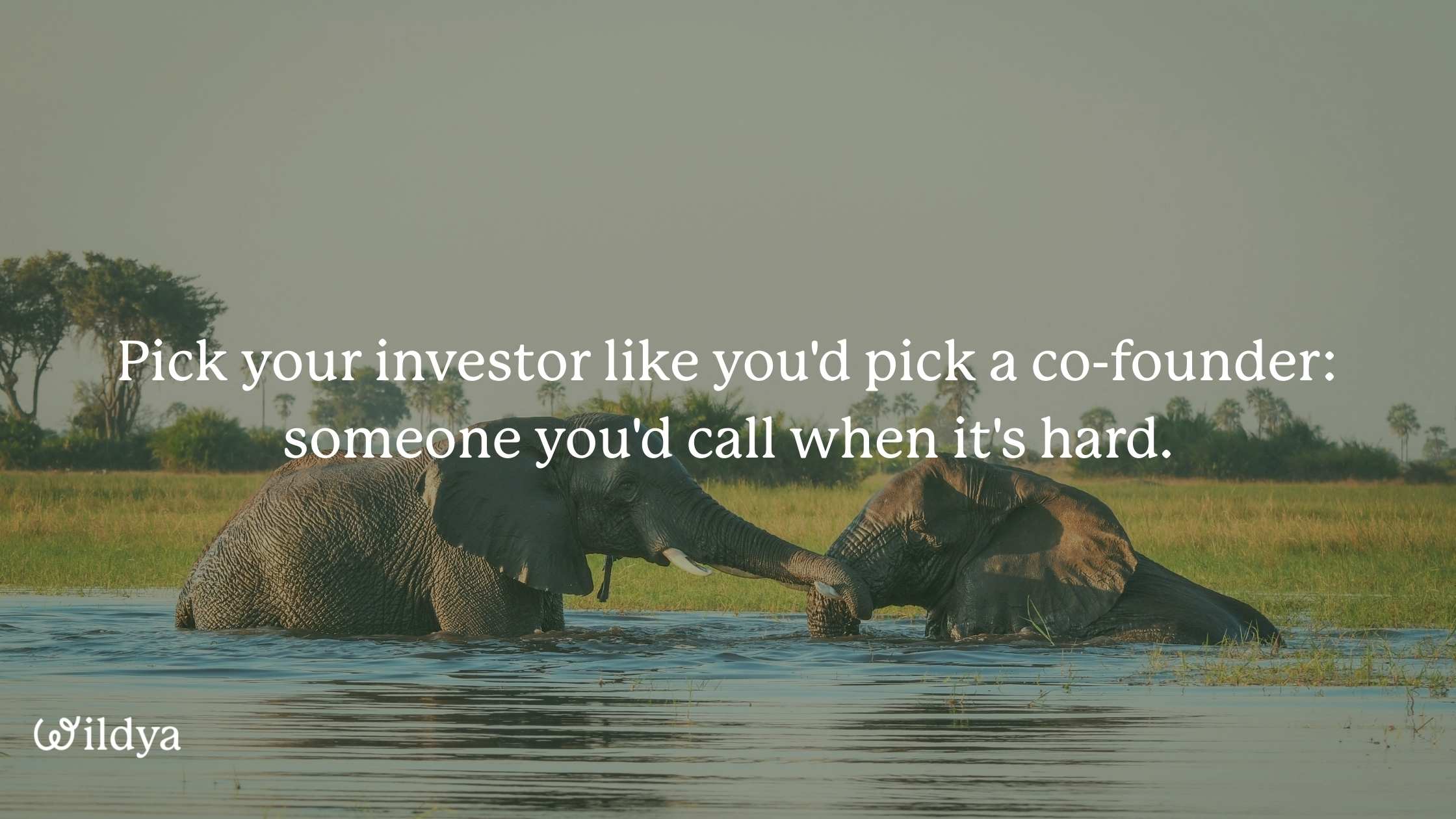
If you need money, getting it is better than not getting it. That is Manoj’s starting point. Any investor is better than no investor when your business needs capital to survive.
But when you have options, other things start to matter.
Manoj thinks of investors as extended team members. People who can pitch your story to others, open doors in their network, and be honest with you when things are not going well.
For that to work, you need to choose someone you could actually call when things go wrong.
“When things get tough, you want somebody in your corner. To have that, you need to be able to have difficult conversations with them.”
Two things he values most from investors:
💸 Market insight, because VCs talk to hundreds of startups every month and can point you towards founders who have already solved the problem in front of you.
💸 Fundraising timing, because a well-connected investor can tell you when the window is open and when to reduce spending before it closes.
Nature founders and VC fundraising: where to actually start
VC fundraising is a funnel. Like sales, like hiring. You talk to many to find the few who say yes.
But unlike most processes, the research, the relationships, and the story you build before sending a single deck shape the outcome more than anything in the deck itself.
Manoj’s closing advice was:
🐾 Have a process before you go into the process.
🐾 Make the story as clear as you possibly can.
🐾 Show what is genuinely hard.
🐾 And know that the first investor is the hardest to get.
This article is based on a live Wildya masterclass with Manoj Harasgama. If you’re at the stage where fundraising, revenue, or growth is the thing blocking your impact, that’s exactly what our Fractional Executive Team helps you working on.