
Three things to know about this Ecopreneur Beginner Bootcamp cohort
- Cohort 3 brought together 9 participants from 8 countries, each building in the ecosystem they know best, from Nairobi’s flood-prone riverbanks to Kalimantan’s clogged waterways.
- Some arrived with 10 years of fieldwork behind them. Others started from scratch. 8 weeks later, every one of them has a named venture and an offer.
- A few even swapped their first idea for a sharper one, which is exactly what 8 weeks of pressure-testing is for.
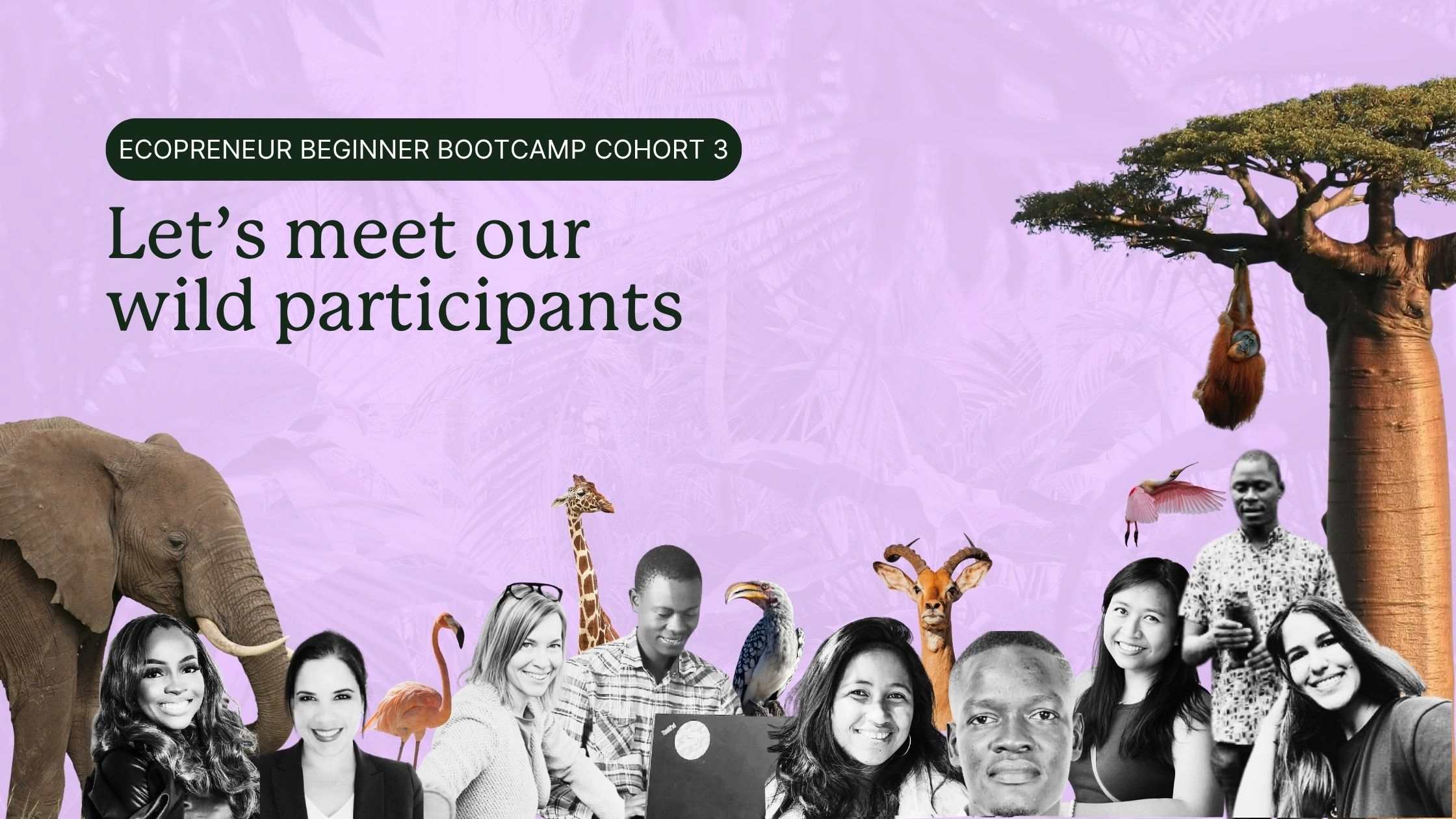
8 weeks ago, Cohort 3 of the Ecopreneur Beginner Bootcamp started with 9 rough ideas and a lot of determination.
They came from 8 countries and wildly different ecosystems, with the same underlying belief: that nature deserves better, and that the people closest to the problem are often the ones best placed to fix it.
Today, they leave the nest. Every one of them now has a named venture, a business model, an offer, and in most cases a first supporter in sight. 🐥
To see the full evolution, read where each of them started in our first article, then come back for where they landed.
Let’s see how far each of them came. 🐾
If you want to follow their journey and get tips on building your own nature venture, join The Impact Millionaire, our free weekly newsletter.
What is the Ecopreneur Beginner Bootcamp?
Most people who want to do something for nature get stuck long before they build anything real. The idea lives in their head for months. Sometimes years. The problem is clear. The passion is there.
But the path from “I want to do this” to “someone just paid me for this” stays blurry.
The Ecopreneur Beginner Bootcamp was built for that specific gap. It runs for 8 weeks, and every single week is built around one purpose: building your nature venture from the ground up, step by step, with foundations designed to actually last. 🌳
In those 8 weeks, you figure out whether your idea is worth pursuing and why. You map out who it is for and how your business model works. You shape your offer, get it in front of the right people, and learn to have the conversations that lead to a yes.
By the end, you have gone from rough idea to first paying supporter.
And you have done it alongside up to 15 other ecopreneurs at the same stage, pushing each other forward.
The 9 people you are about to meet just did exactly that.
But the bootcamp is not for everyone. It’s for people who are ready to do the work. Want to know if it is right for you?
9 participants, 9 wild ideas: see how far they came
From one side of the planet to the other, from wildlife story prints to water-hyacinth products to intuitive animal communication, these 9 people are building where nature needs the most help.
We introduced them at day one. This is what 8 weeks did to each idea.
We are showing you again because the right partner, collaborator, funder, or first customer might be reading this right now.
Olusegun Uhuru | 🇰🇪 Samburu, Kenya
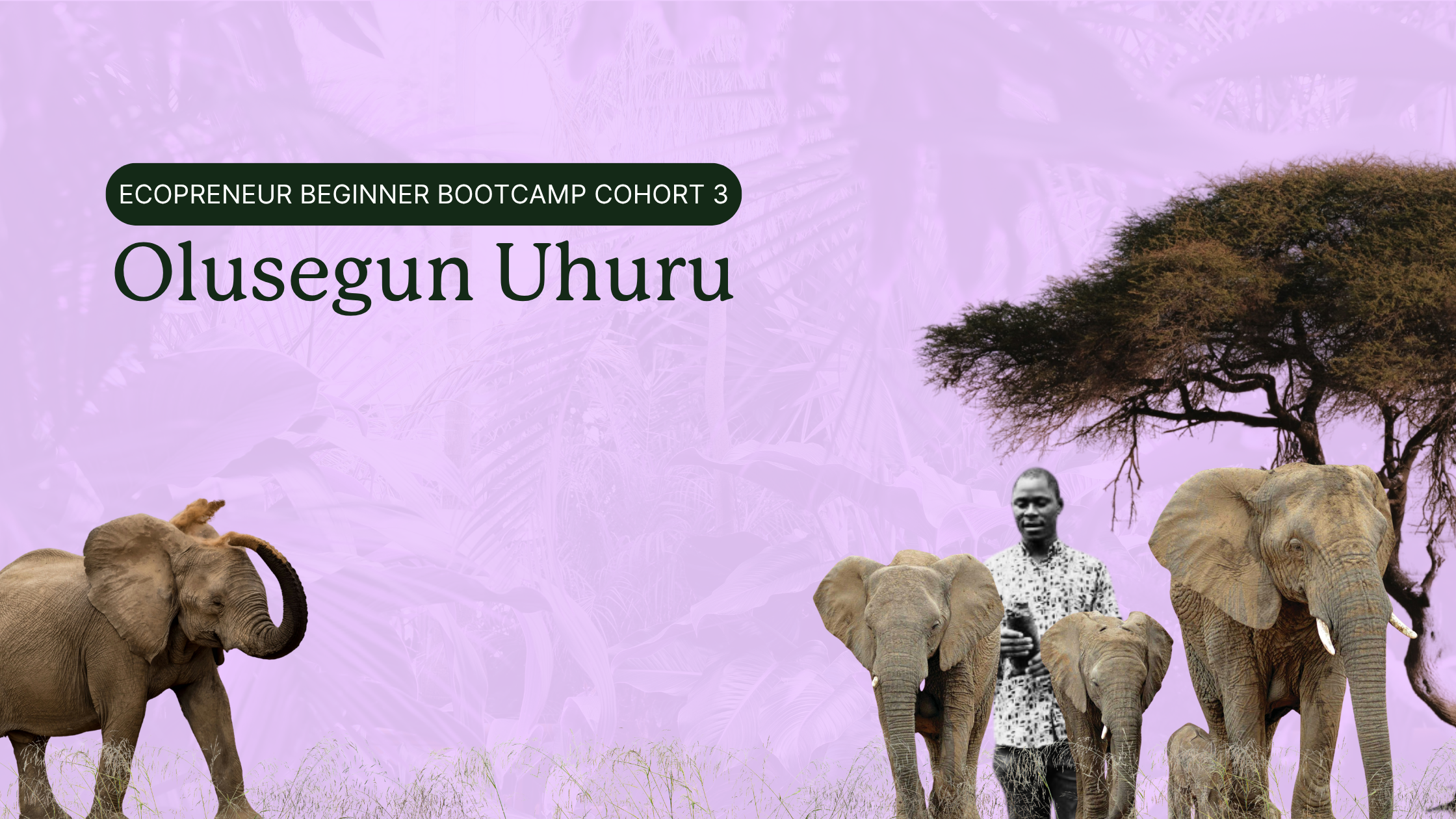
Olusegun arrived with a rough idea: a story network in Samburu, where people affected by human-elephant conflict document wildlife instead of retaliating against it.
8 weeks later, it has a name, Samburu Wildlife Conservation Stories, and it has already been on the ground. 🐘
He engaged around 50 community members, 31 women and 19 men, and learned that reporting by voice note works and that people want it.
The stakes are not abstract: this year alone, his community in Naibor Keju lost 12 women collecting firewood and more than 500 livestock to wildlife. That kind of loss is what pushes people to kill the animals back.
His answer, in his own words, is that “coexistence, not conflict, is the solution.” Local people who live alongside the wildlife become the ones who photograph it, tell its story, and earn from it.
Every print sold turns a giraffe on your wall into income for the family that lives beside it. 🦒
He is looking for his first supporters and for conservation partners who back community-led coexistence.
Leakey Ochieng | 🇰🇪 Nairobi, Kenya
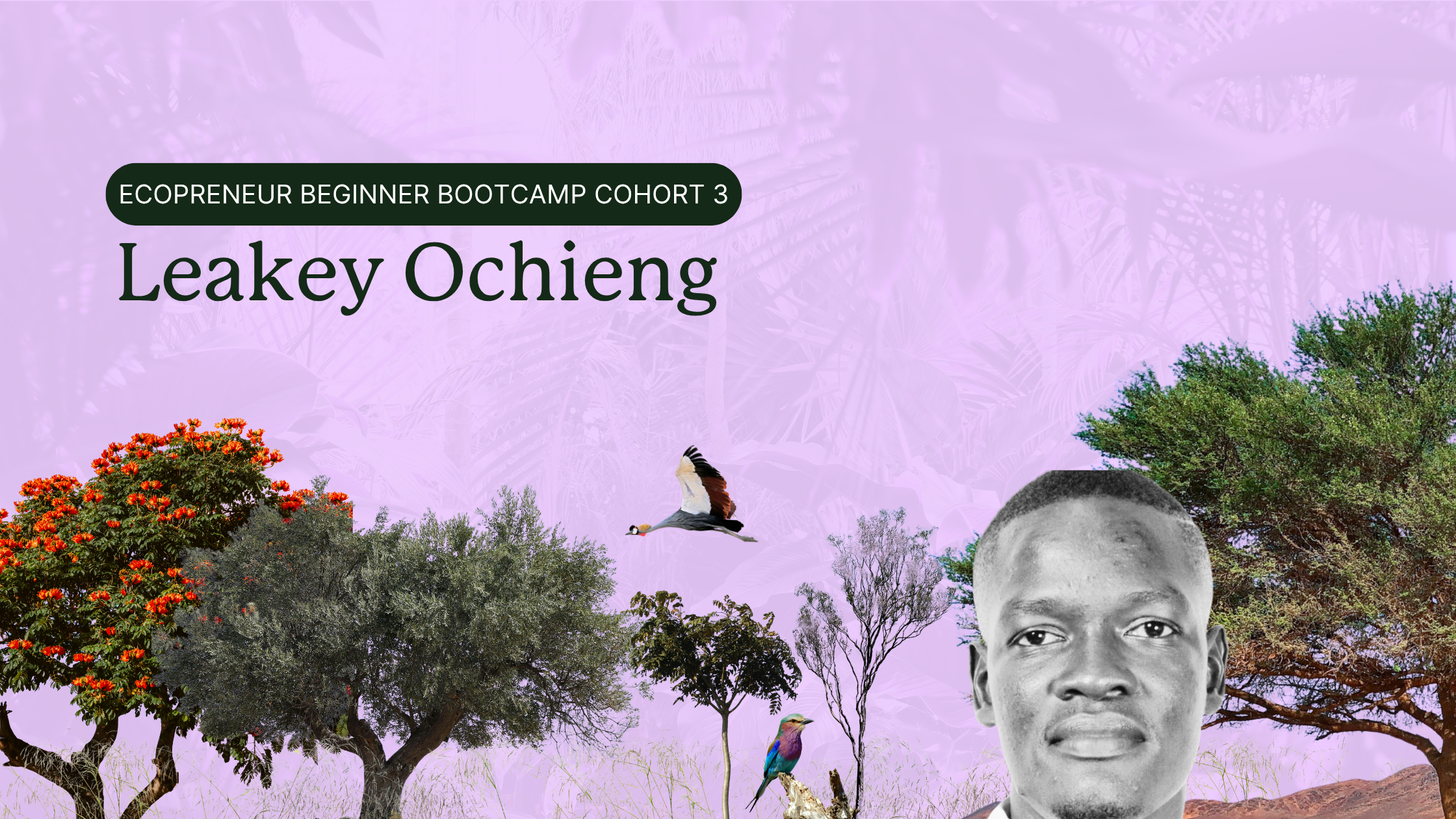
Leakey started with a concept: turn Nairobi’s neglected spaces into “sponge forests” that soak up floodwater and cool the city.
Now it is G&L Legacy, and it has numbers. 🌳
Within 24 months, he wants to plant at least 10,000 indigenous trees along the Nairobi River, recover 5 kilometres of riverbank, and create jobs for young people along the way.
Trees work as a carbon sink and a flood sponge, and this year’s flooding showed Nairobi exactly what happens when the riverbank is left bare.
As Leakey says, “let’s build the cities our children will deserve.”
To get there, he needs seedlings and nurseries suited to Nairobi’s conditions, technical guidance from anyone who has planted at this scale, and funding to pay for the work.
Icha Irdhanie | 🇮🇩 Kalimantan, Indonesia
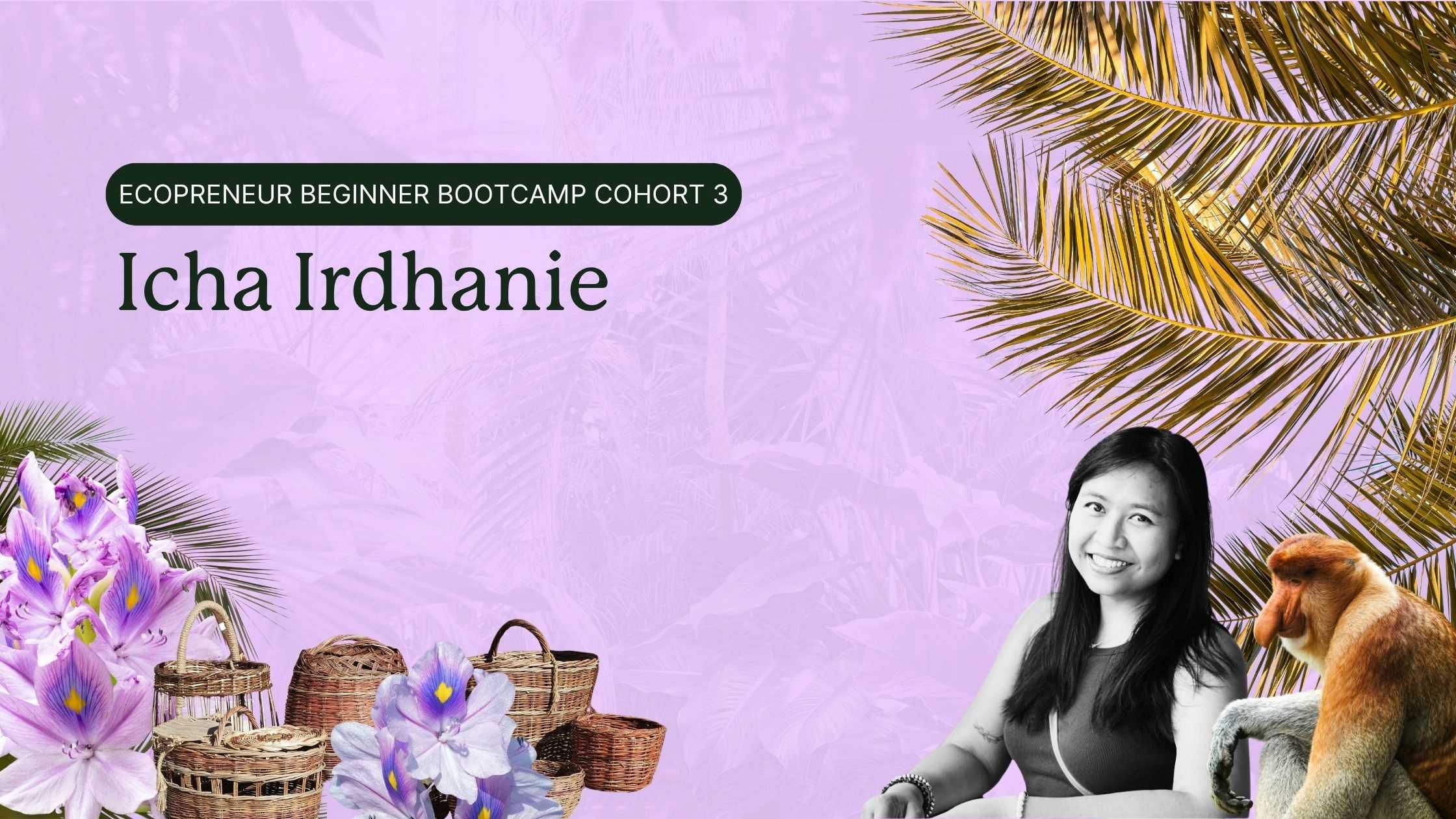
Icha started the bootcamp planning a rattan agroforestry project. 8 weeks in, she pivoted, swapping rattan for water hyacinth. 🌱
Her venture now is Agency by Nature, a B2B social enterprise that turns water hyacinth, the invasive weed choking Indonesia’s waterways, into natural-fibre products for hotels, resorts, and ESG-conscious companies.
Rural women harvest the weed and make the products, earning income during the farming off-season; agroforestry is planted, and every buyer receives a verified impact report. 🌸
She calls it the nature loop, and it behaves like one: the weed comes out of the water, income and trees go in, and the buyer leaves with proof of every outcome. As she puts it, “every purchase restores something.”
She is not building it from a whiteboard. Before the bootcamp, she spent a year and a half with rural artisan communities, learning where these supply chains break when they try to scale.
Now she is looking for hotels and resorts tired of generic amenities, and companies or NGOs with a CSR mandate but no bandwidth to run it.
Hoby Nambinintsoa | 🇲🇬 Antananarivo, Madagascar
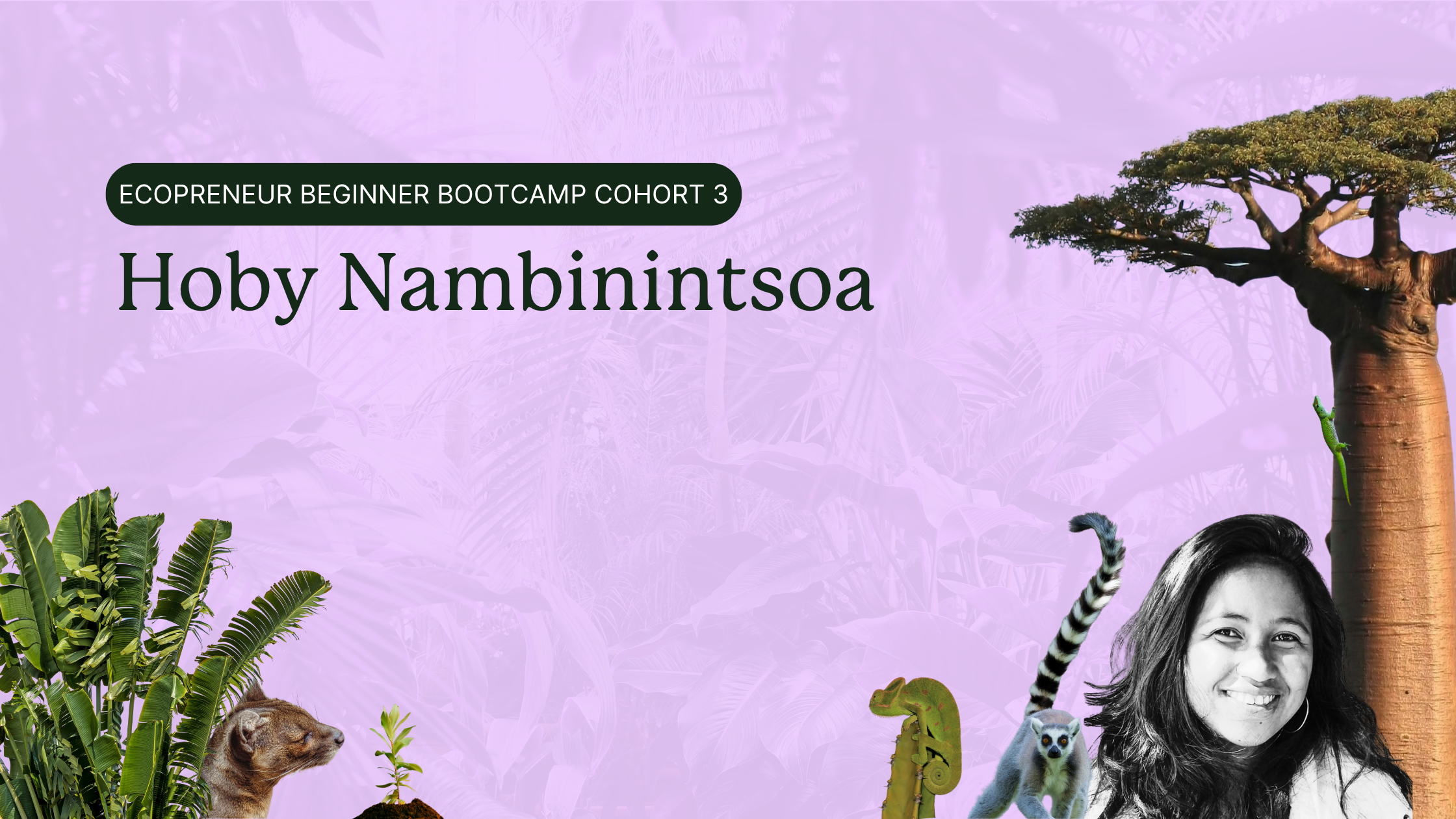
Hoby came in wanting to re-green her city, Antananarivo, with native trees.
8 weeks later, the plan has a name, Mandrary Project, and a first site. 🌴
The gap she is closing is easy to picture: you think of Madagascar as lemurs and baobabs, then you land in Antananarivo, and that picture disappears into traffic and pollution.
She wants to bring the city back to nature, and nature back into the city.
The first initiative is Merikanjaka, a forest fragment 4 hours from the capital that is still better preserved than most.
In April 2026, she made her first field visit and mapped part of its plant life with the local community because, in her words, “we wanted to conserve what remained first.”
To finish the picture, she needs a second visit for the rest of the flora and all the fauna, then a management plan and legal protection so the forest stays standing. She aims to have the site active by June 2027. 🦎
She is looking for funding to get there, and for partners who care about biodiversity you cannot find anywhere else on Earth.
Citros Chipetah | 🇲🇼 Lilongwe, Malawi
Citros starts with a question: “What if a part of Malawi’s fertiliser problem is already lying in our fields?”
His day-one idea was a biochar composting system. 🌾
It now has a name, Farm Future, and a business around it. He turns agricultural waste into soil-health products using biochar and composting, works with farmers through training and demonstrations, and measures what actually happens in the field.
The problem is brutal in numbers: a 50kg bag of fertiliser costs $111, and government subsidies reach fewer than three-quarters of farmers. The rest are left with thinning soil and worsening weather.
The science already works on his demonstration farm. The hard part is turning it into a system that keeps feeding farmers and soil long after the first funding runs out. His closing line: “let us turn agricultural waste into wealth.”
He is raising $40,000 for that, plus farmer networks and technical and distribution partners.
Patricia Fernández Cañas | 🇦🇷 Buenos Aires, Argentina
Patricia’s idea was a circular-economy food NGO. Now, she presents us with the Circular Food Recovery Alliance (CFRA), and the method behind it.
During the 2020 pandemic, she and another food technologist turned rejected egg yolks and unsold fruit into Nutal, a high-protein product for people facing malnutrition. 🍎
That is where she learned to see food waste differently: “we recover food, we recover resources, we recover value.”
CFRA now runs a six-step protocol across producers, wholesale markets, and restaurants. It spots surplus, preserves its quality, redistributes what it can, and turns the rest into new products, biofertiliser, or energy.
Every step is measured, because circularity only holds up when it also makes business sense.
She is seeking $15,000 to run a first pilot with real food-chain partners and prove the numbers.
Eniola Omotoye | 🇳🇬 Epe, Lagos, Nigeria
Eniola came in with a community-owned cold storage idea for fishing towns. Eight weeks later, it is Ipàmo, with a name, a model, and a clear first step.
In Epe, a fishing town that has had no grid power for about a year, fishers keep their catch in ice blocks and rusted, broken freezers. 🐟
Every spoiled fish costs income, and lost income pushes them back out to fish harder, including the small fish meant to grow and refill the lagoon. Eniola is wondering: “what if reliable cooling could become community infrastructure?“
Her answer is Ipàmo, solar-powered cooling huts built for the reality of Epe, where the model is catch, store, hold, sell. Reliable power, with no falling back on a generator.
She is raising $20,000 for the first hub and looking for technical partners and business advisors to build it to last.
Daniela Congote | 🇨🇴 Medellín, Colombia
Daniela’s idea was an NGO to reconnect people with nature through spirituality and ancestral knowledge. Discover Yarumo Verde, a flagship experience.
She starts with the Amazon: “the Amazon is more of a living garden than a pristine wilderness.” Her thesis is that when deep inner exploration meets regenerative tourism, people change how they live. 🌴
The flagship is Returning to the Whole, a 10-day journey from the Andes to the Gulf of Tribugá, one of the most biodiverse corners of the planet, guided by breathwork, whale song, mangroves, and community wisdom.
Since 2018 she has reached more than 250 people across rural Colombia, and now she is building it into something that can sustain itself instead of chasing the next grant.
She is opening the waitlist for the founding journey in September 2027.
Christine van Leeuwenstijn-Sponholz | 🇳🇱 Wijhe, Netherlands
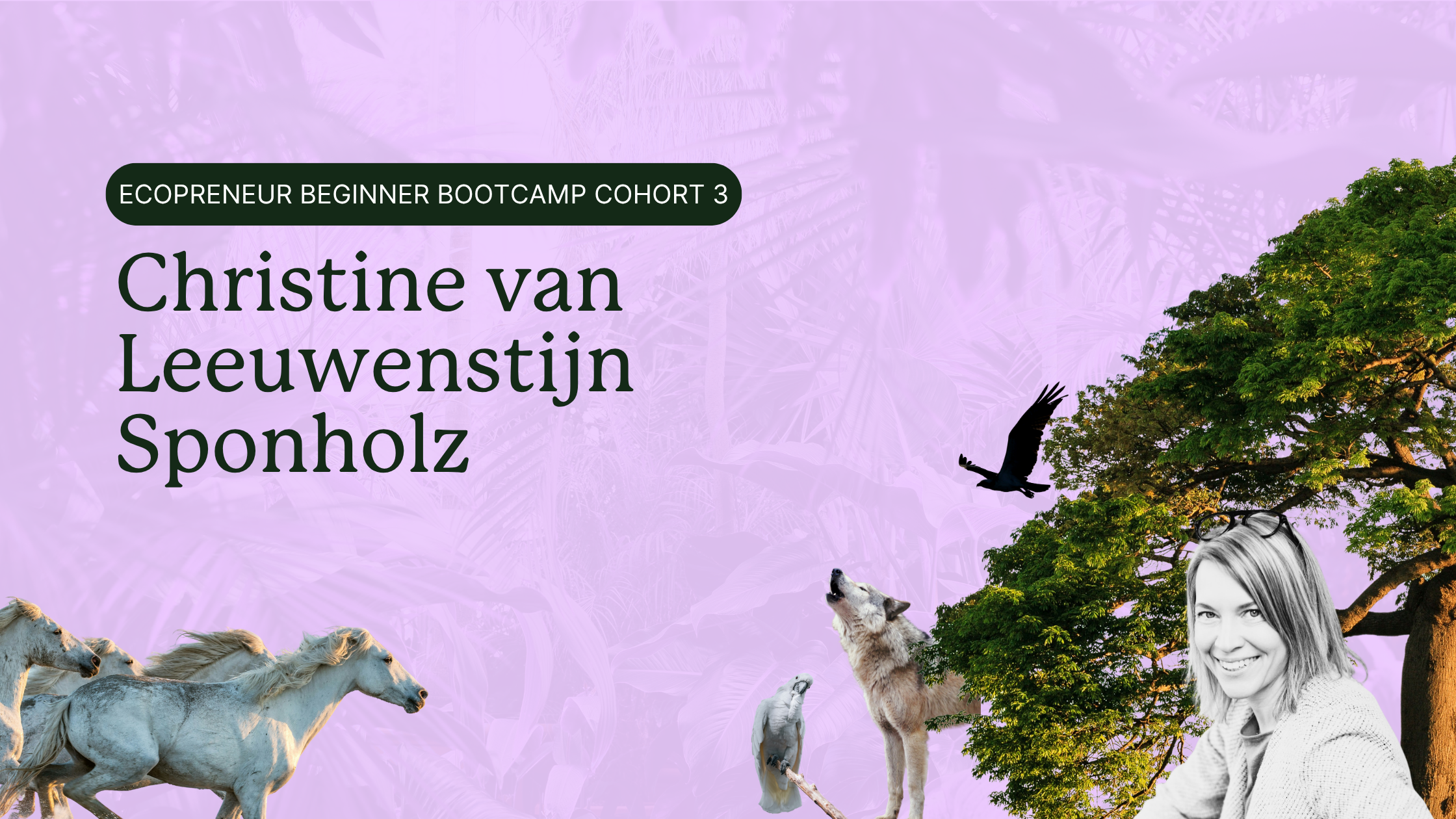
Christine spent 20 years as a translator. When AI came for her profession, she asked a different question: what if the translation the world needs most is between humans and other species?
Her venture is Wild Allies. She starts from a hard question, why we keep destroying what we love, and answers it in one line: “Connection is the missing ingredient if we want to start acting differently.”
We try to solve nature with our heads, she argues, when what we have lost is the feeling of being part of it. 🦆
Wild Allies runs tailor-made workshops for individuals and teams, where people relearn how to tune in and have a real experience of connecting with an animal or species they love.
She calls intuition the original language, the one we all spoke before words.
She is looking for people and teams who want to try it. Send her a DM to join or host a workshop.
In 8 weeks, these 9 participants built something real
When Cohort 3 started, we promised a second article showing what each of them built. This is it.
Some ideas pivoted. Some found their name. All of them moved from “I want to do this” to a real venture with a real ask. 🐾
Every one of these ventures is a bet on the same thing: that nature can still recover, and recover faster, when the people closest to it decide to build for it.
That is the whole point of the bootcamp, and it is what we are most proud to be part of.
If one of these ventures is in your orbit, whether as a funder, a collaborator, a first customer, or someone who knows the right person, reach out to them.
The start is the hardest part, and you can shorten it for them.
What you should do next
- Among these 9 participants, 8 got this chance thanks to our scholarship program. Spots fully funded by a handful of sponsors, and over 130 people applied for them. For every person who gets in, dozens do not. Each spot costs 747€ and gives a nature founder in the Global South the structure, support, and network to turn a wild idea into something real. To fund a spot for the next Cohort, reach out to Oliver.
- If you are based in the Global South and a paid spot is out of reach, the scholarship exists for exactly this. Every cohort, we have a limited number of fully funded spots for people ready to build something for nature. Apply for a scholarship now and tell us about your wild idea.