

Key takeaways
- Only 1% of LinkedIn users post at least once a week. Showing up already puts you ahead of 99% of your network.
- The hook is everything. If your first line doesn’t stop someone mid-scroll, the rest doesn’t get read.
- Posts that make people feel something get shared. Posts that just inform get liked and forgotten.
Knowing how to write a good LinkedIn post about nature is one of the most underrated skills in the ecopreneur world.
The stories are there. Worth telling. A coral reef coming back against the odds. A woman flipping 50 million tiles across Dutch cities to bring back urban wildlife. 🪸
But most LinkedIn profiles in the nature space are either quiet or sound like an annual report nobody asked for.
You are about to change that.
Everything here is built on LinkedIn post best practices from real posts by Oliver Dauert, founder of Wildya and one of the most followed voices in the ecopreneur space with 46,000+ followers on LinkedIn.
Whether you are a founder, a field scientist, a campaigner, a freelance consultant, or someone who recently quit their corporate job to restore peatlands full time. A good LinkedIn post can really change the trajectory of your mission.
Why LinkedIn is worth your time as an ecopreneur
One number worth sitting with: only 1% of LinkedIn users post at least once a week.
One percent. On a platform with over a billion members.
The other 99% are scrolling, reading, occasionally reacting, but publishing nothing. The moment you start showing up with real content, you are already one of the few voices your network actually sees.
For anyone working in nature, that visibility gap matters more than it seems.
Biodiversity loss does not make the front page every day. Most people in your network have no idea what a peatland does, why wolves belong in European forests, or how ocean dead zones form. 🐺
Your posts change that, one scroll at a time.
LinkedIn is also where decisions get made. Funders use it. Journalists find sources on it. Future collaborators, co-founders, team members, and donors scroll it every morning over their coffee.
A well-written post about a bachelor parrot increasing populations, or a community flipping tiles in Dutch gardens, can reach people who would never find your website, open your newsletter or show up to your event. 🦜
For nature ventures specifically, attention is not a nice-to-have. A good LinkedIn post is what turns good projects into funded, supported, shared, and scaled work.
How to write a good LinkedIn post: 2 examples broken down
Before learning step by step how to write a good LinkedIn post, let’s look at two posts from Oliver that worked. Pull them apart and see exactly why.
Example 1: the tiles post
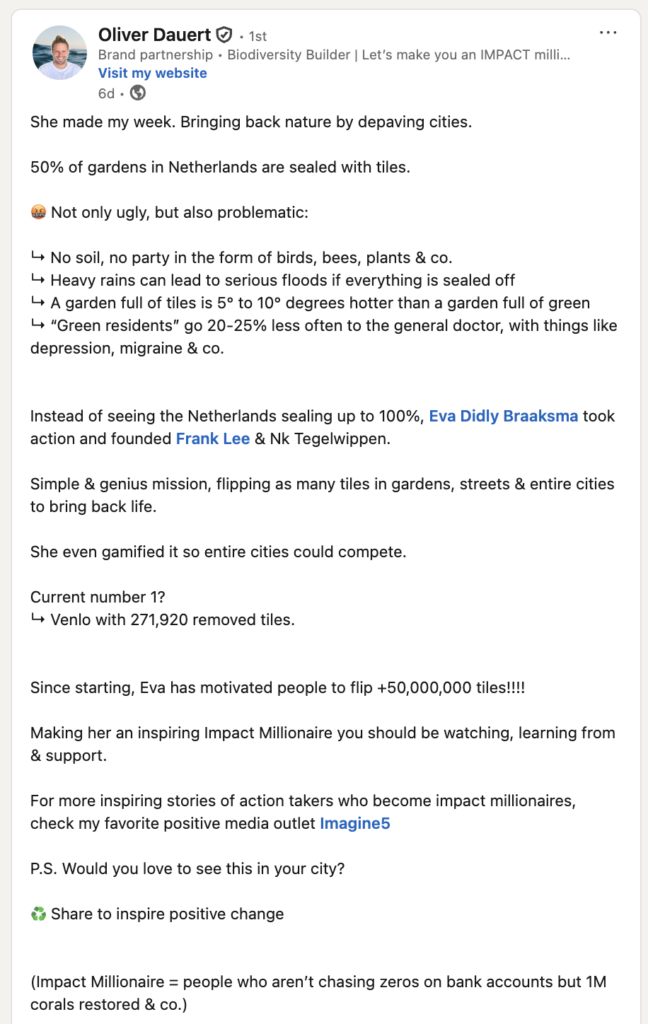
The hook: “She made my week. Bringing back nature by depaving cities.”
You know there’s a person, a mission, but not who she is, what she built, or how she did it. That gap between what you know and what you want to know pulls you straight to the next line.
The problem section: Four bullet points, each tangible and surprising.
“A garden full of tiles is 5° to 10° degrees hotter than a garden full of green”.
“Green residents go 20-25% less often to the general doctor”.
These are facts the reader did not know, delivered in seconds. Easy to remember.
The turn: One person, one mission, two sentences.
Then the gamification detail lands: cities competing to flip tiles. Almost funny.
Then 50 million tiles, a number so large it reads like a typo. That moment of “wait, really?” is exactly what makes people share. 🤨
The writing itself: Short sentences. Short paragraphs. No jargon, no institutional voice.
It reads like someone telling you something exciting over a terrible airport coffee. ☕️
People on LinkedIn have between 2.8 and 8 seconds to decide if something is worth reading. This post earns those seconds without asking for any effort.
The close: “Would you love to see this in your city?”
Anyone can answer that. Zero effort to comment, high chance of a response. 💬
Example 2: the Kākāpō post
A completely different animal from the tiles post, in every sense.
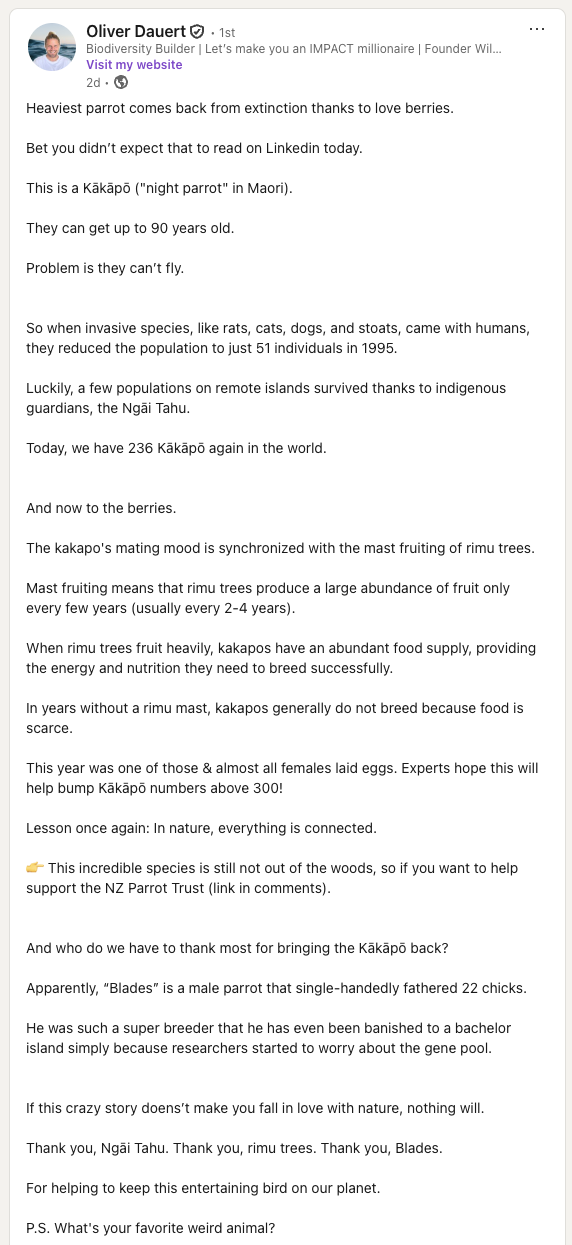
The hook: “Heaviest parrot comes back from extinction thanks to love berries.”
Absurd. Funny. Specific. You don’t know what love berries are or what they have to do with a parrot. You have to keep reading. 🫐
Then Oliver immediately winks at you: “Bet you didn’t expect that to read on LinkedIn today.”
That self-awareness makes you feel like a person is talking to you.
The facts: 51 individual Kākāpō left alive in 1995. 236 today. The masting cycle of rimu trees explained in three short paragraphs. 🦜
Each fact is surprising and builds on the last. You are learning something without feeling like you are being taught.
The turn: Blades. The bachelor male parrot.
That detail is so specific and so absurd it almost reads like a joke. It is not. And that gap between “this can’t be real” and “this is completely real” is exactly what makes people share.
The close: “Thank you, Ngāi Tahu. Thank you, rimu trees. Thank you, Blades.” Warm, specific, and a little funny.
Then a genuine question: “What’s your favourite weird animal?”. Low barrier, perfectly matched to the mood. 🐌
Short paragraphs throughout. Real names. Real numbers. A human voice from the first line to the last.
Two posts, completely different in length, format, and subject. Both follow the same LinkedIn post best practices.
Knowing how to write a good LinkedIn post is less about picking the right format and more about applying the same handful of principles every single time.
And it doesn’t always need to be long. The deer post from Oliver proves that. Two sentences, one perspective shift, 3 actions and a question. Just as powerful. 🦌
LinkedIn post best practices for ecopreneurs
Here is how to write a good LinkedIn post, step by step. Field notes from posts that worked, distilled into things you can do today.
Pick one clear idea
Look at the tiles post. It touches on heat, flooding, mental health, urban planning, and biodiversity. But it never loses sight of Eva and her mission.
Everything orbits one story. That focus is what makes the whole thing land.
Before writing anything, finish this sentence: this post is about ___.
If you need more than ten words to fill it in, you have more than one idea. Save the rest for next week.
A lion doesn’t chase two zebras at once. Pick one zebra. One idea. 🦁🦓
Write a hook that stops the scroll
Remember those 2.8 to 8 seconds. They are all riding on the first line. People decide in a second whether your post is worth reading.
Your first line is the only one that matters, until it earns the second. Miss it and your reader has already moved on to something else, probably a video of a cat. 🐈
The tiles post opens with “She made my week. Bringing back nature by depaving cities.” It touches on curiosity because people don’t understand it fully. They want to know more. They click on “…more”.
Don’t reveal anything in the first line. Be mysterious. Or quirky like “Heaviest parrot comes back from extinction thanks to love berries.”
Each one makes people stop and think “wait, what?” before they have read a single fact. That’s what you’re looking for when writing a good LinkedIn post.
How to write a good LinkedIn post body
Once your hook has earned attention, the body has one job: keep it.
Short paragraphs with white space between them, so skimmers can follow the thread without reading every word.
Look at both posts above. Neither has a paragraph longer than three lines.
Use arrows (↳), emoticons, or simple line breaks to make lists scannable. Vary your sentence length. A short punch after a longer sentence lands harder because of the contrast.
Read your draft out loud before publishing. If you run out of breath, the sentence is too long. If it sounds like an internal memo, start over.
The body is also where your emotional arc lives.
Build an emotional arc
This is the difference between a post people like and one they send to three colleagues at 11pm.
Your post needs to take the readers somewhere. They should feel something different at the end than they did at the start.
👩🏻🦰 The tiles post moves from frustration (tiled gardens quietly suffocating urban wildlife) through surprise (one woman with a beautifully absurd mission) to joy (50 million tiles flipped, Venlo winning a city-wide tiles competition).
Something shifts between the first line and the last.
🦜 The Kākāpō post does it differently. It opens with absurdity and warmth, moves through genuine surprise (a parrot mating cycle tied to berry seasons), and lands on gratitude. “Thank you, Ngāi Tahu. Thank you, rimu trees. Thank you, Blades.” You smile at the end.
Ask yourself when writing your LInkedIn post: Where does this post start emotionally, and where does it end?
If the answer is the same place, keep writing.
Back your point with personal stories and numbers
Adjectives prove nothing. “Devastating decline.” “Incredible impact.” “Remarkable recovery.” These words are wallpaper. They cover the wall without telling you anything about the room.
Numbers do the job instead. 💯
271,920 tiles removed in Venlo. 51 individual Kākāpō left alive in 1995. Your reader can picture 51 birds. A “dramatic population decline” gives them nothing to hold onto.
Personal stories work just as well. 📖
Oliver opening his shark post with “During my parental leave, I had time to watch one of my all-time favourite movies” is not a fact or an argument. It is a moment.
You picture him on the sofa with a baby asleep on his chest. You are already with him before the conservation data even starts. 👨🍼
Use both. A number anchors the claim. A personal moment makes the reader feel it.
Write like a person, not a brand
Read your post out loud before you publish. If it sounds like something a communications team approved at a Tuesday morning meeting, rewrite it.
Oliver writes “Oh boy“. Or “Thank you, Blades” to a parrot that fathered 22 chicks before getting banished to a bachelor island for disrupting the gene pool. 🐥
He says “Bet you didn’t expect that to read on LinkedIn today.” Those moments of personality are not unprofessional. They are the reason 46,000 people follow him.
A press release has never once made anyone feel something.
You are not a logo. You are a person who cares about something deeply and has stories to prove it. Write like that person.
This is even more important when talking about nature. For people to care about it, they need to connect with it. If your LinkedIn post is impersonal, you already lost.
End with a call to action
Every post needs a close. Not always a link, but always somewhere for the reader to go with what they just felt.
The most effective close for driving engagement is a curiosity question. Simple, low barrier, matched to the mood you built.
Posts that consistently drive real comment sections end with a genuine question.
“Would you love to see this in your city?”
“What do you think ? Do we need more roads or forests?” 🌳
A question turns a monologue into a conversation, and a conversation keeps your post alive in the algorithm long after you hit publish.
A proper action prompt works too. When the post has built enough emotional momentum, the reader is ready to move. They have just learned something, felt something, or had their mind shifted. They’re ready to take action.
“Support the NZ Parrot Trust.”
When that action involves a link, put it in the first comment and mention it at the end of the post. LinkedIn reduces the reach of posts with external links in the body text because the algorithm does not like sending people off the platform.
Oliver ends every high-performing post with a question, an action, or both. His comment sections run for days after he publishes. That does not happen by accident.
Feeling unsure about your LinkedIn post? Want Oliver’s eyes on it before publishing? Wildly possible. 🦡
Send him a message on LinkedIn!
The mistakes that kill LinkedIn posts

You can apply the LinkedIn post best practices, know how to write a good LinkedIn post, and still publish something flat. Usually because of one of these mistakes.
Opening with context instead of a hook.
LinkedIn is made fun of with its usual “I’m proud to announce…” and for good reason.
Or “As someone who has spent years working in the field, I wanted to share..” Nobody reads past “I wanted to share.” Start with something off and lead the context later.
Posting walls of text.
The focus span on LinkedIn, or any other social media is very limited.
A big block of text answers the “is this worth reading?” question very fast.
Break it up. Give the eyes somewhere to land before the brain decides to leave.
Being vague where you could be specific.
“51 Kākāpō left alive in 1995” is something your reader mentions at dinner. “Many species are in decline” is something they scroll past without registering.
Real names and real numbers stick. Adjectives evaporate.
Writing only for people who already agree with you.
If every post assumes the reader already knows what rewilding means, what a peatland does, or why keystone species matter, you are writing for the 1% who are already convinced.
Write for the 99% who don’t know yet. They are the ones who share things and bring in new people.
Ending with nothing.
No question, no prompt, no action. The post just stops.
You did all the work of building something worth reading and then left the reader standing in the hallway with nowhere to go.
Tagging people who have nothing to do with the post.
If tagged people do not engage, LinkedIn reads that as a signal and reduces your reach. Only tag when it is genuinely relevant.
Posting once and disappearing for months.
One post does not build an audience. It brings curiosity, yes. But consistency builds a community.
Once every three months is a ghost story. Once a week is enough to stay visible (and puts you above the 99% who don’t).
No time to fix all this yourself? Oliver dedicates one day a week to your venture.
Content strategy, personal branding… One full day a week, on your mission.
Biodiversity needs a voice. Start posting now.
Knowing how to write a good LinkedIn post is not about marketing skill. It’s a bit of common sense, a topic worth telling, a weird way to bring it, and a human behind it.
The principles in this article are the same ones behind every post that stopped you mid-scroll and made you feel something.
Apply these LinkedIn post best practices one at a time. Start with the hook, then move on to the body, the emotion, and finally the close.
The people who could fund your work, join your mission, or simply learn why peatlands matter are on LinkedIn right now. You just need a good post to reach them.
And most importantly, don’t be afraid of trying! A post that goes out a little rough beats a polished one living forever in your drafts.
If you want more of this every week, join the 4,000+ ecopreneurs already receiving The Impact Millionaire newsletter, written by Oliver!
Tips, strategies, and real stories to help you start and scale your nature venture, whether it’s on LinkedIn or out in the real world.