

3 takeaways on preventing burnout
- Burnout progresses through 12 stages. Yet, it can go unnoticed until stage 9 or 10.
- Caring deeply about your mission is a strength. But when the mission becomes your only identity, any setback at work becomes a threat to yourself.
- When the stressor cannot be removed, the stress response still needs to go somewhere. There are mechanisms for preventing burnout from advancing.

This article is based on a live masterclass we hosted inside the Ecopreneur Community with Kasia Gajos, resilience coach and founder of Gajos Coaching and Training, who works with high achievers and purpose-driven founders on sustainable performance and burnout recovery.
Every Tuesday we bring in biodiversity heroes, nature founders, and field experts to share what they are building, the lessons they have learned, and real insights for starting or scaling a nature venture.
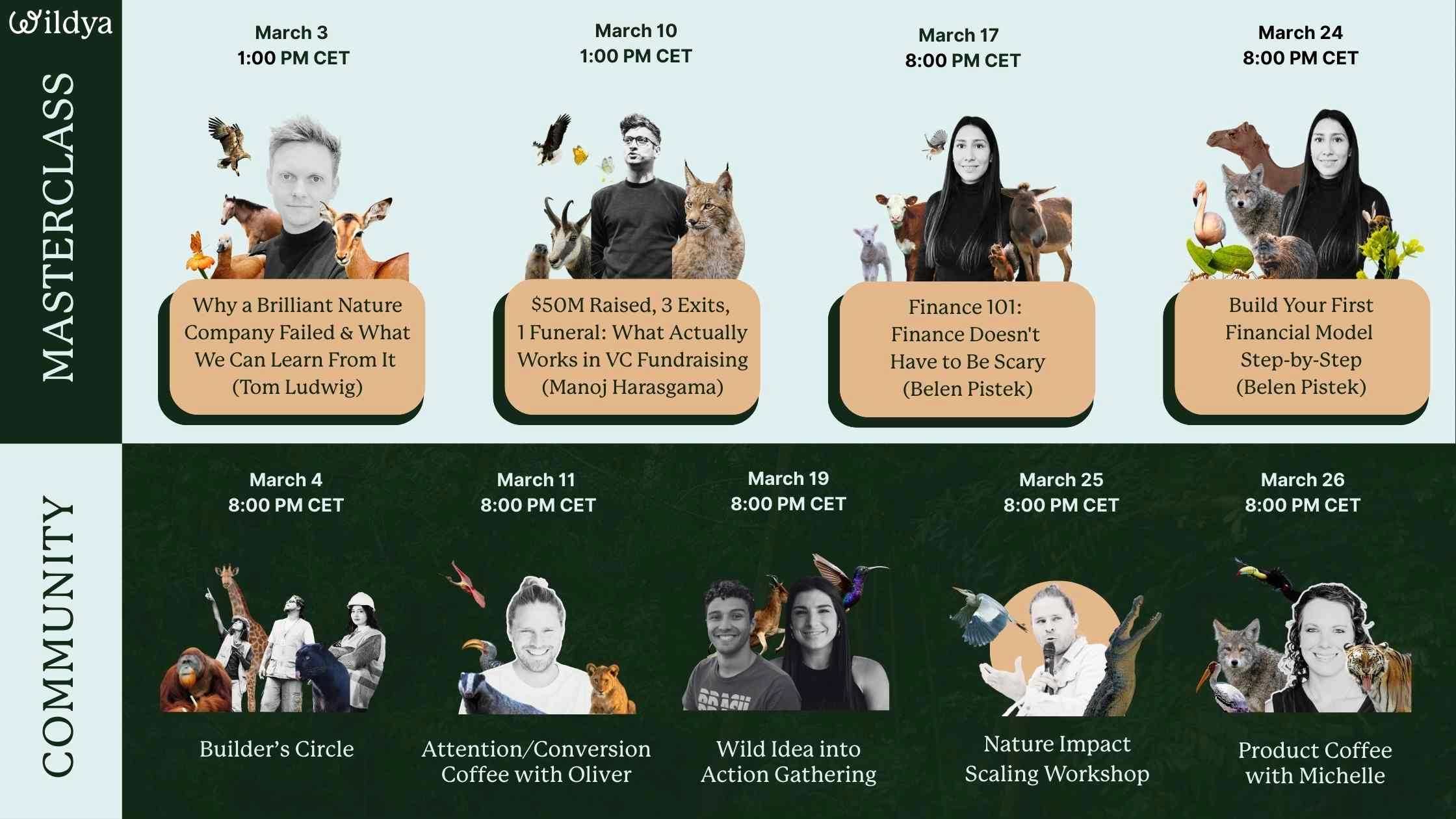
Check our masterclasses lineup and join our wild community!
The burnout nobody saw coming
In 2021, Kasia Gajos burned out herself. That same year her father died and her mother was diagnosed with fast-progressing Alzheimer’s.
She had spent years in management consulting and then as a senior director at a Telco, leading customer experience transformation, performing at the level that high achievers perform, right up until she couldn’t anymore.
That experience changed her path entirely.
She now runs Gajos Coaching and Training, helping founders and executives across 20+ countries build resilience before the body forces a shutdown.
She explains that most people do not recognise burnout until it is already well advanced. For purpose-driven people, it moves faster and hides better than almost anywhere else.
Why ecopreneurs are at higher risk
48% of the global workforce reports symptoms of severe burnout.
For younger, purpose-driven people, the number is worse: only 33% feel they can successfully switch off from work, compared to 46% of older generations.
If you are building a nature company or NGO, Kasia says you sit at a “particularly vulnerable intersection.”
You are likely both purpose-driven and a high achiever. That combination is the most deceptive path through burnout.
For mission-driven people, it starts with obsessive passion. You care deeply, you are all in, and that is a good thing. But then guilt creeps in. Resting starts to feel like abandoning the cause.
You carry the emotional weight of the problem you are trying to solve every single day: the species disappearing, the ecosystems degrading, the gap between what is and what could be. 🐘
That emotional weight depletes you faster than neutral work would.
And in later stages, something deeply uncomfortable happens: the species or communities you are working to protect stop feeling real. You start using flat, clinical language. Anything that drains the feeling out of the work.
63% of NGO workers who experience burnout say nothing about it. They are afraid it will harm the mission, or that others will see them as weak.
The ripple goes further than most people realise:
🧑🍼 Children of burned-out parents are 5 times more likely to develop depression or anxiety.
👩❤️👨 Partners are 3 times more likely to develop clinical anxiety.
🧎♀️➡️ Social isolation from burnout carries a cardiovascular risk equivalent to smoking 15 cigarettes a day.
Burnout is never only about the person burning out.
What burnout is and how it builds
Most people think they will recognise burnout when it comes. They will not. Here is what is actually happening, and how it progresses.
What is happening in your brain
Kasia used to dismiss breathing exercises.
“If you tell me to just breathe in and out, I will tell you where to go. But if I understand what is happening, I can work with it.”
The amygdala (your fight/flight/freeze response) processes incoming information before your prefrontal cortex (where reasoning and decision-making live) gets a chance to respond.
Under stress, the amygdala takes over fast. And the responses it triggers are based on patterns your brain encoded before you could even think critically about them.
That’s why sometimes you react in ways you later cannot explain.
The key distinction: stress and stressor are separate things.
“In the environment we evolved in, the moment you dealt with the stressor, you kind of dealt with the stress already.”
You ran from the predator and the response dissipated. But you cannot outrun financial difficulty. You cannot outrun a world not moving fast enough on biodiversity. 🐝
When the stressor does not disappear, the stress response has to be addressed on its own terms.
Deep breathing sends a signal to the amygdala: you must be safe. If you were being chased, you would not be breathing slowly. A physiological input changes the brain’s threat assessment.
The two types of burnout
Kasia describes it with two balloons.
🎈 One is overfull, stretched, one squeeze away from popping. This is burnout fuelled by anger and pressure, where everything feels like an assault.
🎈 The other is deflated. You try to inflate it, hold it, but the air keeps leaking out. At work, you seem fine. You are hitting your targets. But you come home and disappear into nothing. No energy, no presence, no tank left.
Kasia calls this “highly functioning burnout.”
Both are burnouts. One just looks a lot more like success.
She also uses a bathtub. In a healthy life, water pours in (stress, demands, responsibilities) and drains out (rest, recovery, connection, nature). At the end of the week, the tub empties.
But when the drain clogs, stress keeps pouring in and you start overflowing into your relationships, your body, your work.
During COVID, Kasia made this mistake herself. Her workload had not changed, so she assumed she was fine. What she missed was that all her recovery mechanisms had quietly disappeared: the one-on-one connections she needed, time in the mountains, time in nature.
The water was still coming in. The drain was blocked.
The 12 stages of burnout
Burnout does not arrive out of nowhere. It progresses.
Kasia maps it across 12 stages:
🐾 Stage 1: Compelled to prove yourself. High energy, driven, buzzing, but needing validation from others.
🐾 Stage 2: Working harder. You push more, and you cannot switch off at night.
🐾 Stage 3: Neglecting basic needs. Skipping meals, sleeping badly, forgetting things. It feels like a busy season.
🐾 Stage 4: Blaming others. People seem difficult today. It is them, not you.
🐾 Stage 5: Identity shift. The work or the mission becomes your only source of validation.
🐾 Stage 6: Bitterness. You feel misunderstood, like the world is out to get you.
🐾 Stage 7: Withdrawal. You pull back from social contact but still show up out of obligation.
🐾 Stage 8: Behavioural changes. Apathy creeps in, nothing matters anymore, vices pick up.
🐾 Stage 9: Robot mode. Empathy switches off. You run on autopilot.
🐾 Stage 10: Numbness. You become more vulnerable and feel less of everything.
🐾 Stage 11: Hopelessness. The wanting to give up sets in.
🐾 Stage 12: Collapse. The body forces the shutdown.
For high achievers, the first four stages feel completely normal. Output stays high all the way to stage 9 or 10 because they compensate with more effort.
The “drop in performance” that most burnout content describes does not apply here.
What starts appearing instead are unexplained physical symptoms. For Kasia, it was six months of headaches with no apparent cause.
A colleague was rushed to hospital with heart attack-like symptoms. Another had high blood pressure. None of them would have looked burned out from the outside.
When you’re building your nature venture, being alongside other ecopreneurs, with structure and support around you from the start, changes that dynamic.
Our Ecopreneur Beginner Bootcamp is built around that with a specific focus in week 2 on staying motivated, getting more done with limited time and resources, and avoiding burning yourself out before you even launch.
Four strategies for preventing burnout
Kasia chose these four strategies for preventing burnout specifically because you can start them without outside help, today, wherever you are in the 12 stages.
Preventing burnout with transition rituals
A physical routine that closes one context and opens another helps preventing burnout. This matters most when you work from home and there is no commute to act as a natural buffer.
Depending on how sensitive you are, the transition can take up to an hour. Closing your laptop is not always enough. Your brain needs time to actually move from one state to another.
Kasia’s own ritual evolved by accident: she started meeting her partner at the playground near their building after work. It became a non-negotiable half hour outside before going in.
One of her clients cleared her desk and put her laptop in a drawer at the end of each working day.
That was the signal. Find yours.
Choose low-stakes activities
Choose activities like gardening, baking, board games, dancing, walking with no phone. Things that require some effort but carry no performance pressure.
As burnout progresses, the pull toward passive recovery gets stronger: scrolling, drinking, Netflix.
These feel like rest but make apathy worse. They do not activate the default mode network, where real mental recovery happens and where your best ideas actually surface.
Define your vision first
This is the hardest strategy for preventing burnout and yet, the most important.
If what you do and who you are have become the same thing, any setback at work becomes a threat to yourself.
Separating those does not mean caring less. It means being able to deal with setbacks without your whole sense of self destabilising.
Kasia draws a distinction worth writing down:
🐣“I want to be a good parent” is an impossible standard.
🐣 But “I want to be as present a parent as possible” is different. It acknowledges constraints and focuses on what you can control.
The same logic applies to your nature venture.
Track your energy
Track your daily activities and what they do to your energy, before, during, and after.
Note what you procrastinate on, what you look forward to, how the time of day affects the same task.
Do this fourth, not first. Without a clear vision of how you want to live, you will end up optimising things that should not exist at all.
The vision is the filter. Once you have it, the energy audit shows you what to remove, what to protect, and where to put more of yourself.
Preventing burnout to keep helping biodiversity
Kasia ends with Lao Tzu: “Nature doesn’t hurry. Yet everything is accomplished.”
Going steady is how things get done. The bison do not get rewilded by someone at stage 11. The corals do not get restored by a founder running empty. 🪸
Preventing burnout is part of the mission, because the mission needs you in it for the long haul.
Mental health, resilience and sustainable performance are topics we come back to regularly inside our community. Because rewilding the planet is a long game, and the people doing that work deserve support for the full journey.
This article is based on a live Wildya masterclass with Kasia Gajos. The recording is available inside our Ecopreneur Community. We host a new masterclass every Tuesday with founders building in the nature space. Join us now.
Wildya March events