
3 things worth taking from this masterclass:
- Running on grants alone puts your survival in someone else’s hands. Build multiple revenue streams from the start.
- Get one paying client before you scale. Real money validates your business model faster than any plan on paper.
- Imposter syndrome doesn’t go away. You just decide not to let it drive.
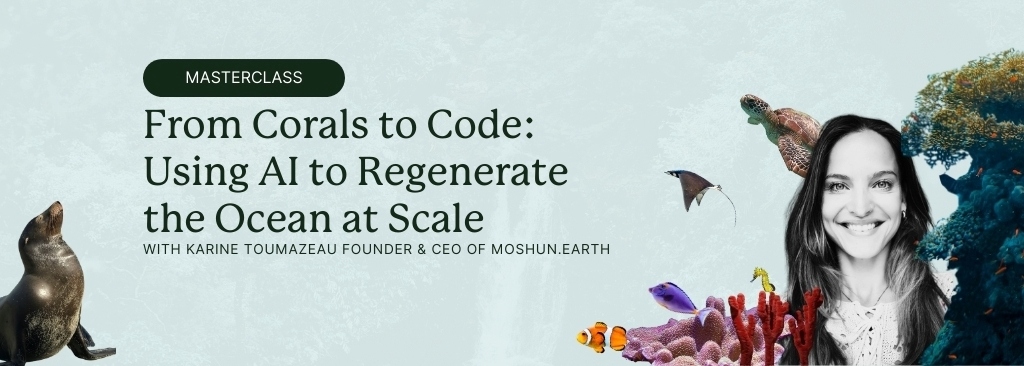
This article is based on a live masterclass we hosted inside the Ecopreneur Community with Karine Toumazeau, founder of Moshun. Moshun helps organisations keep the ocean blue by turning their marine footprint into measurable and profitable regeneration on the field.
Every Tuesday we bring in biodiversity heroes, nature founders, and field experts to share what they are building, the lessons they’ve learned, and real insights for starting or scaling a nature venture.
Check our masterclasses lineup and join our wild community (enjoy a 10-day free trial)!
When a corporate consultant becomes an ocean founder
Knowing how to start an ocean organisation rarely comes from a textbook.
Karine Toumazeau figured it out by selling everything, packing her life into a 12-kilogram backpack, and flying one way to Tahiti.
Before that, she was on track to become one of the youngest managing directors at a major consulting firm in Toronto. She had the salary and the status that were supposed to mean she had made it.
But month after month, she felt more disconnected from who she actually was. She was playing a character, doing the job brilliantly, but not for herself.
“I was literally the actress of my life. I was performing every single day going into the office. I was really good at my job, but I was performing.”
She got a promotion, but a few days later she took a leave of absence. Then she sold everything, flew to Vancouver, crossed the Pacific, and landed in Tahiti during rainy season.
She met Coral Gardeners almost by accident, covered in mud. By that same evening she and founder Titoan were laying out the contours of a collaboration.
By the next morning they were redesigning the organisation’s entire five-year plan.
How Karine learned to start an ocean organisation at Coral Gardeners
Coral Gardeners was Karine’s first real school in how to start an ocean organisation. What she found was a group of passionate people with no systems, no business model, and a constant anxiety about money.
Break the NGO mindset first
The first thing Karine did at Coral Gardeners was challenge the way the organisation thought about itself.
“If he wanted to reach the dream he had in his mind, he had to shift his mindset. He was not actually running a traditional NGO. Because with that mindset you tend to have a scarcity mindset. It’s like we don’t have money, or we need to beg for money constantly.”
So they rebuilt Coral Gardeners as a nature venture. They looked at what organisations like Patagonia were doing and applied those principles to reef restoration.
The shift was about funding it properly.
Start with what you have and crack the business model early
Titoan had no business background. What he had was a brilliant creative mind and an existing social media presence. So that is where they started.
Karine prepared hand-drawn cards for him, each one laying out what it would take to move to the next stage of reef restoration.
Do you have a marine biologist? The equipment for a baseline assessment of the reef? A network that could help?
“We built the foundations. We looked at all the things that they were doing very well that we could basically transform into assets that we could sell.”
The coral adoption program and brand relationships were the first blocks. And alongside those foundations, they worked on how to fund it all without depending on grants.
“One thing that we cracked very early on is the business model. We were able to define multiple business models. We distanced ourselves from the grant-based model.”
At a time when grants are being pulled, overapplied for, and cut without warning, this is not optional. The nature ventures still running today built their own revenue. The ones that didn’t are closing quietly.
How Karine built Moshun
The first three months of Moshun were the last three months of Karine’s pregnancy. She was working against two clocks at once.
They were two people: Karine handled the business model, value proposition, and vision. Her friend Bri handled branding, copywriting, and the website.
The entire plan for Moshun, its structure, revenue model, and five-to-ten-year vision, was sketched across three pieces of paper taped together.
She incorporated Moshun in June. She gave birth on July 5th. At 11am that morning she was on a call with a client in Madagascar. Labour started one hour later. She gave birth at 8pm. One week after that, Moshun officially launched.
She asked Bri to keep things moving while she was in hospital: “Hold the fort for me. Just make it look like we’re out there and we’re doing something.”
Very few people knew she was pregnant at all.
Get one paying client first, then scale
Before the launch, Karine had been chasing one lead hard: Hermès, for a marine biodiversity footprint assessment of their maritime shipping operations. She had nothing except the vision and the pitch.
That contract closed five months after she gave birth.
“I wanted to go out there and at least have even one client that I could test my business model with.”
One client to validate the model. That was the goal from the start.
Don’t pursue passion without evidence of a market
Moshun itself pivoted. The original version was about inspiring behaviour change. It wasn’t working as a business. The pivot toward AI and quantifying financial impact was how the mission got funded.
“Never pursue something you’re deeply passionate about if you have evidence there’s no traction or no market for it. Because that could be a dead end very quickly.”
“Try to translate those skills that you have into a real tangible market need, and I think you’ll go a long way if you master that.”
You’re feeling inspired by Karine and you want to start a nature NGO or ocean organisation ? But not sure how to structure it? We covered the full process.
The hardest part of building an ocean organisation: selling to corporates
Selling ocean restoration to large organisations is slow. Most corporations don’t yet see the value of understanding how their supply chain impacts the ocean, unless they are already directly exposed. Sales cycles are long.
The invisible bill
Moshun’s answer to this challenge is a concept Karine calls the “invisible bill”.
“We actually show them what they’re missing. There’s these big talks about we need to put nature back into the balance sheet. It’s always super abstract. Well, if we can quantify what that means at the level of your business, then you will start paying attention because every discussion is a money discussion.”
The companies that understand this the fastest are the ones already materially exposed: fisheries, maritime shipping, and offshore energy developers.
For everyone else, the invisible bill is how you make the abstract concrete.
Bringing the ocean to market as an investable asset
To take this further, Moshun is building one of the first tools to quantify the investment readiness of ocean restoration solutions.
It calculates return on impact alongside return on investment, and presents the ocean as something a corporate can actually put on a balance sheet.
Global insurers, big energy companies, and maritime transport companies are already in conversation. The market is early and the sales cycles are long.
Karine is building it anyway, knowing that being an early mover is both a risk and an advantage.
You want to start your own ocean venture, but don’t know where to start? Build it with us during our Ecopreneur Beginner Bootcamp!
What Moshun needs right now
Moshun is bootstrapped and entering pre-seed fundraising.
You can help with:
✅ Introductions to investors and business angels,
✅ Warm connections to C-suite contacts at companies in maritime, fisheries, luxury supply chain, or offshore energy,
✅ And LinkedIn engagement to help get their content seen.
One warm introduction can open a door that months of cold outreach never will. If you know someone who might be relevant, reach out to Karine on LinkedIn or visit moshun.earth.
What Karine’s story teaches us about starting an ocean organisation
Starting an ocean organisation does not require a science degree, a full team, or a perfect plan. Karine had a business brain, a friend with design skills, three pieces of paper taped together, and a baby on the way.
She tested her idea with a real client before scaling. She built a business model that didn’t depend on grants. She kept going when the market didn’t immediately understand what she was building.
She defines herself as “a brilliant imposter with a delusional belief in my vision.” Looking at what she built, that sounds about right.
The ocean space needs more people willing to do exactly that.
This article is based on a live Wildya masterclass with Karine Toumazeau. The recording is available inside our Ecopreneur Community! We host a new masterclass every Tuesday with founders building in the nature space. Join the community now to attend more masterclasses.
March events