
Three takeaways from Douglas Eriksen’s masterclass
- Conservation and zoos are more connected than most people realise. Accredited facilities collectively fund hundreds of active field projects worldwide, yet that work rarely reaches the public.
- AI models tested across 21,000 species in 2024 scored just 27% on conservation reasoning. The systems being trained now will shape ecological decisions for the next 50 years.
- Tourism revenue alone left zoological facilities dangerously exposed. Douglas Eriksen built a model where data, research, and education carry the weight instead.
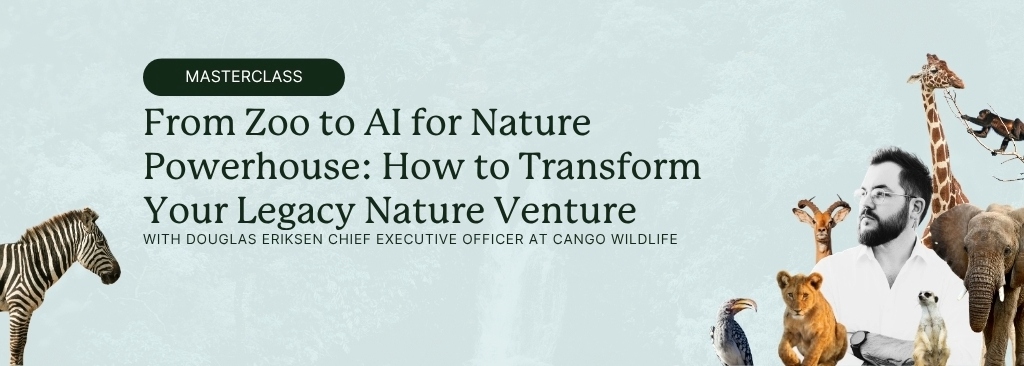
This article is based on a live masterclass we hosted inside the Ecopreneur Community with Douglas Eriksen, second-generation conservationist and CEO of Cango Wildlife, a zoological facility in the arid interior of South Africa that he describes as “a live laboratory for the modern zoological institution.”
Every Tuesday we bring in biodiversity heroes, nature founders, and field experts to share what they are building, the lessons they’ve learned, and real insights for starting or scaling a nature venture.
Check our masterclasses lineup and join our wild community!
Who is Douglas Eriksen and what did he build at Cango Wildlife
Douglas grew up on the grounds of Cango Wildlife, a facility his parents bought in 1986 in South Africa’s arid interior, about four hours north of Cape Town. He never planned to run it.
He spent years in music, then moved through law and finance before a decade in tech across AI, blockchain, and startup investor relations.
Then his father passed away. COVID had gutted tourism. A flood followed in 2024. Cango Wildlife ran almost entirely on visitor revenue, and visitors had stopped coming. Douglas stepped in.
Five years later, he had won a startup innovation award at the World Economic Forum in Davos, launched Project ZOA, and was building what he calls a global biodiversity data infrastructure for the AI era.
The story of conservation and zoos that this masterclass tells starts here, with someone who asked “what infrastructure does the future actually need?“
Why the zoo debate is stuck
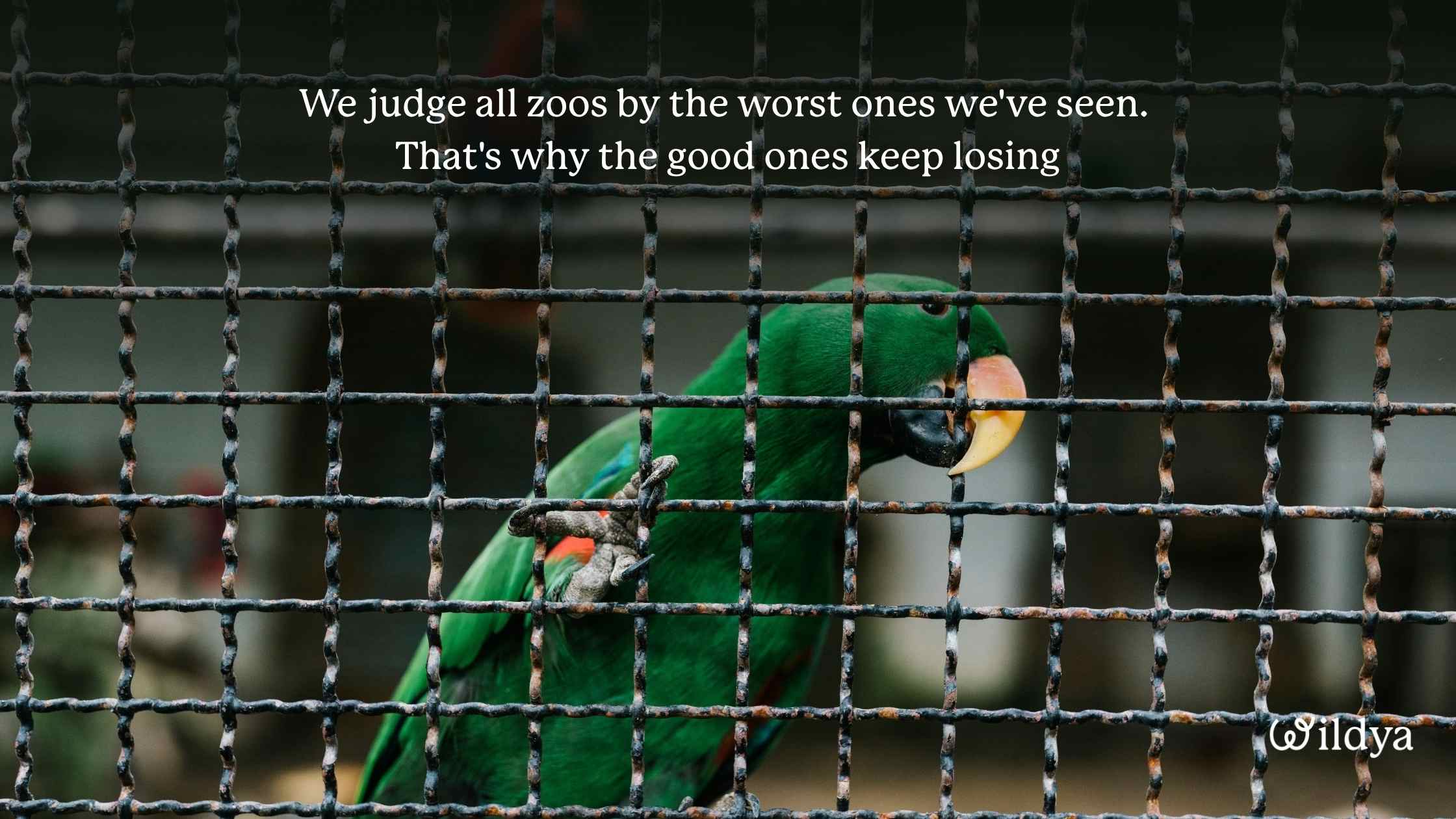
Zoos have a reputation problem that goes back thousands of years, literally.
The earliest recorded collections date to around 3,500 BC: animals as trophies, status symbols for royalty and diplomats. The first public zoo opened in London in the 1800s, officially for scientific study. The spectacle element was obvious to anyone who visited.
That history left a mark.
What changed, largely unnoticed, came in 1981. Conservation became the primary mandate for accredited zoological facilities, alongside the launch of the Species Survival Plan.
WAZA, the World Association of Zoos and Aquariums, was founded in 1935 and now includes around 500 member institutions.
Being accredited means a facility has been independently reviewed and verified against WAZA’s global standards: animal welfare, enclosure design, conservation programs, research output, all checked.
Not every zoo is part of WAZA, or any organisation at all. Standards vary wildly. The facilities with no oversight and the ones doing world-class conservation work get judged by the same name, which is a bit like rating every restaurant by the one that gave you food poisoning.
Douglas is direct about why the conversation stays stuck: “Accreditation matters. It matters when the public is choosing where to go. What is the actual conservation impact these zoos and aquariums have? These are actually recorded. They are displayed, and they are validated through these different organisations.“
Most people don’t think to check. That gap is why the debate around conservation and zoos keeps going in circles.
Cango Wildlife is one of only three WAZA-accredited facilities in South Africa, a status it has held for 25 years.
What accredited zoos are actually doing
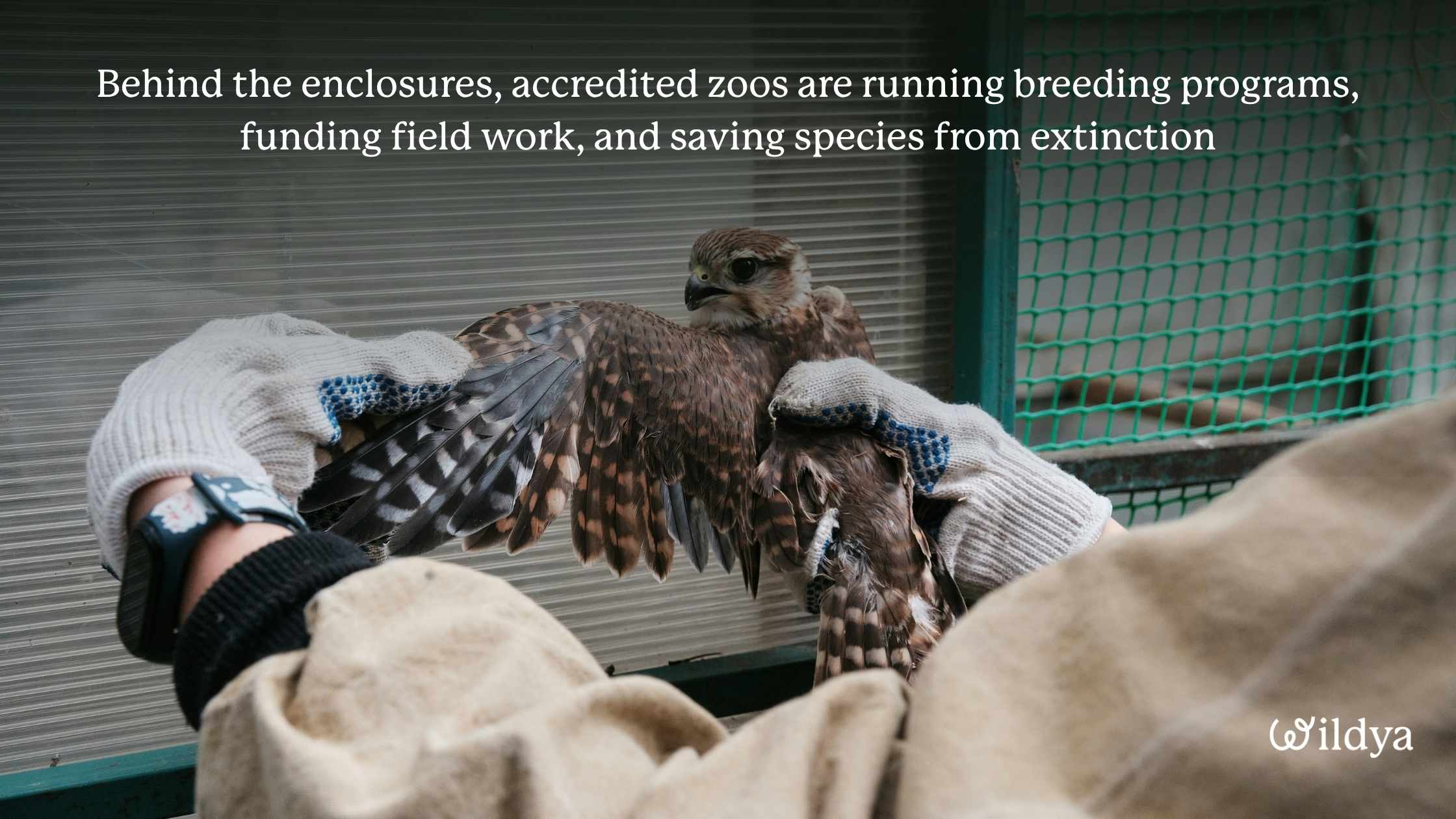
The public-facing side of a zoo, the enclosures, the signage, the school trip, is a fraction of what actually happens inside an accredited institution.
The fieldwork, breeding programs, and research partnerships run mostly in the background. This is what conservation and zoos actually look like from the inside.
Species rescued: what captive breeding has done
San Diego Zoo Wildlife Alliance runs the world’s largest biobank: genetic material from over 10,000 individuals across 1,100 species.
A biological insurance policy for species on the edge of extinction. If habitat can eventually be restored, the genetic material to reintroduce a species still exists.
That insurance has already paid out. The Arabian oryx, the California condor, the black-footed ferret. All saved through captive breeding programs run by zoological facilities. 🦅
Cango Wildlife currently cares for 90 species, many of them endangered due to habitat loss and poaching.
Its mission has three parts: conserve, care, connect. Intervene where intervention is needed, hold the highest standard of animal welfare, and share 40 years of expertise back out to other facilities, researchers, and communities.
Douglas is clear that captivity is not the ideal outcome for any wild animal. But for species whose habitats are already gone and whose populations have already collapsed, intervention is sometimes the only option left.
“Think of it like an orphanage for some of these animals,” he said. “They don’t have a home to go to. They don’t have families. They will die in the wild if they’re not intervened with.“
Field conservation and zoos: what the funding looks like
WAZA members collectively fund around 400 active field projects worldwide. Chester Zoo alone operates across 35 countries and contributes close to 50 million euros a year to fieldwork and conservation.
Frankfurt Zoological Society has been funding anti-poaching, community development, and ecological monitoring across 1.5 million hectares of the Serengeti-Mara ecosystem since 1959. Over 60 years of sustained field work, run by an institution most people would describe simply as “a zoo.”
Cango Wildlife sits in this same network. Its mission, its accreditation, and its 40-year track record make it one of the nodes Douglas is now trying to connect to something much bigger.
None of this is visible when you’re standing in front of an enclosure reading a plaque. 🐒
The AI problem conservation hasn’t caught up with yet
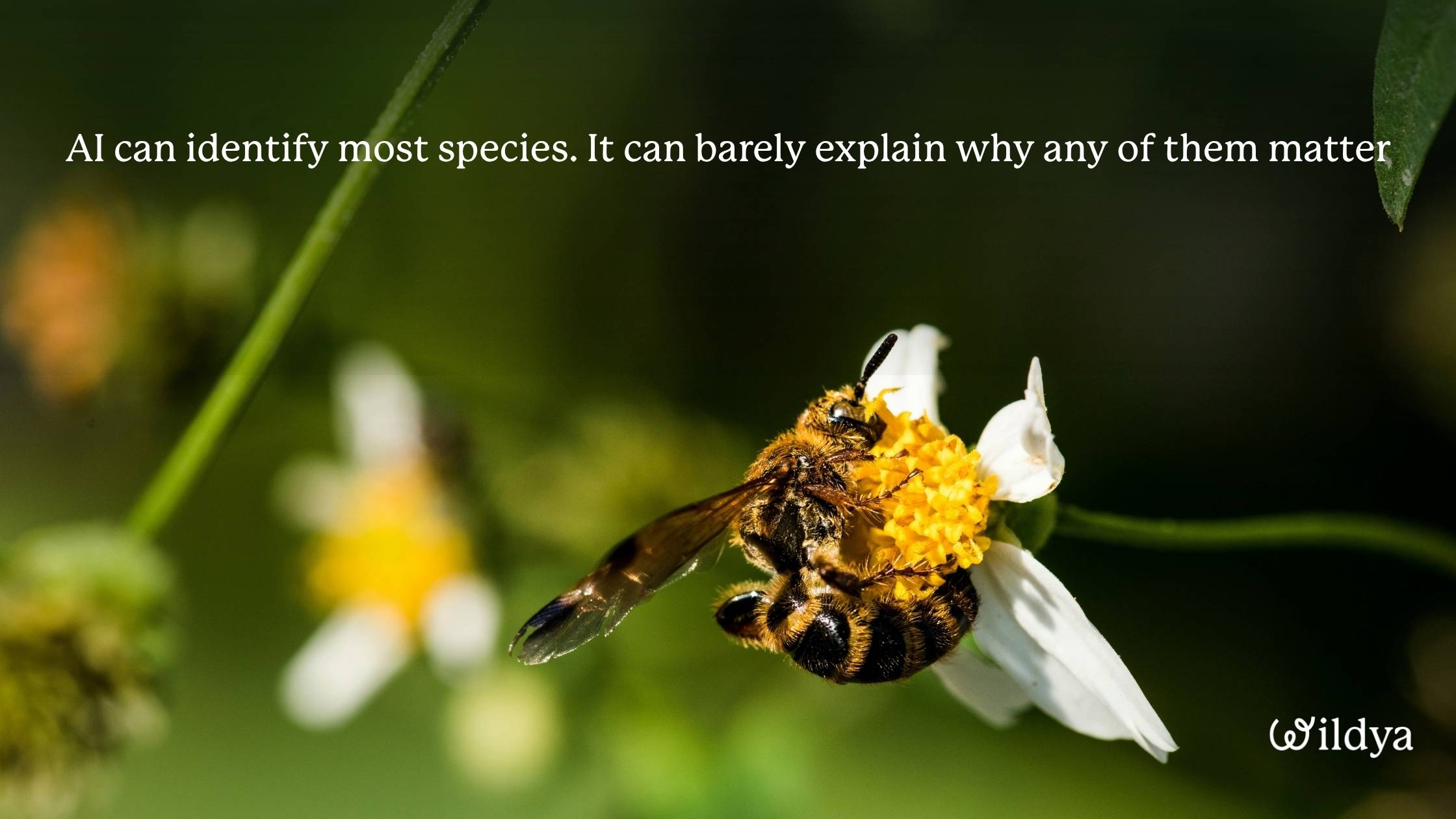
When AI was tested on conservation reasoning, the results were sobering.
What AI currently knows about ecology
Identifying an animal and understanding its role in an ecosystem are completely different things.
Knowing a bee exists is not the same as understanding what happens to a forest, a food chain, or a predator population when that bee disappears. 🐝
Researchers at Utrecht University tested, in 2024, commercial AI models, including ChatGPT, Grok, and Gemini, across 21,000 IUCN red list species.
On visual identification, the models scored 95% accuracy.
On conservation reasoning, meaning what would the extinction of this species mean for its ecosystem, the accuracy dropped to 27%.
AI systems are already informing conservation decisions at institutional level. The decisions being made now will shape how resources are allocated, which species get prioritised, and which habitats get protected over the next 50 to 100 years.
And right now, those systems are working almost blind on anything ecological.
The models being trained today will lock in their limitations for decades. You cannot retrofit the information later. As Douglas put it: “We have about five to six years before we essentially create irreversible AI damage.“
The Cango Wildlife data sitting untouched
Here’s what makes that fixable, and also frustrating.
Accredited zoological facilities already hold the data AI needs: decades of verified animal records, behavioural observations, genetic data, and field notes from real ecosystems.
Hundreds of institutions, each sitting on something valuable.
The problem is that none of it is connected. None of it shares a common format. And none of it is readable by any AI system. At Cango Wildlife alone, 40 years of that data exists. Right now it’s in the same state as data across most facilities: isolated, untouched, and unreachable.
Douglas’s vision is to change that at scale. “The only ground truth you can rely on takes the form of data, raw data that is validated through a consensus mechanism that is completely immutable and based on real world findings,” he said. “And if we have that, we don’t need organisations to determine what species qualify as important. We have verifiable open source data to determine that for us.“
What Douglas Eriksen is building: Project ZOA
Here’s where Cango Wildlife stops being just a zoo and starts being something bigger.
The three-layer architecture
Project ZOA, Zoological Open Architecture, is built on top of Cango Wildlife’s 40 years of data.
The goal is to connect verified biodiversity records from 500+ global zoological facilities into one shared dataset that AI systems can actually read and reason from.
Right now those records sit in private portals, incompatible formats, and in some facilities, still in physical paper records. Like five hundred libraries that each speak a different language and refuse to lend each other books.
To tackle this, Project ZOA works in three layers.
1️⃣The first is a protected blockchain layer.
It keeps sensitive location data, like where endangered animals actually live, hidden from poachers, while making everything else verifiable and shareable between facilities.
Donors can also see exactly where their money goes.
2️⃣ The second layer is open-source ecological relationship mapping.
It documents how species interact: how a pollinator affects a plant, how a drop in prey numbers ripples through to predator behaviour. 🦋
The kind of relationship data current AI models have almost nothing on.
3️⃣ The third layer is an AI-queryable API.
Any commercial AI system wanting to answer questions about ecology would pull from this dataset. Douglas’s long-term goal is to make that a policy requirement: you don’t deploy a commercial AI without this as a training layer.
Project ZOA won the sustainability in AI startup innovation award at Davos in January. Cango Wildlife is already its first institutional data node.
University partnerships and facility onboarding are in progress, with a funding round being prepared.
What Cango Wildlife needs right now
Douglas is looking for four kinds of support:
🐾 Data partners and research bodies that can contribute verified records,
🐾 Technical co-builders with expertise in biodiversity informatics or AI infrastructure,
🐾 Impact-aligned investors and philanthropic capital,
🐾 And policy contacts in AI safety and conservation.
His approach to finding the right people is worth remembering whether you’re building a nature venture or anything else. “You can talk to 100 investors, and maybe two of them will actually care about nature preservation. And those are the two people I’ll focus my attention on.“
If any of that describes you, reach out to Douglas directly on LinkedIn.
Thinking about how to reposition your own nature venture around a bigger opportunity? That’s exactly what we do to help ecopreneurs as fractional execution team.
Book a free discovery call!
Conservation and zoos: the case for looking closer
The debate around conservation and zoos has been shaped by the worst examples for too long. The facilities doing real work, species rescue, field funding, and now building the data infrastructure that AI will need, do most of it without anyone watching.
Douglas’s closing message was not a defence of all zoos. It was simpler than that. “Go look at your local zoo and aquarium,” he said. “Find out if they’re doing the work that you would support, and then support them, because they need it.“
This article is based on a live Wildya masterclass with Douglas Eriksen. The recording is available inside our Ecopreneur Community. We host a new masterclass every Tuesday with founders building in the nature space. Join us now.
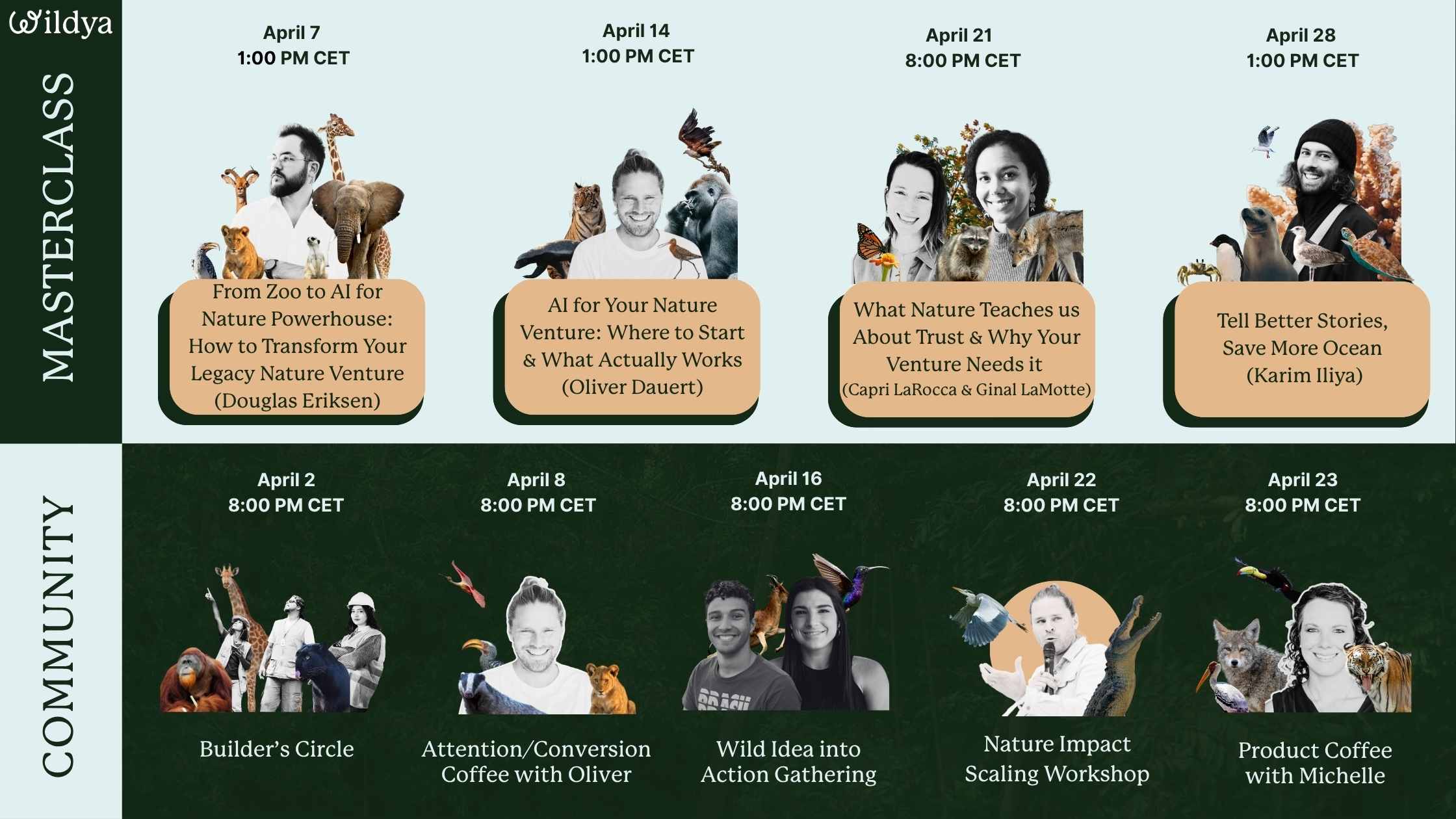
Wildya events happening in April
We have a packed April inside the Ecopreneur Community. Here’s what’s coming up this month for ecopreneurs like you, starting or scaling their nature venture. Join the events, ask your questions, and connect with fellow nature founders.