
3 things worth taking from this masterclass:
- Chase revenue before famous clients. The client nobody has heard of might be the one that keeps your nature venture alive long enough to matter.
- A product too complex for your market is not a strong product. It’s an expensive lesson waiting to happen.
- Overpromising kills trust faster than any competitor ever will. Be upfront about what your solution cannot do.
This article is based on a live masterclass we hosted inside the Ecopreneur Community with Tom Ludwig about what he learned with the failed nature company Biometrio.
Every Tuesday we bring in biodiversity heroes, nature founders, and field experts to share what they are building, the lessons they’ve learned, and real insights for starting or scaling a nature venture.
Check our masterclasses lineup and join our wild community (enjoy a 10-day free trial)!
When a nature company closes, most people say nothing
The most useful thing a failed nature company can leave behind is honesty about what went wrong. Most don’t. They close quietly, and the lessons disappear with them.
Tom Ludwig made sure that didn’t happen with Biometrio.
When the German biodiversity monitoring startup closed at the end of 2025, Tom wrote about it on LinkedIn. He called it embarrassing. He wrote it anyway.
Then he came to Wildya to give a masterclass about what he learned from this failure.
What Biometrio built and where it ran into trouble
Biometrio had things going for it:
✅ A strong science team and a product validated at scale, including work with the Mexican government on jurisdictional biodiversity monitoring.
✅ Founders who genuinely believed in what they were building.
Tom joined on a consulting contract as a sales strategist. His job was to professionalise their commercial approach and build the pipeline.
What he found was a company with something real to offer and a market that wasn’t ready to buy it the way Biometrio wanted to sell it.
“We developed a suite of products that were quite complex in their delivery, thinking that this is what the market needed.”
What clients actually wanted was simpler. Easier to pilot. Cheaper to start with.
So the team had to reverse-engineer their own products, strip them back, and rebuild for what buyers could actually use today.
That process costs time and money. Two things you almost never have enough of when you’re already stretched.
“Perhaps we didn’t do that soon enough, and eventually it caught up with us.”
The lessons you need from a failed nature company
From chasing the wrong clients to building products the market wasn’t ready for, Biometrio ran into challenges that most nature ventures will recognise.
Here is what Tom took away from it.
Chase revenue before famous clients
This is the one Tom would repeat from every stage he could find.
The temptation to chase recognisable clients is real. A sustainability-forward brand. A company your community admires. The kind of name that signals you have arrived.
Tom understands the pull. He also watched it distract from what actually mattered.
“The clients that are gonna pay the bills and keep the revenue ticking over are probably the ones we’ve never heard of before.”
Companies nobody in your network has heard of. Mid-size businesses with a real biodiversity footprint who need something affordable and straightforward right now.
Revenue is what buys you enough time to eventually land the clients you actually wanted.
Meet your buyers where they are
The science was solid and the methodology had been tested.
But the market wasn’t ready for the full version. Building ahead of where your buyers actually are will drain you before they catch up.
The way through is simple, though not easy.
Start with what the buyer can use and pay for today. Get that working. Then build toward the bigger vision using their feedback to shape it.
Not sure if your nature venture is solving a problem people will actually pay for? You need to test your business idea before wasting time and money.
What a failed nature company almost always gets wrong: overpromising
Tom carried this lesson from NatureMetrics and applied it to everything that followed.
“Overpromising kills trust. You’ve got to be really clear and upfront, honest, and transparent about what your solution can deliver, and also be upfront about what it can’t.”
When you are trying to close a deal, promising the version of the product you are still building is very appealing. The client seems excited. You want to match that excitement.
Then six months later the delivery falls short, the client is dissatisfied, and a dissatisfied client talks far more than a satisfied one.
Being honest about your limitations from the start costs you some deals, but it also saves you from far bigger problems down the line.
Case studies matter more than you think
Tom pushed hard to get the team creating and sharing more case studies. It wasn’t happening enough. And that hurt.
When a potential client called, there was little concrete work to point to. No story showing how the solution had worked for someone in a similar situation. No reason for that client to close a deal.
“The more you can shout about what you are doing, even if it isn’t with your dream clients, the better.”
A case study from a mid-size infrastructure company probably won’t get you a keynote slot.
But it might get you three more clients in that sector who read it and think: they solved it for them, they can solve it for us.
Worth far more than a famous name you can’t actually close.
What Tom found on the ground selling nature solutions to corporates
Selling biodiversity solutions to large organisations is slower and more complex than most founders expect. Tom spent years navigating this at NatureMetrics and Biometrio. Two things stand out.
The sales cycle is longer than you expect.
Six to eight months to close a large corporate client in the nature space is normal. Sometimes it runs to twelve.
If your runway depends on closing a deal in month two, you are in trouble before the first call.
The structure of sustainability inside large companies has also changed. There is rarely one person you can target and close.
“You can’t just think about the chief sustainability officer anymore. You’ve got to have 3, 4, 5 conversations going on with any client now.”
Finance, procurement, legal, and operations all carry sustainability responsibilities now.
Your contact in the nature or biodiversity team might champion you strongly. They almost certainly cannot sign anything.
Cut the conversations that go nowhere
In the early days at Biometrio, saying yes to every conversation felt right. Every call looked like a possible opportunity. Tom learned to filter harder.
The conversations worth pursuing have three things:
✅ an immediate budget,
✅ a clear and urgent need,
✅ and a realistic path to a decision.
Without all three, you can spend months in conversations that feel like progress but aren’t. That is a slow and quiet way to run out of runway.
Navigating long corporate sales cycles while keeping your pipeline clean and your cash flow alive is one of the hardest parts of building a nature venture. If that’s where you’re stuck right now, let’s talk!
The personal side of closing a nature venture
Biometrio closed just before Christmas 2025. The timing made it harder.
“It was probably the worst Christmas I’ve had.”
Tom spent a few nights in a cabin on Exmoor. No phone. Long walks, a fire in the evenings, and a couple of books. He came back and wrote the post.
“I was really in two minds about whether to share anything. But in the end, I’m so glad I did.”
The response surprised him. Other founders in similar situations. Nature ventures closing quietly all over the place, with no public record of what went wrong.
An entire space losing hard-won experience because people feel too embarrassed to say what happened.
The embarrassment is real. Tom named it directly. He had poured his energy into something that mattered. It didn’t survive. He posted about it anyway.
Then he started building again.
You also want to build for nature, but not sure where to start and you’re afraid to run into the ground? We got you covered!
What Tom is building now
Tom co-founded Corridors of Finance with Sam, a filmmaker based in Cape Town.
They plan to make documentary films about UK nature restoration projects where private investment is involved.
The goal is to show that nature markets function, that returns are real, and that the gap between investors and nature projects is largely a communication problem.
They are in pre-production. If you know a UK nature restoration project with a private finance angle worth showcasing, reach out to Tom on LinkedIn.
If your company is looking for mission-aligned content to support, that conversation is worth having.
What a failed nature company teaches us
The biggest waste in the nature space is not money. It’s experience that disappears because nobody writes it down. Tom Ludwig wrote it down and talked about what he learned.
A failed nature company taught him that revenue outlasts recognition, that simple beats complex when your market isn’t ready, that overpromising does more damage than losing the deal, and that the client nobody posts about might be the one that keeps you alive long enough to matter.
He’s still building. A different route, with the same mission underneath it. Trying to get more capital flowing into nature, one documentary at a time.
This article is based on a live Wildya masterclass with Tom Ludwig. The recording is available inside our Ecopreneur Community! We host a new masterclass every Tuesday with founders building in the nature space. Join the community now to attend more masterclasses.
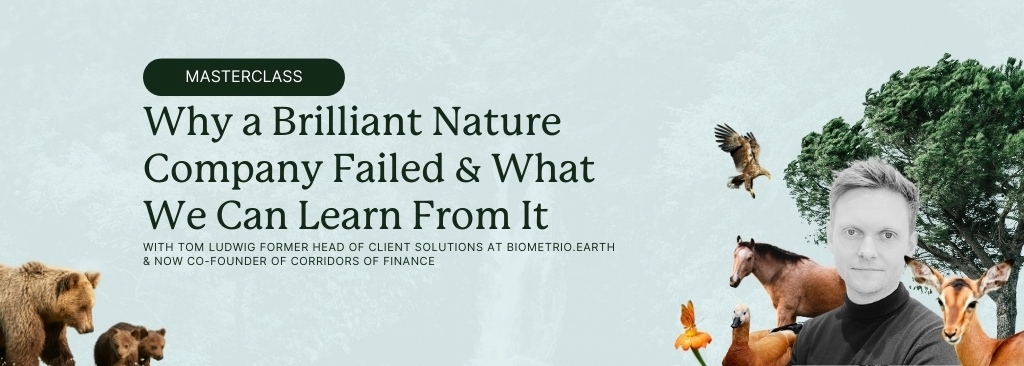
March events