
When you want to launch a project for biodiversity, one question always comes up at the start of the journey: how to test business ideas without wasting months in the void?
Species are disappearing. Ecosystems are taking a hit. 🦤
And you’re wondering how to turn this urge to help into something concrete.
Starting an NGO. Launching a project. Building a green business…
Good news: testing business ideas saves you from spending six months building something nobody uses or doesn’t really help where it matters.
When you want to protect the living world, you want to do things right. Really right. Sometimes too fast.
The result: blurry ideas, projects launched out of guilt, hours wasted, and that little voice whispering “maybe I am not made for this”.
But you are made for this. You just need a method to test your idea.
So, ready to get your hands dirty?
Before testing business ideas, you need an idea worth testing

Testing business ideas that are blurry is a waste of time and energy. It’s better to clarify what you actually want to solve before running any test.
The most common trap: nature passion with no clear problem
Loving nature is not enough to build a useful project.
A testable idea always starts from a specific problem in the field:
🦏 A species declining in a given area
🏞️ A habitat threatened by human activities
🇺🇳 A local organisation lacking resources to act
You need to start the other way around and ask yourself the real question:
What is the problem I’m trying to solve?
Saying “I love chameleons, so I’ll build a business around them” is not enough and will not work.
Without a clear problem, you don’t know who to talk to, what to measure, or even what “it works” means.
A good starting point is to frame your idea as a concrete problem:
✓ Who is affected?
✓ Where?
✓ By what?
✓ And why is it stuck today?
This clarity then helps you choose the right tests, the right people to talk to, and the right indicators.
A fast way to find a business idea worth testing: the Wild Idea Finder
Many ecopreneurs get stuck at the idea stage, either because they have too many ideas, or because none of them feels solid enough to deserve testing.
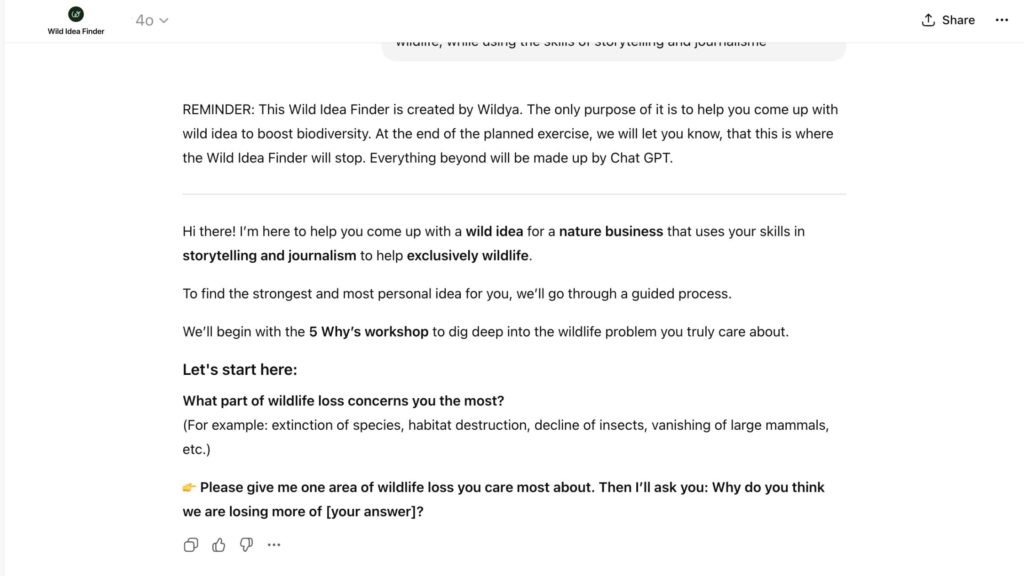
The Wild Idea Finder was designed to break this deadlock.
This AI tool helps you turn your desire to help biodiversity into concrete project ideas, grounded in real problems. 🤖
You answer a few questions about your interests, your context, your skills, and what frustrates you about the current state of things.
From there, you get business ideas structured around clear problems to solve.
You can then pick the one that resonates most with you and move on to the next step.
And a little bonus: it’s for free! 🎁
What you are actually testing in a business idea
When you wonder how to test business ideas, you probably think about testing your product or service.
In reality, you are mostly testing assumptions. Not to prove you’re right, but to see where you might be wrong before it gets too expensive.
Problem, audience, offer, channel, willingness to pay
A biodiversity project idea stands on five pillars.
If one of them is weak, the whole thing becomes unstable.
1️⃣ First, the problem: is it real and happening on the ground?
A wetland being drained. A reef losing its nurseries. A local NGO drowning in admin work instead of restoring habitats.
2️⃣ Then, the audience: who lives this problem daily?
A conservation team. A city exposed to floods. A community living next to a protected area.
3️⃣ The offer: a tool, a service, a program, a product.
Something people can test, criticise, and actually use.
4️⃣ The channel: how do you reach these people in real life?
Field partners, local networks, existing conservation programs, social media.
5️⃣ And finally, willingness to pay: this is where many testing phases fail.
People can love your mission and still never support it financially.
If you don’t test these five pillars, you are building your project like a nest on a branch chosen randomly. Sometimes it holds. Sometimes it breaks. 🪺
The evidence ladder for testing business ideas in the real world
Not all feedback is equal.
A friend saying “love your idea” feels good for your ego. But it proves nothing.
Testing business ideas in the real world means climbing an evidence ladder. You move from opinions to real signals. 🪜
At the bottom of the ladder, you have likes and encouragement. Nice, but useless to make decisions.
One step above, you have active interests. People leaving their email, asking for more info, agreeing to talk about the problem with you.
Above that, you have real engagement. Potential customers giving their time, a field test, a partner opening their data or network, people recommending you.
At the top, you have money or concrete resources. A paid pilot, a donation tied to results, a contract. 💰
The goal is not to jump the whole ladder at once. It’s to know which step you are on, and design your next test to move one step higher.
How to test business ideas with tiny experiments
Waiting for the “right moment” to test your idea usually means waiting too long.
Out in the wild, biodiversity does not wait for your concept to be perfect.
Tiny experiments help you learn fast, without burning your energy or your budget.
Talk to people the right way
One real field conversation is worth more than ten kind comments on LinkedIn.
If you want the testing business idea phase to actually help you, you need to talk to people who live with the problem every day.
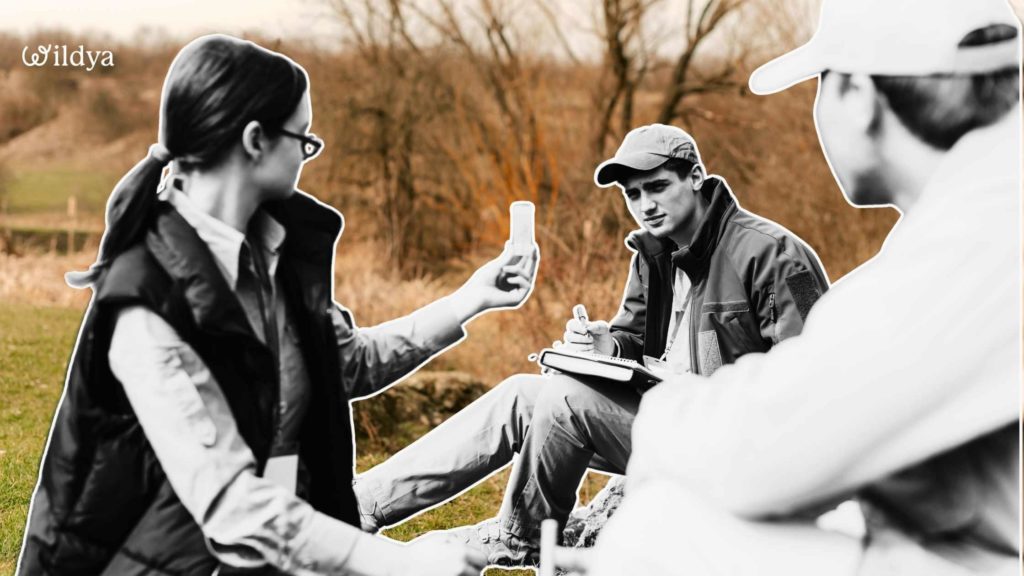
To find them, go where they actually are: out in the field, in local NGOs, at nature events. 20min with a reserve volunteer will teach you more than a whole thread of nice comments.
Forget questions that fish for emotional validation. 💘
“Do you find this useful?” gives you nothing.
Ask when things get stuck, how they deal with it today, and what they have already tried. You are looking for their struggles, not their compliments.
Talk to different profiles: a park ranger, an NGO, citizens, and pay attention to nature itself, since it is at the heart of your project. 🌲
You will quickly see whether your idea hits a real nerve.
And if you don’t know where to search, check the Wildya Ecopreneur Community. Lots of ecopreneurs and nature lovers will be happy to help you move forward!
Little plus: you’ll also find tons of resources and online events to support you while building your biodiversity mission.
Build a scrappy MVP
MVP stands for “Minimum Viable Product”. It’s a simple version of your product, service or tool.
For a nature project, that can be very simple to set up:
🏫A pilot workshop with a school
👩🔬A protocol test with a field team
🎖️A service delivered to an NGO for two weeks
The goal is not to ship something perfect. It’s to see whether your solution is actually used in real life, and whether it creates a measurable effect, even a small one.
Run a small visibility test
Sometimes your idea is good, but your message doesn’t land.
A visibility test helps you see whether the problem you describe actually resonates with the right people.
A simple page that explains the problem you are tackling.
An email sent to a few people in the field. 💌
A post in a group where the right people actually hang out.
A short deck sent to an NGO to see if it sparks a conversation.
If nobody reacts, it is not a failure. It’s a very useful signal.
Better to know it now than after six months of work, energy, and savings.
More ways to test business ideas without burning out
You don’t need to build everything from the start. Some answers show up before you even launch a first prototype.
If you’re asking how to test business ideas without burning out, these two simple reflexes can save you a lot of time.
Map the market before building anything heavy
Before you invest your energy into a solution, look at the ecosystem around the problem you want to solve:
🐾 Who is already working on this?
🐾 Which NGOs are active on the ground?
🐾 Which projects have already tried and failed?
🐾 Where does it actually get stuck for them?
For example, if you want to protect a specific wetland, look at what already exists in that area: restoration programs, citizen initiatives, available funding, local regulations.
Mapping the market helps you spot the gaps where nobody is really acting, or where everyone is struggling with the same blockers.
This is a key step in testing your business idea, even if it doesn’t look like a “test” in the classic sense.
You avoid reinventing a wheel that is already stuck in the mud. ⚙️
Test pricing and willingness to pay early
Many ecopreneurs avoid this part because talking about money feels wrong when you talk about biodiversity.
Yet, testing an idea without testing willingness to pay is like planting a tree and never watering it. You can have the best seed in the world, without water, it dries out.
If nobody is ready to pay or invest, your project slowly runs out of steam, even if it is useful.
You can test without being aggressive:
🦡 Offer a paid pilot to a local authority
🦡 Ask an NGO if they would put a budget on your service
🦡 See if a foundation would offer to fund a first real test
The goal is not to sell expensive things from day one. It’s to see whether your idea is worth something to someone other than you.
How to read your results without panicking
After a few tests, you start collecting signals.
Some reassure you. Others give you a little stress hit.
What matters most is knowing how to read them to actually get value from them.
Green flags, yellow flags, red flags
Not all feedback carries the same weight.
Some signals tell you to move forward. Others tell you to slow down. Others save you from running straight into a wall.
🟢 Green flag: the same concrete signal keeps showing up.
Several people describe the same problem during interviews
People use your test more than once or start recommending you
A field actor suggests an intro or a more “serious” test
And when it comes to pricing, someone says “ok” without wincing
🟡 Yellow flag: there is interest, but it does not stand on its own yet.
People understand the problem, but your offer is still blurry
Your MVP is tested once, then forgotten
You hear “let’s talk about it later”, but no date ever gets set
On budget, things block or require heavy adaptation
🔴 Red flag: it does not land.
Nobody really feels concerned
The field tells you “this is not a priority”
The market is already crowded with more credible solutions
Nobody is ready to put resources on the table, even at a small scale
Reading these signals is like watching an ecosystem rebalance after a storm. 🌪️
Total silence can mean something’s wrong. Small activity can signal life’s coming back. But it takes time to understand what you are seeing.
If you’re struggling to interpret your results or figure out what to tweak next, we’ve got you covered in the Ecopreneur Community.
Product issues? Join the Product Coffee with Michelle.
Attention or conversion problems? That’s what the Coffee with Oliver is for.
Need help making sense of your results? The Builder’s Circle is your go to space.
PS: these online events are once a month!
The fastest pivots for nature ventures
When a test does not give you the results you hoped for, it doesn’t mean your project is doomed.
Most of the time, one piece is simply in the wrong place.
🎯 Sometimes, the problem is misframed.
You focus on beluga decline, while the real bottleneck is lack of coordination between local actors.
👫 Sometimes, the audience is wrong.
Volunteers love your idea, but local authorities are the ones with real power to act.
💣 Sometimes, the offer is too heavy.
You pitch a full program, when a simple tool or a field workshop would already help.
📱 Sometimes, the channel is wrong.
You post on LinkedIn, while the people you want to reach spend their days on TikTok (or elsewhere).
A good pivot feels more like taking a side trail than doing a brutal U-turn.
You adjust your angle. You shift your point of view.
And you keep moving forward without crushing everything you have already learned.
You don’t have to test a business idea alone
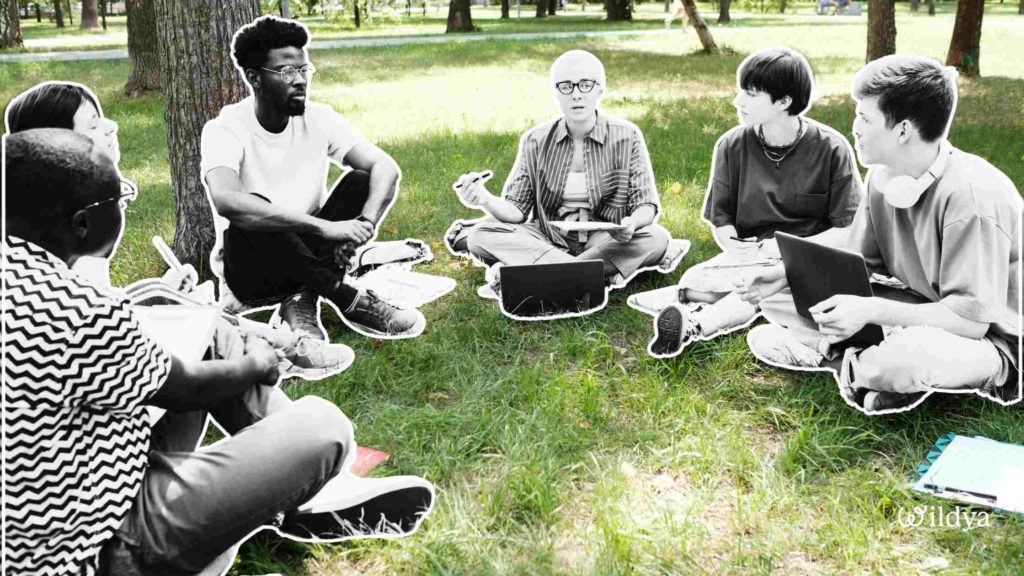
Testing a business idea for biodiversity is often uncomfortable.
You get a lot of no’s. You start doubting with the test results.
Having a clear framework and people around you helps you move forward without getting lost.
The Ecopreneur Beginner Bootcamp
The Ecopreneur Beginner Bootcamp is an 8 week sprint to go from idea to your first paying supporters, including a full testing phase.
You work every week on your own nature project. You clarify your problem. You build your nature positive business model. You define your offer. You test your message and your sales.
Everything is designed to push you into action:
📞 Weekly group calls
📑 Actions to complete between each session
💬 Direct feedback on what you’re building
You move forward with a group of ecopreneurs facing the same struggles. It helps you keep going when things get hard. And it helps you read your results with more clarity.
If you’re curious about the Ecopreneur Beginner Bootcamp and want to see whether it’s a good fit for you, start with our article!
How to test business ideas inside the bootcamp
Testing is part of the program. From the first week, you test the viability of your idea.
Then you go into the field, you talk to the people concerned, you check whether your problem is the right one, and you adjust your idea based on feedback.
You also build a first simple version of your offer. You present it to real actors, you observe their reactions, and you see what blocks, what sparks interest, and what triggers a yes.
You’ll also have the chance to map the market and see what’s already out there, what’s blocking, and how your project would fit into it.
If you truly want to build a viable project with a positive impact on nature, but feel too alone, not prepared enough, or overwhelmed, then the bootcamp is for you.
When you’re trying to figure out how to test business ideas for biodiversity, what you really want is to avoid burning yourself out on a project that doesn’t help where it actually matters.
Testing early saves you a huge amount of time. It anchors you in reality, on the ground, with real problems and real actors.
And yes, sometimes the testing business ideas phase hits hard.
Tests that go nowhere. Feedback that stings. Paths you have to drop.
But it’s exactly what allows you to build something that can have a real impact on what you want to protect or restore in nature.
If at any point you feel lost on your ecopreneur journey, we’re here to help, whatever stage you’re at.
And if you feel you’re already more advanced than the Beginner Bootcamp, or you’d rather work with us directly in 1:1 consulting, you can book a free call to see if we can help your project bloom. 🌸
Key takeaways:
- To build a useful project, you need to go beyond your love for nature. It starts with defining a clear problem you want to solve. Learn to love the problem, not the solution.
- Testing business ideas is about testing assumptions. Focus on five pillars: problem, audience, offer, channel, and willingness to pay.
- Before building your nature venture, map out the market to see real pain points, existing solutions, and where things get stuck.
- Testing business ideas means reading results. This is how you know where to pivot and where to double down.